+ 91 8108850334
info@parineeinterio.in
+ 91 8108850334
info@parineeinterio.in

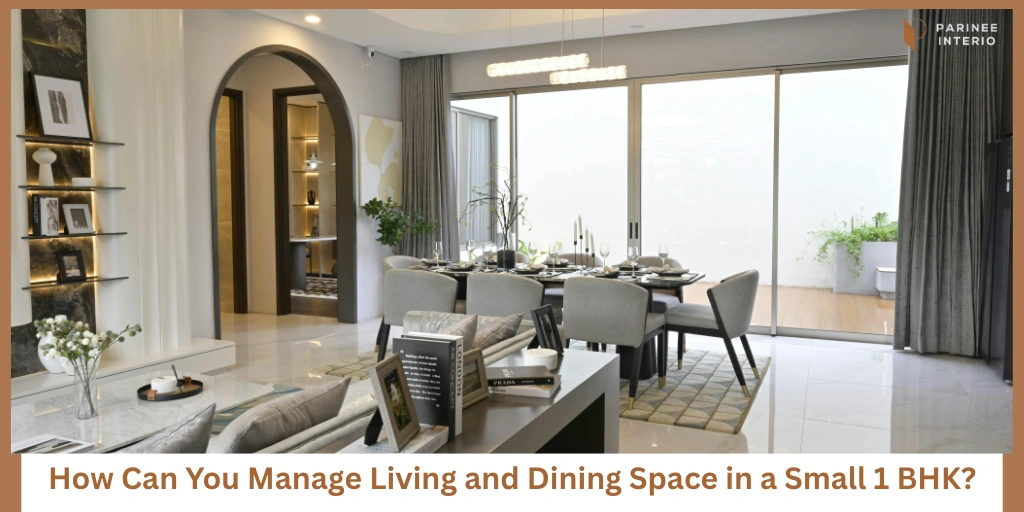
Your living room is also your dining space.
And somehow… neither feels right.
- The sofa blocks movement
- Dining feels squeezed into a corner
- There’s no clear separation
So even if your home is decent in size, it still feels cluttered.
Here’s the truth most people miss:
The issue isn’t space—it’s how both functions are arranged together.
In a 1 BHK, living + dining has to work as one system.
If the layout is wrong, the whole space feels uncomfortable.
If the layout is right, the same space feels open and usable.
In this guide, you’ll see layouts that actually work in real homes — not just good-looking designs.
Get a step-by-step checklist to plan your living-dining layout with clarity.
Stop guessing where to place your furniture. Plan your space properly before moving anything and avoid trial-and-error mistakes.
The 3 Rules of a Perfect Living-Dining Layout
Before jumping into layouts, you need a simple framework.
Every good small apartment layout idea follows these 3 rules.
Keep Movement Clear
This is the most important rule.
If you can’t walk freely, the layout is already wrong.
- Entry to seating should be smooth
- Path to dining should not be blocked
- No furniture in the walkway
If movement feels tight, your space will always feel smaller than it is.
Define Zones Without Blocking Space
Living and dining should feel separate… but not divided.
Use subtle methods:
- Furniture placement
- Rugs
- Lighting
Avoid:
- Heavy partitions
- Full walls
You don’t need to separate physically — just visually.
Use Multi-Functional Furniture
In a 1 BHK, every piece of furniture should do more than one job.
- Storage beds
- Foldable dining tables
- Sofa-cum-beds
This is how you save space without compromising usability.
Simple takeaway:
Every layout you’ll see next works because it follows these rules.
5 Practical Living-Dining Layout Ideas That Actually Work
These are real, usable layouts for a living dining combo layout in a 1 BHK.
Layout 1: Sofa Facing Wall + Dining Behind
Best For: Narrow rooms
How it works:
- Sofa placed along one side
- TV unit on the opposite wall
- Dining table placed behind the sofa
Why this works:
- Creates a natural division
- Maintains a clear walkway
- Doesn’t block light or movement
Result:
You get two zones without using any partition.
Layout 2: L-Shaped Sofa + Corner Dining
Best For: Compact square rooms
How it works:
- L-shaped sofa defines the living zone
- Dining table fits into one corner
Why this works:
- Corners are used efficiently
- Central space remains open
- Seating capacity increases without clutter
Result:
Balanced layout with better space utilization.
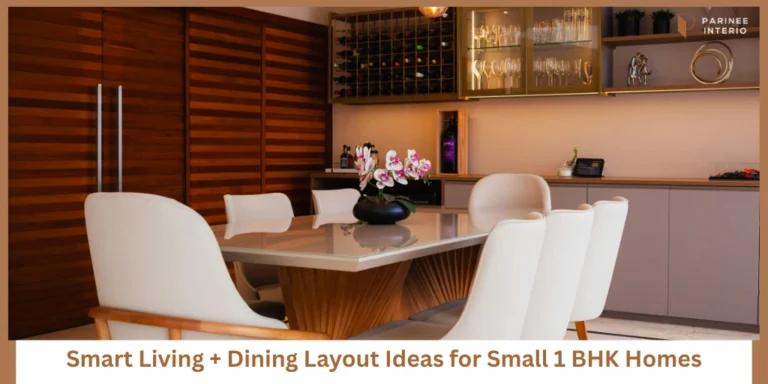
Layout 3: Open Layout with Minimal Dining
Best For: Minimal lifestyle
How it works:
- Smaller or foldable dining table
- More open space for living
Why this works:
- Reduces visual clutter
- Makes the room feel larger
- Flexible usage
Result:
A clean, open layout that feels bigger than it is.
Layout 4: Dining Near Kitchen Entry
Best For: Practical everyday use
How it works:
- Dining placed close to kitchen
- Living area slightly separate
Why this works:
- Easy serving and usage
- Clear functional zones
- Less movement overlap
Result:
Highly practical and efficient layout.
Layout 5: Divider-Based Layout
Best For: Privacy + zoning
How it works:
- Light partition, console, or open shelf
- Living and dining visually separated
Important tip:
Avoid heavy partitions.
Use:
- Open shelves
- Slim dividers
Result:
Defined zones without making the space feel closed.
Visualize your layout and fix mistakes before execution.
Before finalizing your layout, test it on a planner instead of moving furniture multiple times. This saves time and avoids wrong decisions.
Furniture Tips That Make These Layouts Work Better
Even the best layout fails with wrong furniture.
Here’s what works in small homes:
- Slim sofas instead of bulky ones
- Compact or foldable dining tables
- Wall-mounted TV units
- Open shelving instead of closed heavy cabinets
Important:
Furniture choice doesn’t just affect looks — it affects movement and usability.
Mistakes That Ruin Living-Dining Layouts
Avoid these common mistakes:
- Blocking pathways with furniture
- Using oversized sofas or dining tables
- Not defining zones at all
- Adding too many decorative elements
Reality:
Most layout problems are not because of size — but because of wrong choices.
How to Choose the Right Layout for Your Home
Not every layout works for every home.
Here’s how to decide:
Based on Room Size
- Narrow → Go for linear layouts
- Square → Use L-shaped or corner layouts
Based on Lifestyle
- Frequent dining → Dedicated dining space
- Minimal use → Foldable dining
Based on Storage Needs
- More storage → Multi-functional furniture
- Less storage → Open layouts
Simple rule:
Choose a layout that fits how you live — not just how it looks.
Conclusion: A Good Layout Makes Your Home Feel Twice the Size
A 1 BHK doesn’t feel small because of its size.
It feels small because of a poor layout.
When your layout is right:
- Movement improves
- Space feels open
- Everything becomes easier to use
Layout matters more than square footage.
Get Your Living-Dining Layout Planned Properly
If you’re unsure which layout will work best for your home, getting a clear plan helps avoid mistakes.
Share your layout and get a space-optimized plan.
Get a personalized living-dining layout plan based on your room size and requirements. Avoid trial-and-error and make the right decision from the start.