+ 91 8108850334
info@parineeinterio.in
+ 91 8108850334
info@parineeinterio.in


Your interior designer initially told you that your home would be ready in three months.
You calculated your moving date accordingly. Perhaps you informed your landlord, planned your housewarming or arranged to take leave from work around the expected handover.
But now, the project is entering its fourth month.
The wardrobe installation is incomplete. Some materials are still pending. The electrician says he cannot finish until another contractor completes his work.
And then comes another uncomfortable conversation.
The designer informs you that additional work will cost more than originally estimated.
You begin wondering whether you should have asked more questions before signing the agreement.
Unfortunately, home interior project delays and cost overruns are not always caused by one major mistake. They often develop through several smaller decisions, unclear responsibilities and unresolved requirements.
The good news is that many of these problems can be reduced through better planning, documentation and communication.
Let us understand what actually causes interior projects to exceed their budgets or timelines, and what you can do to keep your project more predictable.
Why Do Home Interior Projects Get Delayed or Go Over Budget?
A home interior project involves several interconnected activities.
Furniture design, material selection, civil work, electrical modifications, manufacturing, painting and installation often depend on one another.
When one activity changes, another may be affected.
For example, a delay in finalising your kitchen appliances can hold up cabinet dimensions. That may delay manufacturing and, consequently, installation.
Similarly, adding a storage unit after the original quotation has been finalised may require additional material, labour and installation work.
The challenge is that homeowners sometimes see these developments as separate problems.
In reality, they can be connected.
A predictable interior project requires an agreed scope, realistic execution sequence, timely decisions and a clear process for handling changes.
Here are the situations you should pay particular attention to.
1. An Incomplete Scope Creates Unexpected Expenses
Imagine that you have approved an interior quotation for your 2BHK.
It includes a modular kitchen, three wardrobes, a TV unit and selected false ceiling work.
During execution, you realise that you also need an additional shoe cabinet, balcony storage and a few electrical modifications.
These requirements might be perfectly reasonable.
However, if they were not included in the original quotation, they can increase your overall project cost.
How to Prevent Scope-Related Cost Overruns
Before signing the contract, review the proposed work room by room.
Understand what has been included, what has been excluded and which items still require a decision.
Ask your designer to explain the scope alongside the furniture layouts and quotation.
A detailed Bill of Quantities, or BOQ, can help you understand the agreed work, quantities and material specifications.
Also clarify whether appliances, decorative lighting, curtains, loose furniture and other purchases are included.
A fixed-price agreement can establish a predictable price for the agreed work. However, it does not automatically include additional requirements introduced later.
The objective is to identify as many of your actual needs as possible before execution begins.
2. Late Design Approvals Can Disturb the Entire Schedule
You receive your kitchen design and decide to discuss it with your partner over the weekend.
The weekend passes, but you are busy.
A few days later, you request another colour option. Then you want to reconsider the internal storage arrangement.
Meanwhile, the designer may be unable to release the kitchen for manufacturing.
This is how a relatively small approval delay can affect subsequent activities.
Set Practical Decision Deadlines
Ask your designer to identify which decisions are required at each stage.
| Decision | Why Timing Matters |
| Decision | Why Timing Matters |
|---|---|
| Furniture layout approval | Establishes the arrangement and major furniture dimensions |
| Kitchen appliance selection | Helps confirm cabinet spaces and service provisions |
| Material approval | Allows relevant materials to be ordered |
| Working drawing approval | Establishes details required for manufacturing |
| Electrical layout approval | Supports coordination before finishing work |
| Final hardware selection | Helps confirm relevant manufacturing and procurement requirements |
| Agree on realistic approval deadlines rather than rushing through important decisions. | |
| If a decision is likely to be delayed, communicate that early and ask how the schedule may be affected. | |
| A project timeline should account for homeowner approvals, not just contractor working days. |
3. Inaccurate Measurements Can Lead to Rework
Suppose a wardrobe is designed using measurements taken before wall finishing.
When the finished site is measured, the available width is slightly different.
If the wardrobe has already entered manufacturing, adjustments may be necessary.
Depending on the discrepancy, this could affect the design, production schedule or cost.
Similar situations can arise with kitchen cabinets, countertops, appliances and false ceiling arrangements.
What Should Happen Before Manufacturing?
Relevant site measurements should be verified at the appropriate stage before manufacturing dimensions are finalised.
The designer and execution team should also consider site conditions that could affect installation.
Ask whether the drawings being used for manufacturing reflect the verified dimensions and latest approved revisions.
This is particularly important during renovation, where existing walls, floors and concealed conditions may differ from assumptions made during initial planning.
If you are preparing to begin work, Parinee Interio can help you discuss how measurements, design approvals and execution planning should be coordinated before manufacturing starts.
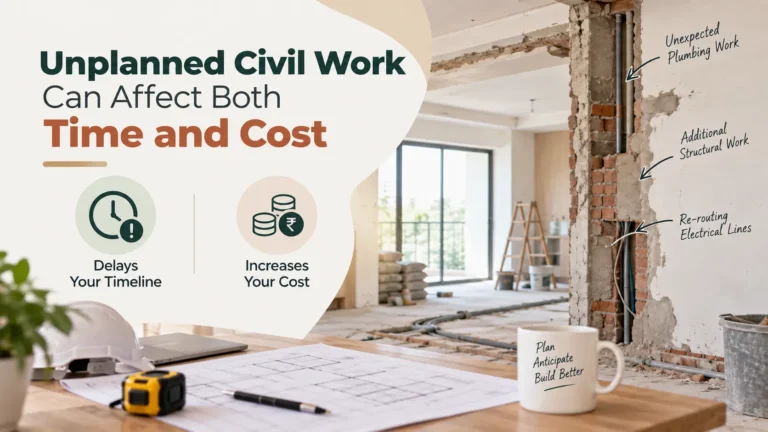
4. Unplanned Civil Work Can Affect Both Time and Cost
Renovation projects deserve additional attention because the existing condition of your home may not be completely visible before dismantling begins.
Picture an older kitchen.
You plan to replace the cabinets and countertop. However, after removing the existing units, damaged plaster or plumbing problems become visible.
The corrective work may need to be completed before the new kitchen can be installed.
That introduces an additional activity into the schedule.
It may also require a separate financial decision.
Discuss Site Conditions Before Signing
Ask your designer which site conditions have been assessed and whether any work remains subject to inspection.
Clarify how unexpected civil, plumbing or electrical requirements will be handled.
If additional work becomes necessary, request an explanation of the proposed solution, cost and timeline implications before approving it.
Not every unexpected condition can be identified in advance.
However, agreeing on how such situations will be addressed can prevent unnecessary confusion when they occur.
5. Material Changes and Substitutions Can Interrupt Execution
You have approved a particular laminate for your wardrobe.
But when manufacturing is about to begin, the selected finish is unavailable within the required timeframe.
The designer suggests an alternative.
You are uncomfortable approving it without seeing the actual sample.
Now manufacturing is waiting for another decision.
Material availability, procurement timing and changes in selection can all affect execution.
Confirm Materials Before They Are Needed
Ask which materials require advance selection or procurement.
Where relevant, approve physical samples and ensure the selected specifications are documented.
Also understand how substitutions will be handled.
Will you receive an alternative material for approval? Could the replacement affect the agreed price? Will it change the manufacturing schedule?
These questions should be resolved through the agreed contract and approval process.
For custom-made furniture, material changes become particularly important once components have been ordered or manufacturing has started.
6. Contractor Dependencies Can Create a Chain of Delays
Home interiors are not completed by one person performing every activity.
Different teams may be responsible for civil work, plumbing, electrical modifications, false ceilings, painting, furniture installation and finishing.
Some activities can happen simultaneously.
Others must follow a particular sequence.
For example, certain electrical provisions may need to be completed before ceiling closure and finishing. Final installation work may depend on earlier site preparation being completed.
If one contractor cannot finish the necessary work, another may have to wait.
Ask for an Execution Sequence
Before work begins, understand the proposed order of activities.
You do not need to manage every contractor personally.
However, you should know who is responsible for coordinating the work and communicating changes in the schedule.
Ask whether the execution plan identifies important dependencies, anticipated completion stages and activities that require homeowner decisions.
If you are already facing repeated delays, request an updated schedule showing the remaining work and the issues preventing progress.
A revised plan is more useful than repeated verbal assurances that everything will be finished shortly.
7. Repeated Design Changes Can Increase Manufacturing and Labour Costs
Your family may suggest additional storage after seeing the first installations.
You might decide to change a wardrobe finish or extend a TV unit.
These requests can be understandable, especially when you are seeing the home take shape.
But changes have different consequences at different stages.
Changing a finish before materials are ordered may be relatively straightforward.
Changing it after furniture has been manufactured may require additional material, labour or replacement components.
Introduce Written Change Orders
A written change order records a modification to the agreed scope or specifications.
It should explain:
- What is changing and why.
- The additional cost or applicable credit.
- Whether previously completed work must be modified.
- The effect on the remaining project schedule.
- Who has approved the change.
For example, if you request an additional storage cabinet, the designer should explain its cost and expected effect on execution before proceeding.
You can then decide whether to approve it, postpone it or retain the original scope.
The purpose of change control is not to prevent you from improving your home. It is to help you understand the consequences before making a commitment.

How to Make Your Interior Execution Plan More Predictable
Now that you understand the common reasons for delays and additional expenses, let us discuss how these risks should be managed during execution.
A realistic execution plan should establish more than a proposed handover date.
It should identify the main activities, approval requirements, responsibilities and the process for handling changes.
Establish a Clear Starting Point
Before execution begins, confirm that the relevant designs, specifications and scope have been approved.
The project team should understand which drawings and material selections form the agreed basis for execution.
Pending decisions should be identified rather than silently assumed to be final.
Review Progress Against the Schedule
Ask how progress updates will be communicated.
A useful update should explain completed work, upcoming activities, pending decisions and issues that may affect the timeline.
If the schedule changes, request a revised version showing the new expected sequence.
This helps you distinguish between a temporary adjustment and a change that affects your planned handover.
Approve Budget Impacts Before Additional Work
When a new requirement arises, establish the financial implications before allowing it to proceed.
A written approval record should help both parties understand whether the work forms part of the original agreement or represents an additional commitment.
Parinee Interio can help you discuss a more predictable interior execution plan by identifying the decisions, documentation and coordination requirements relevant to your home project.
| Your Practical Interior Delay and Cost Prevention Checklist | |
| Use this checklist before signing your interior contract and revisit it when execution begins. | |
| What to Check | Why It Matters |
|---|---|
| Complete scope of work | Reduces uncertainty about included requirements |
| Written exclusions | Helps identify purchases requiring a separate budget |
| Approved furniture layouts | Establishes the planned room arrangements |
| Verified site measurements | Reduces dimensional discrepancies |
| Coordinated working drawings | Helps identify conflicts before execution |
| Final material specifications | Reduces uncertainty during procurement |
| Appliance dimensions | Supports kitchen and electrical planning |
| Decision deadlines | Helps prevent avoidable approval delays |
| Contractor responsibilities | Clarifies who manages dependent activities |
| Written change-order process | Records additional work and financial implications |
| Budget-impact approvals | Helps prevent unapproved additional expenses |
| Revised schedules | Makes changes in completion expectations visible |
| Progress communication | Helps identify emerging problems earlier |
| Handover requirements | Clarifies what must be completed before final acceptance |
| You do not need to eliminate every possible risk before starting your project. | |
| The objective is to establish a process in which potential problems are identified, discussed and addressed without unnecessary confusion. | |
| Use this checklist as a practical discussion guide before your interior project begins. |
| Frequently Asked Questions |
| Practical answers to common questions about interior project delays, budgets, changes and coordination. |
01 What is the most common reason home interior projects get delayed?There is no single cause that applies to every project. Late approvals, incomplete drawings, material availability, contractor dependencies and unexpected site conditions can all contribute. Understanding which activities depend on earlier decisions helps you identify potential delays before they affect execution. 02 Can a fixed-price interior contract prevent budget overruns?A fixed-price contract can establish the price for an agreed scope, subject to its terms. However, additional requirements, approved design changes and other contractually permitted adjustments may affect the final amount. Review the scope, exclusions and variation process before signing. 03 How can I avoid interior project delays before work begins?Finalise the relevant designs, confirm material specifications, verify site measurements and understand the proposed execution schedule. Also establish approval deadlines and clarify who is responsible for coordinating contractors. These measures can reduce avoidable delays, although they cannot eliminate every possible disruption. 04 What should I do if my interior designer keeps changing the completion date?Request an updated execution schedule that identifies completed activities, pending work and the reasons for the revised timeline. Ask which dependencies or decisions are affecting progress. Review the contract to understand the agreed completion terms and responsibilities. 05 Can changing furniture designs during execution increase costs?Yes, depending on the nature and timing of the change. Modifications after materials have been ordered or manufacturing has begun may require additional labour or replacement components. Request written confirmation of the financial and timeline implications before approving revised designs. 06 Who is responsible when one contractor delays another contractor?Responsibility depends on the contractual arrangement and the cause of the delay. Ask who coordinates the relevant trades and whether the project schedule identifies their dependencies. If a delay occurs, request a clear explanation of the affected activities and proposed corrective plan. 07 Should homeowners keep an additional budget for unexpected renovation work?A contingency can be useful, particularly when renovating older homes where concealed conditions may only become visible after dismantling. The appropriate amount depends on the property and proposed work. Discuss known uncertainties and possible additional requirements before finalising your financial commitment. 08 What should a written change order include?It should identify the requested modification, revised specifications, additional cost or credit, and any effect on the project schedule. It should also record the necessary approvals. This helps avoid disagreements about whether work was requested or financially authorised. 09 Can material substitutions cause project delays?They can, particularly when the original material is unavailable and an alternative requires approval. Substitutions may also affect specifications or costs. Confirm material selections early and establish how alternatives will be proposed, reviewed and approved before manufacturing proceeds. 10 How can I maintain control over my interior project without managing every contractor?Agree on a clear communication process, progress updates, approval responsibilities and an escalation route for unresolved problems. You should understand the schedule and approve relevant changes without needing to direct every activity. Effective coordination remains the responsibility of the parties identified in your contract. |
|
Interior Project Planning Discuss a More Predictable Interior Execution Plan with Parinee Interio If you are preparing to sign an interior contract or are concerned about the execution of your home renovation, discuss your requirements, pending decisions and expected timeline with Parinee Interio. Understanding how your project will be planned, coordinated and reviewed can help you move forward with greater financial and practical clarity. |