+ 91 8108850334
info@parineeinterio.in
+ 91 8108850334
info@parineeinterio.in

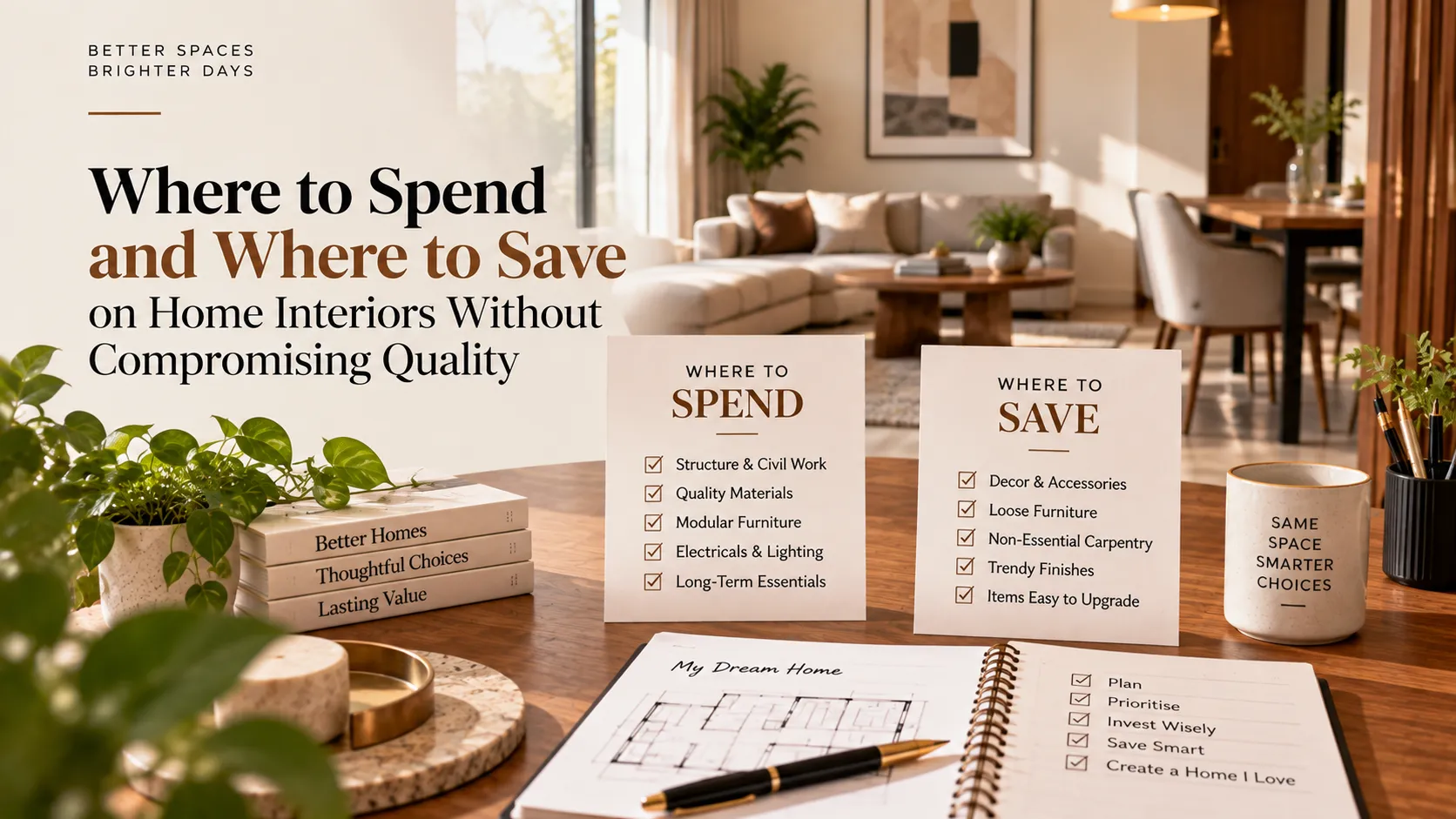
You have a certain budget in mind for your home interiors. You want the kitchen to look beautiful, the wardrobes to have enough storage, the living room to feel welcoming and the bedrooms to look just as good as the photographs you have saved.
But once you start exploring designs, something interesting happens.
The designer shows you a premium laminate. Then there is an option for soft-close hardware, decorative wall panelling, profile lighting and a different wardrobe finish.
Individually, every upgrade seems reasonable. Together, they can push your budget much further than you originally planned.
Now you are wondering where to draw the line.
Should you spend more on the kitchen and choose simpler bedroom furniture? Is expensive hardware really necessary? Can you reduce the cost of your living room without making it look ordinary?
The secret to budget-friendly home interiors is not choosing the cheapest option everywhere. It is knowing which decisions deserve your money and which upgrades you can comfortably avoid.
Let us look at how you can make those decisions for your home.
First, Understand the Difference Between Saving Money and Cutting Corners
Before deciding where to spend, understand what you are actually trying to achieve.
There is a difference between reducing unnecessary costs and compromising something that your family will use every day.
For example, choosing a simple laminate instead of an expensive decorative finish can be a sensible saving.
However, reducing the quality of kitchen hardware that will be opened and closed several times every day may not be a sensible decision.
The first decision primarily affects appearance. The second can affect everyday convenience, performance and future maintenance.
A practical way to approach your interior budget is to divide expenses into three categories.
| Category | What It Includes | Budget Approach |
|---|---|---|
| Essential functional requirements | Kitchen cabinets, wardrobes, storage, electrical requirements and necessary furniture | Prioritise according to everyday use |
| Quality and durability requirements | Suitable boards, hardware, construction quality and appropriate finishes | Choose specifications based on usage and exposure |
| Decorative upgrades | Wall panelling, elaborate ceilings, premium finishes and decorative lighting | Add according to the remaining budget |
This does not mean decorative elements are unimportant.
You want your home to look beautiful, and that is a perfectly reasonable expectation.
But if your budget is limited, it makes sense to complete the functional foundation before spending heavily on decoration.
For example, a practical kitchen with a simpler finish is usually a better allocation of money than an elaborate living room feature wall paired with a kitchen that lacks adequate storage.
Plan Your Interior Priorities Around Your Budget
Planning your interiors within a fixed budget? Parinee Interio can help you understand which design decisions deserve priority and which upgrades can be adjusted according to your requirements.
- Identify essential requirements for everyday use
- Prioritise furniture and storage based on your needs
- Review finishes and design decisions that affect costs
- Adjust optional upgrades according to your available budget
Clear priorities can help you build an interior scope that stays aligned with your spending comfort.
Where You Should Spend More on Home Interiors
Some interior elements are difficult to change once installed. Others experience heavy daily use.
These are the areas where choosing the lowest quotation without understanding the specifications can become expensive later.
1. Spend on a Kitchen That Works for Your Family
Think about how your family uses the kitchen.
Is someone cooking two or three meals every day? Do you need space for large utensils, pressure cookers, groceries and several appliances?
Your kitchen should be planned around these activities.
I would prioritise:
- Adequate storage for everyday utensils and groceries.
- Suitable cabinet materials for the conditions in each area.
- Reliable hinges and drawer channels.
- Comfortable working heights and practical circulation space.
- Proper appliance placement.
- Accessible storage for frequently used items.
If your budget allows, investing in practical drawers can also make everyday cooking more comfortable.
But does that mean every kitchen cabinet needs an expensive pull-out accessory?
Not necessarily.
A specialised corner mechanism might make sense if the corner would otherwise be difficult to access. Installing premium accessories in every available cabinet may offer much less additional value.
The same applies to finishes.
A well-designed modular kitchen with a suitable standard laminate can look attractive without requiring the most expensive shutters.
Spend on how your kitchen functions. Choose decorative finishes according to what your budget comfortably allows.
2. Spend on Wardrobe Storage, Not Just Wardrobe Appearance
Wardrobes are another area where homeowners sometimes focus heavily on photographs.
You see a beautiful wardrobe with glass shutters, integrated lighting and premium handles.
But before selecting these features, consider what needs to fit inside.
Let us say you are planning your master bedroom wardrobe.
You and your partner have different clothing requirements. One needs more hanging space, while the other needs shelves for folded clothes.
You also need space for luggage, winter clothing and occasionally used household items.
A visually attractive wardrobe will not solve your storage problems if the internal arrangement does not suit your belongings.
Prioritise the internal layout first.
Think about hanging space, drawer requirements, shelf heights and frequently accessed items.
Then select the external finish.
Where you can save: Choose a simpler shutter design, standard handles and fewer decorative combinations.
Where you should not compromise unnecessarily: Suitable cabinet construction, appropriate material selection, secure installation and hardware that can support the intended usage.
A wardrobe that looks beautiful but becomes inconvenient after moving in is not a good use of your budget.
3. Spend on Hardware Where Everyday Usage Is High
Hardware is one of those interior expenses that does not always receive much attention during design discussions.
Until something stops working.
Imagine a kitchen drawer that becomes difficult to open after repeated use. Or a wardrobe shutter that starts sagging because the hinge selection was unsuitable.
The problem is not always that the hardware was inexpensive. It may also be the wrong type for the shutter weight, drawer load or frequency of use.
Before selecting hardware, ask your designer where premium specifications would make a practical difference.
High-use kitchen drawers, frequently opened shutters and heavy pull-outs may deserve more attention than an occasionally opened overhead cabinet.
Also remember that expensive hardware does not automatically guarantee a better result.
Correct installation, load suitability and adjustment are equally important.
You do not necessarily need the most expensive mechanism everywhere. You need the right mechanism in the right place.
Where You Can Save Without Making Your Home Look Cheap
Now comes the more enjoyable part.
There are several design decisions where you can reduce spending without creating an obvious visual compromise.
4. Choose Simpler Decorative Wall Treatments
A feature wall can improve the appearance of your living room or bedroom.
But a feature wall does not always need extensive panelling, expensive finishes or multiple materials.
Imagine two living rooms.
One has an elaborate television wall with several decorative materials, additional lighting and custom panelling.
The other has a simple television unit, a carefully selected wall colour and a few well-placed decorative elements.
Both can look attractive.
The difference is that the second design may leave more of your budget available for furniture, storage or lighting.
Consider using decorative treatments only where they create a meaningful visual impact.
For example, you might choose one feature wall in the living room and keep the remaining walls simple.
This gives the room a focal point without decorating every surface.
5. Keep False Ceilings Practical
False ceilings can help accommodate lighting, conceal suitable services and improve the visual appearance of a room.
But an elaborate ceiling is not necessary in every bedroom or passage.
Before approving a ceiling design, ask why it is being proposed.
Is it needed for lighting arrangements or to conceal services? Or is it primarily decorative?
If the purpose is decorative, consider whether a simpler design would achieve the appearance you want.
You might choose a straightforward peripheral ceiling treatment in your living room while retaining a simpler ceiling in the bedrooms.
The saving can then support something your family needs more.
Plan a Premium-Looking Home Without Overspending on Upgrades
Want a premium-looking home without spending on every available upgrade? Explore interior design options within your budget with Parinee Interio and understand how different design choices affect your overall scope.
- Identify design choices that matter most to your home
- Compare finishes and features based on your budget
- Prioritise essential requirements before optional upgrades
- Understand how design changes can affect the overall scope
A clear balance between essential requirements and design upgrades can help you plan a premium-looking interior within your available budget.
6. Save on Finishes Without Ignoring Material Suitability
There is a common assumption that expensive surface finishes automatically mean better interiors.
That is not always how it works.
A cabinet has multiple components, including its internal board, external finish, edges, hardware and construction details.
Choosing an expensive decorative surface does not compensate for poor construction or an unsuitable underlying material.
Similarly, selecting an economical laminate does not automatically mean the furniture is low quality.
The important question is whether the complete specification suits the intended use.
For instance, a kitchen sink cabinet may have different moisture-exposure requirements from a dry bedroom wardrobe.
You should evaluate them accordingly rather than applying one specification throughout your home.
If you like a premium finish, consider using it selectively on visible surfaces while choosing suitable standard finishes elsewhere.
This can help control costs without losing the appearance you want.
Lighting Is One Area Where Balance Matters
Homeowners frequently ask whether they should spend more on lighting or save by keeping it basic.
My suggestion is to separate essential lighting from decorative lighting.
You need adequate illumination in places where your family cooks, reads, gets dressed and carries out everyday activities.
Poorly planned lighting can make even an expensive interior feel uncomfortable.
However, you do not need multiple decorative lighting layers in every room.
Consider the difference:
| Lighting Requirement |
Practical Approach |
|---|---|
| Kitchen worktop | Prioritise suitable task lighting |
| Study table | Provide adequate lighting for comfortable use |
| Wardrobe area | Ensure clothing and storage areas are visible |
| Living room | Combine general lighting with selected decorative elements |
| Bedroom | Prioritise comfortable everyday lighting before adding decorative features |
You might use profile lighting selectively in the living room while keeping bedroom lighting straightforward.
If you want to save money on home interiors, avoid eliminating necessary lighting simply to accommodate a decorative ceiling or expensive wall finish.
Your home needs to remain comfortable after the photographs have been taken.
Do Not Forget the Furniture Your Family Uses Every Day
Let us talk about your sofa, bed, dining table and other everyday furniture.
These items deserve attention because your family will interact with them constantly.
An uncomfortable sofa does not become more comfortable because the wall behind it looks expensive.
A poorly planned bed with inadequate clearance can make a beautiful bedroom inconvenient.
Before allocating money to decorative upgrades, think about furniture comfort, dimensions, construction and available circulation space.
For a family that spends most evenings together in the living room, the sofa may deserve more budget than elaborate wall decoration.
For someone working from home, a comfortable chair and properly planned work area may be more valuable than an expensive bedroom feature wall.
Your lifestyle should decide where the money goes. Not the number of premium features shown in a design presentation.
And remember that replacing everyday furniture later can be inconvenient, particularly when it has been custom-made to suit the room.
Storage Is Worth Planning Properly, but Not Every Space Needs Custom Furniture
It is easy to underestimate your storage requirements when looking at an empty flat.
There are no suitcases in the corner, no extra bedsheets, no children’s schoolbags and no grocery supplies occupying shelves.
Once your family moves in, those belongings need somewhere to go.
That is why adequate storage deserves a place in your interior budget.
However, creating custom furniture in every available corner is not automatically the answer.
A custom cabinet should solve a specific requirement.
Before adding another storage unit, ask yourself what you will keep inside it and how frequently you will need access.
If you cannot identify its purpose, reconsider whether it is necessary.
An overcrowded home with expensive storage units is not necessarily more functional than a well-planned home with fewer cabinets.
See How Small Budget Trade-Offs Can Improve the Overall Result
Let us consider a hypothetical couple planning their first 2BHK.
They want a premium appearance but have a fixed budget.
Here are some decisions they could make during design discussions.
| Original Preference | Practical Alternative | Why It May Make Sense |
|---|---|---|
| Elaborate television wall | Simple television unit with selected decorative treatment | Preserves living room appeal while reducing decorative work |
| Premium wardrobe shutters throughout | Simpler shutters with practical internal organisation | Prioritises storage and daily convenience |
| Expensive kitchen accessories in every cabinet | Select accessories according to actual usage | Avoids paying for mechanisms that add little value |
| Decorative ceiling in every room | Focus decorative ceiling work on selected areas | Retains visual interest without unnecessary repetition |
| Custom furniture in every corner | Build storage around identified requirements | Reduces unused cabinetry and overcrowding |
Notice something important.
None of these decisions requires the couple to choose the cheapest material or compromise the entire design.
They are simply spending money where it provides greater practical value.
That is how you create a controlled interior budget.
Think About Maintenance and Replacement Costs Before Approving an Upgrade
The initial quotation is only one part of the financial decision.
You should also consider what happens after your family starts living in the home.
Some finishes need more frequent cleaning. Certain decorative surfaces may be more difficult to repair or replace.
Specialised hardware may involve different servicing or replacement requirements from standard mechanisms.
A highly customised furniture design can also be difficult to modify if your requirements change.
For example, a young couple may initially want a large decorative bedroom unit. A few years later, they might need additional space for a child’s furniture.
A simpler, flexible layout could make that change easier.
You do not need to avoid customised interiors. Just understand which decisions might restrict future changes.
The most economical choice is not always the one with the lowest initial price. It is the one that offers suitable durability, manageable maintenance and value throughout its useful life.
Before Finalising Your Interior Budget, Ask These Questions
Once you have decided where to spend and save, make sure those priorities are reflected in the actual quotation.
Here is a practical checklist:
- Have we prioritised the kitchen, wardrobes and essential furniture?
- Are the proposed materials suitable for their intended locations?
- Do the hardware specifications match everyday usage requirements?
- Are decorative upgrades clearly separated from essential work?
- Does the quotation include the storage discussed during planning?
- Have we considered lighting and necessary electrical work?
- Can any premium finish be replaced with a suitable standard alternative?
- Are installation, finishing and other relevant charges included?
- Do we understand which items can be upgraded later?
- Have we retained financial flexibility for other home-related expenses?
You can also ask your designer to prepare alternative specifications for selected items.
That makes the discussion more productive than simply asking for a discount on the total quotation.
Instead of reducing everything indiscriminately, you can decide which modifications make sense for your family.
Review Which Interior Upgrades Are Worth the Additional Cost
Not sure which items in your interior quotation are worth the additional expense? Discuss your priorities with Parinee Interio and explore options that suit your budget before finalising the design.
- Identify upgrades that matter for everyday use
- Compare essential features with optional additions
- Discuss alternative specifications within your budget
- Understand how upgrade choices can affect the overall scope
Reviewing upgrades before finalising the design can help you keep the project aligned with your priorities and spending comfort.
Frequently Asked Questions
01 How can I save money on home interiors without compromising quality?
Start by prioritising the kitchen, wardrobes, essential storage and everyday-use furniture. Choose materials and hardware according to their intended use. Reduce unnecessary decorative upgrades, simplify selected finishes and avoid custom furniture that does not solve a genuine requirement.
02 Where should I spend the most money on home interiors?
Your largest priorities should depend on your lifestyle. For many families, the kitchen, wardrobes and frequently used furniture deserve careful investment. Rather than following a fixed percentage, allocate more money to areas that experience regular use and are difficult to replace later.
03 Is it worth spending more on modular kitchen hardware?
It can be worth spending more where usage, weight or accessibility requirements justify it. Frequently used drawers and heavy pull-outs may benefit from suitable higher-grade hardware. However, expensive accessories are not necessary in every cabinet. Choose mechanisms according to practical requirements.
04 Can a simple laminate kitchen look premium?
Yes. A thoughtfully selected laminate, appropriate colour combination, well-planned layout and good finishing can create an attractive kitchen. Premium appearance depends on the complete design, not just the price of the shutter material. Material suitability and construction quality should remain priorities.
05 Should I spend more on wardrobe interiors or external finishes?
Start with internal storage requirements. Hanging space, drawers, shelves and accessibility influence how comfortably you use the wardrobe. Once these are planned, choose an external finish that suits your preferred appearance and budget. Decorative shutters should not come at the expense of necessary storage.
06 Is a false ceiling necessary for every room?
No. A false ceiling should serve a clear functional or decorative purpose. It may help accommodate lighting or conceal certain services, but elaborate ceiling treatments are not compulsory throughout the home. Simpler ceilings can work well in rooms where additional detailing offers limited value.
07 Can I save money by reducing the number of storage cabinets?
Yes, provided you have properly calculated your storage requirements. Avoid creating cabinets simply because empty space is available. Identify what you need to store, where those belongings should go and how frequently you will access them before finalising the furniture.
08 Should I choose cheaper materials to reduce my interior budget?
Not automatically. A lower-cost material may be perfectly suitable in one location and inappropriate in another. Evaluate moisture exposure, expected usage, construction requirements and maintenance before selecting materials. Often, simplifying decorative finishes is a more practical saving than compromising essential furniture specifications.
09 Is expensive decorative lighting worth the money?
Decorative lighting can improve the appearance and atmosphere of a room, but it should come after essential lighting requirements. Prioritise adequate illumination for cooking, reading and everyday activities. Once those needs are covered, add decorative fixtures according to your design preferences and available budget.
10 What is the biggest mistake homeowners make while trying to reduce interior costs?
One common mistake is reducing specifications across the entire project instead of identifying unnecessary expenses. Another is approving decorative upgrades before essential furniture requirements are finalised. A more practical approach is to review usage, durability and priorities before deciding which items to simplify.
11 Can I complete my interiors in phases to manage my budget?
Yes, if the phases are planned carefully. You may prioritise essential kitchen and bedroom requirements while postponing selected decorative upgrades. However, electrical provisions, space planning and future furniture dimensions should be considered early to avoid unnecessary modifications when you complete the remaining work.
12 How do I know whether an interior design upgrade is worth the extra cost?
Ask what practical or visual difference the upgrade will make, how frequently you will benefit from it and whether a simpler alternative can achieve a similar result. Also consider maintenance and replacement requirements. An upgrade should justify its cost against your family's actual priorities.
Final Thoughts — A Beautiful Home Does Not Need Every Expensive Upgrade
You do not have to choose between a beautiful home and a financially comfortable one.
The key is understanding what makes a difference to your everyday life.
A kitchen that works comfortably, wardrobes that accommodate your belongings, furniture that suits your family and thoughtfully planned lighting can contribute more to your experience of living in the home than adding decorative features everywhere.
This does not mean you should avoid premium finishes or special design elements.
Choose them where they genuinely contribute to the appearance you want and where your budget allows.
And if something does not add enough practical or visual value, you can confidently leave it out.
Your goal is not to create the most expensive version of your home. It is to create a home that looks beautiful, functions comfortably and remains a sensible financial decision for your family.
Explore Interior Design Options Within Your Budget
Planning your home interiors and wondering where you should invest more or simplify the design? Talk to Parinee Interio about your requirements, priorities and available budget. Explore design and material options that help you achieve the right balance between appearance, functionality and long-term value.
- Discuss your priorities and available budget
- Compare design options based on your requirements
- Consider material choices and their cost impact
- Balance appearance, functionality and long-term value
A focused discussion can help you make design decisions that remain aligned with your requirements and available budget.