+ 91 8108850334
info@parineeinterio.in
+ 91 8108850334
info@parineeinterio.in

You have probably reached that stage of planning your home interiors where everyone seems to have a different opinion.
One friend tells you to go for modular furniture because it looks cleaner and gets installed faster.
Your parents suggest hiring a carpenter because they believe furniture made specifically for your home will be stronger and last longer.
Then an interior designer shows you a beautiful modular kitchen, and you start wondering whether the same approach will work for your wardrobes, TV unit and other furniture.
Now you have another decision to make.
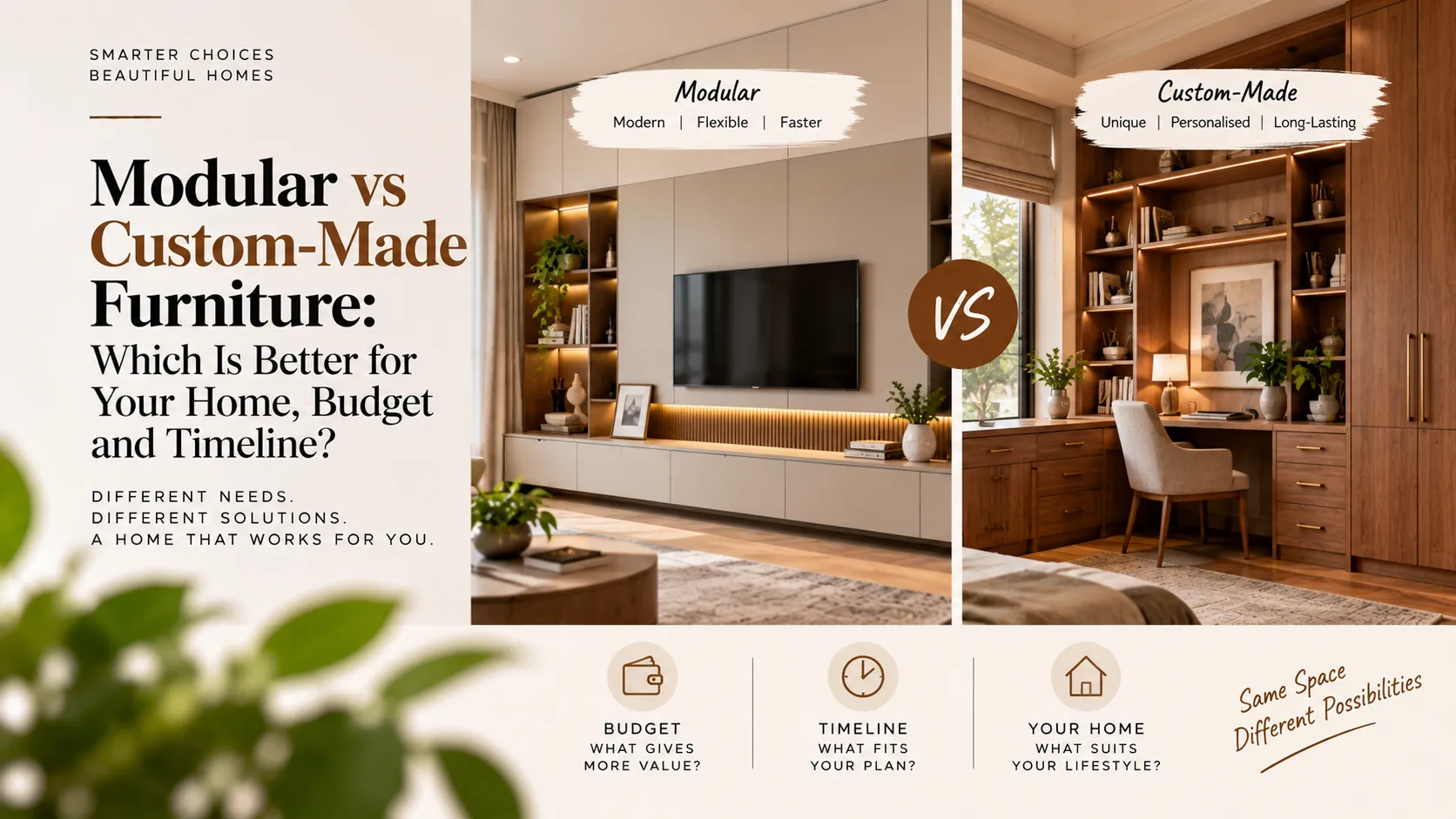
Should you choose modular furniture or get everything custom-made?
And more importantly, will choosing the wrong option mean spending extra money or dealing with inconvenient furniture for years?
The answer depends on what you are making, how your home is planned and what matters most to your family.
Let us understand the differences properly so you can make this decision without relying only on what someone else recommends.
First, What Is the Actual Difference Between Modular and Custom-Made Furniture?
Before comparing prices or finishes, you need to understand something that often gets overlooked.
Modular furniture and custom-made furniture are not always two completely separate categories.
Modular furniture is generally made using individual cabinet units or components that are manufactured and assembled to create the required furniture layout.
Custom-made furniture, on the other hand, is designed around your specific measurements and requirements.
And custom furniture can be manufactured in a factory too.
The distinction homeowners usually want to understand is between factory-produced modular furniture and furniture constructed by a carpenter at the site.
Let us look at both approaches.
How Modular Furniture Is Made
Suppose you are planning a modular kitchen.
Your designer measures the kitchen, understands your storage requirements and prepares the cabinet layout.
The design is then divided into individual cabinet units.
These components are manufactured using the selected materials and finishes. Depending on the manufacturer, production may involve machine-based cutting, drilling and edge banding.
Once the components are ready, they are delivered to your flat and assembled or installed.
The majority of manufacturing work happens away from your home.
This can reduce the amount of cutting, polishing and fabrication required at the site.
How Carpenter-Made Furniture Is Made
Now imagine you have hired a carpenter to construct your wardrobe.
The carpenter visits your flat, measures the available space and begins working with the selected materials.
Depending on the construction method, boards may be cut, assembled, adjusted and finished at the site.
This approach allows the carpenter to work closely with the actual dimensions and conditions of the room.
If a wall is slightly uneven or an unusual corner needs to be accommodated, adjustments can be made during construction.
However, the amount of work happening inside your home is generally greater.
The quality of the finished furniture also depends on the carpenter’s workmanship, equipment, materials and finishing process.
Neither method automatically guarantees better furniture.
The outcome depends on how well the work is designed and executed.
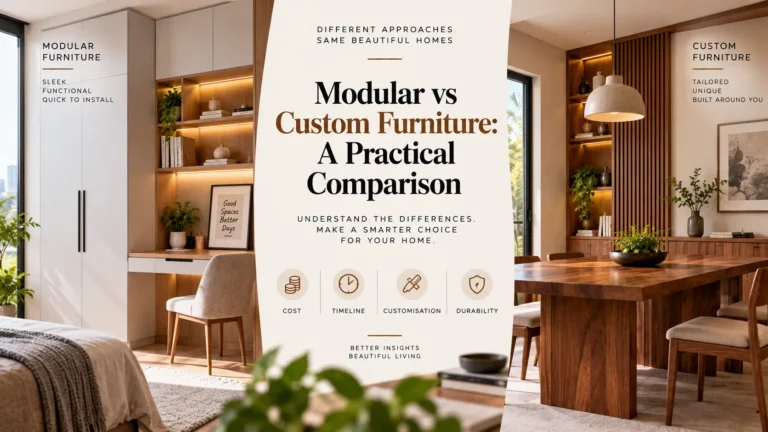
Modular vs Custom Furniture: A Practical Comparison
Here is how the two approaches generally differ when you are planning your home interiors.
| Factor | Factory-Made Modular Furniture | Site-Made Custom Furniture |
|---|---|---|
| Manufacturing | Components are manufactured before installation | Much of the fabrication happens at the site |
| Design Flexibility | Depends on available modules and manufacturer capabilities | Can accommodate individually planned dimensions and construction details |
| Installation | Generally involves assembling prepared components | Often involves cutting, fitting and finishing at the site |
| Site Work | Less on-site fabrication when measurements and production are accurate | More on-site fabrication and material handling |
| Finish Consistency | Factory processes can support repeatable cutting and edge finishing | Depends on tools, workmanship and finishing conditions |
| Difficult Corners | May require fillers, modified modules or specially manufactured units | Can be built around irregular dimensions |
| Repairs | Individual components may be replaceable, subject to design and availability | Local modifications may be possible, depending on construction |
| Cost | Influenced by materials, manufacturing, hardware and installation | Influenced by materials, labour, finishing, complexity and site conditions |
| Timeline | Depends on design approval, factory production and installation | Depends on carpenter availability, work complexity and site progress |
This comparison is useful, but it still does not tell you which solution to choose.
For that, we need to look at the furniture you actually want in your home.
Evaluate the Right Furniture Construction Method for Your Home
Not sure which construction method makes sense for your floor plan? Parinee Interio can help you evaluate suitable furniture solutions based on your storage requirements, available space and budget before you finalise the design.
- Review your floor plan and available space
- Assess furniture solutions based on your storage needs
- Consider construction methods alongside your budget
- Clarify practical differences before finalising the design
Reviewing the construction approach early can help you select furniture solutions that fit your space, requirements and spending comfort.
Modular Kitchen vs Carpenter-Made Kitchen: What Should You Choose?
Your kitchen is probably where this decision deserves the most attention.
You will use the cabinets every day. You need space for utensils, groceries, appliances and cleaning supplies.
You also need a layout that works around your sink, hob, refrigerator and existing plumbing.
When a Modular Kitchen Makes Sense
Imagine you have a reasonably regular kitchen layout in a newly purchased Mumbai flat.
You want organised lower cabinets, overhead storage and dedicated space for appliances.
A modular kitchen can be practical because the cabinet units can be planned around your requirements and manufactured before installation.
You can choose internal storage arrangements, shutters, finishes and hardware according to the available options and project specifications.
Factory production can also help maintain consistency across multiple cabinets.
However, a modular kitchen is not automatically a perfect fit simply because it is factory-made.
Measurements, appliance dimensions and installation planning still matter.
When Carpenter-Made Kitchen Work May Be Useful
Now imagine you are renovating an older flat.
The kitchen has an unusual corner, slightly uneven walls and existing plumbing that you do not want to relocate.
A site-made solution may allow more adjustments during construction.
For example, the carpenter may be able to accommodate an irregular gap or construct a storage unit around an existing obstruction.
But you should still check how the cabinet construction, edge finishing and hardware installation will be handled.
Also, do not assume that difficult layouts cannot be handled through modular manufacturing. Some manufacturers can produce made-to-measure components.
For kitchens, your layout and storage requirements should determine the construction method, not the other way around.
Modular vs Custom Wardrobes: Where Does the Difference Matter?
Let us move to your bedroom.
You want a wardrobe that looks good, accommodates your clothes and uses the available wall space properly.
Should you choose a modular wardrobe or ask a carpenter to make one?
Consider Your Bedroom Dimensions
Suppose your bedroom has a straight wall with sufficient depth for a wardrobe.
You want a combination of hanging space, drawers, shelves and perhaps a loft.
A factory-made wardrobe can work well if the dimensions and internal layout suit your requirements.
But imagine the wardrobe wall has a column at one end.
Or perhaps the ceiling height changes near a beam.
Now the design needs more careful planning.
You may need a specially manufactured cabinet, a filler panel or a custom-built section.
A carpenter-made solution may also be considered, particularly where site adjustments are necessary.
Do Not Ignore Internal Storage
Here is another thing worth discussing with your designer.
A wardrobe is not useful simply because it occupies the entire wall.
Think about how you actually store your belongings.
Do you have more clothes that need hanging space? Do you prefer folded clothes? Do you need separate storage for sarees, luggage or seasonal items?
These questions matter more than whether the wardrobe is labelled modular or custom-made.
A carefully planned modular wardrobe can be more convenient than poorly designed carpenter-made furniture.
The reverse can also be true.
The construction method cannot compensate for a layout that does not suit your daily routine.
What About TV Units, Shoe Cabinets and Difficult Corners?
Not every furniture item in your home needs the same construction approach.
Think about your living room.
A straightforward TV unit with closed cabinets, open shelves and a clean wall-mounted design may be suitable for modular manufacturing.
But suppose your living room has a recessed wall.
You want the TV unit to extend into that recess, conceal an existing column and incorporate a small display area.
A customised solution may help accommodate those details.
The same applies to shoe cabinets and awkward corners.
For example, you may have an unused area near your entrance that is too narrow for a standard cabinet.
Instead of choosing furniture that blocks circulation or leaves the corner unused, you could consider a made-to-measure unit.
However, customisation should serve a purpose.
You do not need to make every piece of furniture complicated merely because you have the option.
Sometimes a simple cabinet is exactly what your home requires.
Plan Furniture Solutions for Unusual Layouts and Difficult Corners
If you have an unusual room layout or want to make better use of difficult corners, discuss the available options with Parinee Interio. We can help you explore where modular furniture may work and where customised solutions deserve consideration.
- Review difficult corners and available floor space
- Identify areas where modular furniture may fit
- Consider customised solutions for unusual dimensions
- Balance space utilisation, storage and project budget
Reviewing the available furniture options early can help you use difficult spaces more practically without adding unnecessary complexity.
Which Is More Budget-Friendly: Modular or Carpenter-Made Furniture?
Now comes the question you were probably waiting for.
Which option will cost less?
Unfortunately, there is no universal answer.
A basic modular wardrobe and a highly customised carpenter-made wardrobe are not comparable merely because they have similar dimensions.
Likewise, a carpenter-made kitchen with premium plywood, expensive hardware and a complicated design may cost more than a simpler modular kitchen.
The final amount depends on several factors.
| Cost Factor | Why It Matters |
|---|---|
| Furniture Dimensions | Larger cabinets generally require more materials and work |
| Material Selection | Different board grades, thicknesses and finishes affect cost |
| Hardware | Drawer systems, hinges and specialised accessories can change the amount |
| Design Complexity | Unusual shapes and specialised details may require additional work |
| Manufacturing | Factory processes and site fabrication have different production requirements |
| Installation | Site access, fitting complexity and adjustments can affect labour |
| Finishing | Surface treatments and finishing processes influence the final cost |
Compare the Same Specifications
Here is what I would suggest.
Before comparing modular and carpenter-made quotations, make sure both options cover the same furniture.
For example, if you are comparing two kitchen proposals, check whether both include the same cabinets, countertop requirements, internal accessories and hardware.
Otherwise, you may choose the apparently economical option only to discover that several things you wanted were not included.
And please, do not compare only the initial amount.
Consider the finish you want, your maintenance expectations and the likelihood of needing modifications later.
A furniture solution that suits your requirements for years may be more valuable to you than an initially cheaper option that creates daily inconvenience.
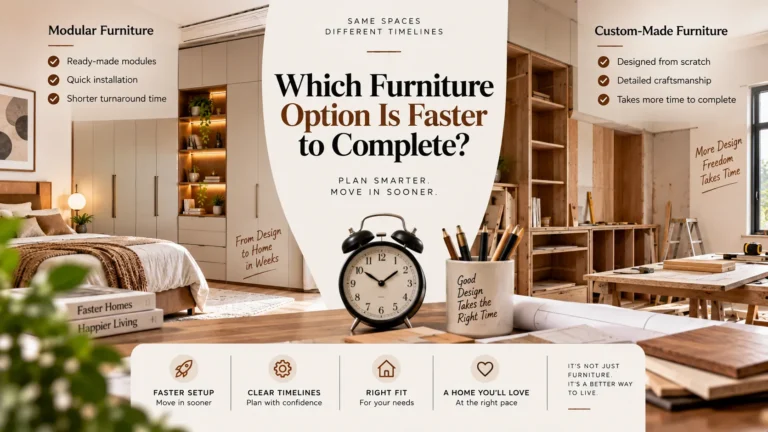
Which Furniture Option Is Faster to Complete?
If you are planning to move into your flat soon, the timeline can influence your decision.
Modular furniture often requires less installation time at the site because many components are manufactured beforehand.
But factory production takes time too.
Your designer must finalise the measurements, layouts, materials and details before manufacturing begins.
Once the components are ready, installation can proceed according to the site conditions.
Carpenter-made furniture may allow work to begin at the site after the required materials and plans are ready.
However, cutting, assembly and finishing can take considerable time, particularly when several furniture items are being made simultaneously.
Site Readiness Matters More Than You Think
Let us say your modular wardrobe is ready for installation, but the flooring work is incomplete.
Or the wall measurements have changed after civil modifications.
The installation may need to be postponed or the components may require adjustments.
Similarly, carpenter-made work can be delayed by material availability, unfinished electrical work or other contractors working in the same room.
This is why you should ask your designer for a realistic project schedule rather than assuming that one construction method will always be faster.
Which Option Is Easier to Repair or Modify Later?
Think about what may happen five years after moving into your home.
A hinge may need replacement. A drawer channel may stop working smoothly. You may want to change a shutter or add storage.
With modular furniture, some individual components may be removable or replaceable.
However, this depends on the construction and whether compatible hardware, finishes and replacement components remain available.
With carpenter-made furniture, local modifications may be possible depending on how the unit was constructed.
But changing an integrated cabinet can still require substantial dismantling or refinishing.
Neither method is completely maintenance-free.
Before finalising your furniture, ask which hardware is being used, how it can be serviced and what happens if a component needs replacement.
These are practical questions that can save you considerable inconvenience later.
Can You Combine Modular and Custom-Made Furniture in One Home?
Absolutely.
In fact, there is no reason to force one construction method onto every room.
You could use modular cabinets for your kitchen, made-to-measure wardrobes for unusual bedroom dimensions and a customised TV unit for a difficult living room wall.
You could even combine different approaches within the same furniture arrangement.
For example, your kitchen may use factory-manufactured base cabinets while a specially designed storage section accommodates an irregular corner.
Similarly, a wardrobe may use modular cabinet sections with a customised loft or filler arrangement, provided the construction and installation details are properly planned.
The important thing is coordination.
Materials, finishes, measurements and installation responsibilities should be decided before the work begins.
Otherwise, combining different methods can create mismatched finishes or fitting problems.
Plan a Combination of Furniture Solutions for Your Home
If you are trying to balance your budget with practical storage and a particular design preference, Parinee Interio can help you explore a combination of furniture solutions rather than limiting your home to one construction method.
- Review your storage requirements and available space
- Consider different furniture solutions for different rooms
- Balance construction methods with your budget
- Match furniture choices with your design preferences
Using different furniture solutions where appropriate can help you balance functionality, appearance and budget across your home.
A Simple Checklist Before Making Your Decision
Before choosing modular or custom-made furniture, sit down with your designer and discuss these questions:
- Which furniture items need standard storage, and which require unusual dimensions?
- Are your walls, corners and ceiling heights suitable for the proposed layout?
- What materials and hardware will be used in each option?
- Where will the furniture be manufactured?
- How much work will happen inside your flat?
- What is the expected manufacturing and installation timeline?
- What happens if measurements change?
- How will damaged components be repaired or replaced?
- Are the quotations based on the same scope and specifications?
- Can different construction methods be combined without compromising the final appearance?
You do not need to decide everything before meeting an interior designer.
But knowing what matters to your family will help you have a much more useful discussion.
Frequently Asked Questions
01 Is modular furniture better than carpenter-made furniture?
Neither option is automatically better for every home. Modular furniture can offer organised manufacturing and relatively straightforward installation, while carpenter-made furniture can be useful for unusual dimensions and site adjustments. Your decision should depend on the layout, materials, workmanship, budget and functionality you need.
02 Is modular furniture more expensive than custom-made furniture?
Not necessarily. A modular unit with premium hardware and finishes may cost more than a simpler carpenter-made alternative. Similarly, complicated custom work can be expensive. Compare identical dimensions, materials, hardware and scope before deciding which option is more suitable for your budget.
03 Is modular furniture durable enough for everyday use?
Modular furniture can perform well in everyday use when suitable materials, hardware and manufacturing methods are selected. Durability depends on construction quality, environmental conditions and maintenance. The modular label alone does not tell you how long a particular furniture item will last.
04 Is carpenter-made furniture always stronger?
No. Strength depends on the materials, construction details, joints, hardware and workmanship. A well-manufactured modular cabinet may perform better than poorly constructed carpenter-made furniture. Ask your designer to explain the proposed construction and material specifications instead of relying on assumptions about either method.
05 Which is better for a modular kitchen, factory manufacturing or carpenter work?
For a regular kitchen layout, factory-manufactured cabinets can be convenient. A kitchen with difficult corners or unusual dimensions may benefit from customised solutions. Both approaches can work when the design, measurements, materials and installation are handled correctly.
06 Can modular furniture be customised according to my flat?
Yes, depending on the manufacturer and production process. Some modular systems offer limited standard dimensions, while others support made-to-measure components. Discuss your actual room measurements and design requirements before assuming that modular furniture cannot accommodate your space.
07 Which option creates less mess inside the house?
Factory-made modular furniture generally involves less cutting and fabrication at the site because many components arrive prepared for assembly. Carpenter-made furniture may require more on-site work. However, both methods involve installation, and the amount of dust or disruption depends on the project.
08 Can I repair modular furniture after several years?
Many modular furniture components can be repaired or replaced, depending on their construction and availability. Common hardware may be easier to source than discontinued proprietary parts. Ask about hardware specifications and replacement availability when finalising your furniture.
09 Is modular furniture suitable for small Mumbai flats?
Yes. Modular furniture can be designed around compact layouts and practical storage requirements. However, some small flats have irregular corners, columns or unusual dimensions that require customised planning. The available space should be measured carefully before selecting the construction method.
10 Can I use modular furniture in the kitchen and carpenter-made furniture in the bedrooms?
Yes. Different rooms can use different construction approaches. You may choose factory-made kitchen cabinets and custom-built bedroom storage according to your requirements. Just ensure that the designs, materials, finishes and execution responsibilities are coordinated properly.
Final Thoughts — Choose What Works for Your Home, Not Just What Sounds Better
When you are planning your home interiors, it is easy to get caught between different recommendations.
Someone will tell you modular furniture is the modern choice. Someone else will insist that traditional carpenter work is more dependable.
But your home has its own requirements.
Your kitchen layout, bedroom dimensions, storage habits, budget and moving timeline are not necessarily the same as those of the person giving you advice.
A straightforward modular wardrobe may work perfectly in one room, while another space may need customised furniture.
You may prefer factory-manufactured kitchen cabinets but choose a specially designed TV unit for your living room.
There is no need to make every piece of furniture using the same method.
The sensible approach is to understand your requirements first and then select the construction method that supports them.
Explore Suitable Furniture and Interior Solutions
Planning your home interiors and unsure whether to choose modular or custom-made furniture? Discuss your floor plan, furniture requirements, preferred finishes and budget with Parinee Interio. We can help you explore suitable solutions for your home, including where modular furniture may be practical and where customisation could make better use of your available space.
- Review your floor plan and available space
- Discuss your furniture and storage requirements
- Compare modular and customised solutions for different areas
- Consider finishes and furniture choices within your budget
A room-by-room discussion can help you choose furniture solutions that fit your space, requirements and budget.