+ 91 8108850334
info@parineeinterio.in
+ 91 8108850334
info@parineeinterio.in


You have finally started receiving quotations for your home interiors.
One designer has quoted ₹8 lakh. Another has quoted ₹10 lakh. A third has sent you a detailed Excel sheet with several pages of furniture measurements, material names and technical terms.
Naturally, you start comparing the final amounts.
But then you notice something confusing.
One quotation mentions plywood, another mentions HDHMR, and the third simply says modular furniture. Some items are calculated in square feet, others in running feet, and a few have only a single amount against them.
You are not sure whether all three designers are actually offering the same things.
And somewhere in your mind, there is a concern.
What if you approve a quotation today and discover later that several important items were never included?
That is exactly why understanding your interior design quotation matters.
You do not need to become an interior designer or learn every technical detail. You simply need to understand what you are paying for, how the amount is calculated and what you will receive.
Let us go through it together.
First, Understand What an Interior Design Quotation Should Actually Tell You
An interior quotation should do much more than tell you the total cost of your project.
Ideally, it should help you answer five questions:
- What furniture and interior work will be completed?
- What materials and hardware will be used?
- How will the measurements and quantities be calculated?
- What is included in the quoted amount?
- What expenses or responsibilities are excluded?
Think about your modular kitchen.
A quotation that simply says:
Modular Kitchen – ₹2,50,000
does not give you enough information to evaluate the proposal.
Does that amount include the countertop? What about the kitchen sink, drawer channels, shutters and installation? Are the cabinets made from plywood or another board material?
Without these details, you cannot confidently compare this quotation with another designer’s proposal.
A useful quotation should explain the scope clearly enough that you understand what the proposed amount represents.
And this is where the BOQ becomes important.
What Is a BOQ in Interior Design?
BOQ stands for Bill of Quantities.
It is a structured list of the work, furniture, materials and quantities included in your interior project.
Think of it as a detailed breakdown of what you are purchasing.
Instead of presenting one combined amount for your entire home, a BOQ separates the project into measurable components.
For example, your master bedroom BOQ might include:
- Wardrobe carcass and shutters.
- Internal drawers and shelves.
- Wardrobe handles and hinges.
- Bed with storage.
- Bedside tables.
- Dressing unit.
- Decorative wall panelling.
- Electrical modifications.
Each item may have its own measurement, quantity, rate and total amount.
A typical BOQ contains the following information:
| BOQ Column | What It Means |
|---|---|
| Item description | What furniture or work is being provided |
| Specification | The proposed material, finish or other technical details |
| Unit | How the item is measured or counted |
| Quantity | How much of that item is included |
| Unit rate | The price charged for one measurement unit |
| Amount | Quantity multiplied by the applicable unit rate |
Some quotations also include separate columns for hardware, labour, installation, taxes and remarks.
There is no single quotation format that every interior designer must use. The important thing is whether the document provides enough information to understand and verify the proposed work.
Why does an itemised BOQ matter?
Suppose you receive two quotations for the same wardrobe.
Designer A quotes ₹85,000.
Designer B quotes ₹1,05,000.
Initially, Designer A appears more affordable.
But after checking the BOQ, you discover that Designer B has included internal drawers, a loft, a different board specification and additional hardware.
You are no longer comparing identical wardrobes.
The BOQ helps you identify these differences before deciding which proposal matches your requirements.
Understand What Is Included in Your Interior Quotation
Have you received an interior quotation but cannot understand what is included? Parinee Interio can help you discuss your requirements and understand the details that should be clarified before finalising your project.
- Review the furniture and work included in the quotation
- Clarify materials, finishes and hardware specifications
- Identify inclusions, exclusions and additional requirements
- Discuss questions to clarify before finalising the project
A clear review of the quotation can help you understand the proposed scope before making a final commitment.
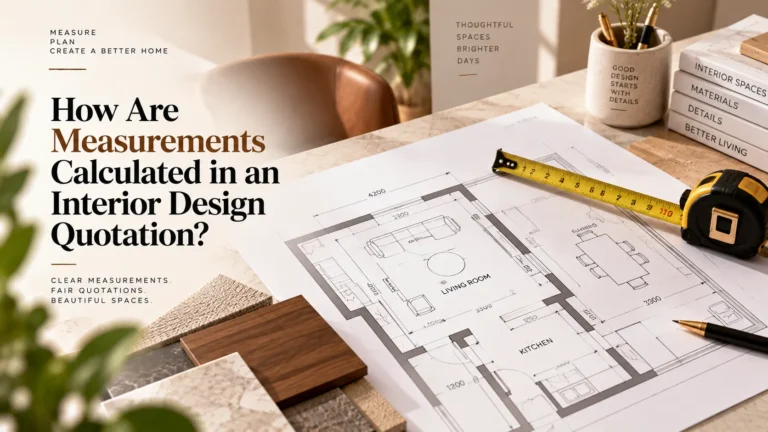
How Are Measurements Calculated in an Interior Design Quotation?
This is one of the most confusing parts for homeowners.
You might see abbreviations such as SQ FT, RFT, NOS and LS in the same quotation.
They represent different ways of measuring work.
Let us understand each one.
Square Feet or SQ FT
Square feet measure area.
For furniture pricing, the calculation may be based on the length multiplied by the height of the unit’s front elevation, depending on the agreed measurement method.
Imagine a wardrobe that is:
- 8 feet wide.
- 7 feet high.
Its front elevation area is:
8 × 7 = 56 square feet
If the quotation calculates the wardrobe on this basis, the unit rate will be multiplied by 56.
However, there is something important to remember.
The front elevation area does not tell you everything about the wardrobe.
Two wardrobes with identical external dimensions can have different numbers of shelves, drawers, partitions and accessories.
That is why measurements and specifications must be considered together.
Running Feet or RFT
Running feet measure length rather than area.
This measurement is commonly used for certain kitchen cabinets, countertops and other linear interior elements.
For example, a kitchen has 10 running feet of base cabinets.
If the agreed rate is calculated per running foot, the quantity would be 10 RFT.
But you should also confirm the standard height and depth covered by that rate.
A 10-foot cabinet with a different depth or configuration may involve a different quantity of material.
Do not assume that running-foot pricing automatically includes everything inside the cabinets.
Numbers or NOS
NOS simply means the number of individual items.
You may see this measurement for:
- Hinges.
- Drawer channels.
- Handles.
- Kitchen accessories.
- Individual furniture pieces.
- Light fixtures.
For example:
12 hinges × ₹350 = ₹4,200.
The rate and quantity should be visible if these items are being charged separately.
Lump Sum or LS
A lump-sum amount is a combined charge for a defined piece of work.
For example:
Electrical modifications – ₹25,000 LS.
This does not automatically mean the quotation is incorrect.
However, you should ask what work that amount includes.
Does it cover additional plug points, wiring, switchboards and installation? Are decorative lights included or charged separately?
A lump-sum item becomes difficult to evaluate when its scope is unclear.
Let Us Read a Sample Modular Kitchen Quotation Together
Now that you understand the measurements, let us see how they appear in an actual quotation format.
Imagine you are planning a modular kitchen with approximately 10 running feet of base cabinets, 8 running feet of wall cabinets and one tall pantry unit.
The following is a completely illustrative quotation created to explain the calculation process. The rates are hypothetical examples, not Parinee Interio’s actual prices or recommended market rates.
Sample Kitchen BOQ
| Item | Unit | Quantity | Illustrative Rate | Amount |
|---|---|---|---|---|
| Base cabinets | RFT | 10 | ₹9,000 | ₹90,000 |
| Wall cabinets | RFT | 8 | ₹7,000 | ₹56,000 |
| Tall pantry unit | NOS | 1 | ₹34,000 | ₹34,000 |
| Hinges | NOS | 12 | ₹350 | ₹4,200 |
| Drawer channels | NOS | 3 | ₹1,800 | ₹5,400 |
| Countertop | SQ FT | 25 | ₹2,400 | ₹60,000 |
| Backsplash work | SQ FT | 30 | ₹450 | ₹13,500 |
| Installation labour | LS | 1 | ₹18,000 | ₹18,000 |
| Illustrative subtotal | ₹2,81,100 |
Taxes and any additional or excluded work are not included in this illustrative subtotal.
At first glance, the quotation looks detailed.
But you should still ask a few questions about each line item.
Base and wall cabinets
What board material is proposed? What is its thickness? Which laminate or finish is included?
Does the rate include shutters, shelves, edge banding and handles?
In this example, hinges and drawer channels are charged separately. The cabinet rate should therefore clarify that these particular hardware items are excluded to avoid double charging.
Tall pantry unit
What are its height, width and depth?
Does the amount include only the cabinet or also internal pull-out accessories?
A pantry with simple shelves and one with an advanced pull-out mechanism are not the same specification.
Hinges and drawer channels
What brands, product ranges and load capacities are proposed?
Does the quantity match the approved kitchen design?
If soft-close functionality has been discussed, is that included in the specified hardware?
Countertop
What material, thickness and finish are included?
Does the rate cover fabrication, edge treatment, sink cut-outs and installation?
Backsplash
Does the amount include the selected tiles, adhesive, grout and installation, or only labour?
These details should be clarified before treating the subtotal as the complete kitchen cost.
The purpose of an itemised quotation is not just to show you how the total was calculated. It should help you understand what each amount will deliver.
How to Understand Material Specifications in Your Quotation
Material descriptions deserve careful attention because they influence durability, suitability, maintenance and the final appearance.
You may encounter terms such as plywood, MDF, HDHMR, laminate and acrylic.
Here is a simple explanation.
| Material Term |
What It Generally Refers To |
|---|---|
| Plywood | An engineered wood panel made by bonding thin layers of wood veneer |
| MDF | Medium-density fibreboard made from compressed wood fibres and resin |
| HDHMR | High-density, high-moisture-resistant engineered board |
| Laminate | A decorative surface finish applied to a suitable substrate |
| Acrylic | A glossy decorative surface material or finish used on selected furniture surfaces |
| Edge banding | A finishing strip used to cover exposed board edges |
These terms describe different components, not necessarily interchangeable alternatives.
For example, plywood is a substrate, while laminate is generally a surface finish.
A quotation mentioning only “premium laminate wardrobe” does not tell you which board material is being used underneath.
Similarly, a material name alone does not establish the complete specification.
What should you ask about furniture materials?
Before approving the quotation, confirm:
- Board type and thickness.
- Proposed manufacturer or product grade.
- Material specifications for moisture-exposed areas.
- External and internal finishes.
- Edge banding details.
- Shutter and carcass specifications.
The carcass is the internal cabinet structure. Shutters are the doors or visible closing panels.
Both should be clearly specified where relevant.
Hardware and Finishing Should Not Be Treated as Minor Details
Let us say you have approved an attractive wardrobe design.
The quotation mentions hinges and handles, but no further details.
After installation, you discover that the shutters do not have the soft-close functionality you expected.
The designer may say that soft-close hinges were never included in the quotation.
You may feel that they were part of the original discussion.
This is exactly the kind of misunderstanding that proper documentation can prevent.
For commonly used hardware, request the brand, product range, type and quantity wherever practical.
Also confirm whether items such as handles, channels, locks and specialised accessories are included in the furniture rate or charged separately.
The same applies to finishes.
A quotation should identify the agreed finish clearly enough to avoid confusion during manufacturing and installation.
Review Your Interior Quotation Item by Item
If you are comparing quotations with different material and hardware descriptions, request an itemised interior quotation discussion with Parinee Interio before making your final decision.
- Compare furniture items and quantities across quotations
- Clarify material, hardware and finish specifications
- Identify differences in inclusions, exclusions and execution work
- Discuss unclear items before finalising the project
Reviewing each quotation item clearly can help you understand the proposed scope before making a final decision.
Understanding Labour, Installation, Taxes and Additional Charges
Some designers include installation labour within individual furniture rates.
Others show labour separately.
Neither format automatically makes a quotation better or worse.
What matters is that you understand the amount payable for the agreed scope.
Check whether the quotation includes:
| Charge | What You Should Confirm |
|---|---|
| Manufacturing | Is furniture manufacturing included in the quoted item rate? |
| Transportation | Is delivery to your building included? |
| Installation | Are fitting and installation charges included? |
| Electrical work | Are wiring, switches and installation covered? |
| Plumbing work | Are kitchen and bathroom plumbing modifications included? |
| Civil work | Are demolition, masonry and related modifications covered? |
| Debris removal | Who is responsible for removing construction waste? |
| Taxes | Are applicable taxes included in the quoted rates or added separately? |
For taxes, ask for the applicable GST treatment and a clear indication of whether the quoted amount is inclusive or exclusive of tax.
You should be able to understand the final payable amount before approving the project.
Watch for These Common Quotation Exclusions
An exclusion means that something is not included in the quoted scope or amount.
Exclusions are not automatically hidden charges.
The problem arises when you assume an item is included while the quotation says otherwise, or when the scope is not documented clearly.
For example, a modular kitchen quotation may exclude:
- Refrigerator, chimney and hob.
- Kitchen sink and faucet.
- Additional electrical points.
- Plumbing modifications.
- Countertop cut-outs.
- Decorative lighting.
- Wall repairs or painting.
These exclusions can affect the amount you eventually spend.
Ask your designer to explain the exclusions room by room, particularly for the kitchen and bathrooms.
And if something was discussed verbally but does not appear in the quotation, request written clarification.
How to Compare Two Interior Design Quotations Properly
Now imagine you have quotations from three designers.
Instead of immediately comparing their totals, prepare a simple comparison.
| Comparison Point | Designer A | Designer B |
|---|---|---|
| Kitchen scope | Confirm | Confirm |
| Wardrobe dimensions | Confirm | Confirm |
| Board materials | Confirm | Confirm |
| Hardware specifications | Confirm | Confirm |
| Countertop | Included or excluded | Included or excluded |
| Electrical modifications | Included or excluded | Included or excluded |
| Installation | Included or separate | Included or separate |
| Applicable taxes | Included or additional | Included or additional |
| Payment schedule | Review | Review |

This exercise may reveal that two quotations with different totals are based on different scopes.
It also helps you ask more specific questions.
Instead of saying, “Why is your quotation expensive?” you can ask:
“Does your wardrobe rate include internal drawers? The other quotation lists them separately.”
That is a much more useful conversation.
What Should You Clarify Before Approving the Quotation?
Before signing off, make sure the final document reflects the latest approved design.
This matters because quantities may change during design development.
A wardrobe may become wider. Additional kitchen drawers may be added. The television unit may be redesigned.
Each change can affect the quotation.
Also ask how revisions after approval will be handled.
If you request additional work, will you receive a revised BOQ or written variation showing the cost difference?
Finally, review the payment schedule, expected execution stages, warranty terms and handover responsibilities alongside the quotation.
The quotation explains what you are purchasing. The accompanying agreement should clarify how the project will be delivered and managed.
Make Your Interior Quotation Clearer Before Work Begins
A detailed quotation cannot eliminate every uncertainty in an interior project, but it can make expectations, responsibilities and costs much clearer before work begins.
- Clarify what furniture and work are included
- Review materials, finishes and hardware specifications
- Identify responsibilities for installation and additional work
- Understand costs, exclusions and possible changes before execution
A clearer quotation can give you a more complete view of the proposed project before execution starts.
Frequently Asked Questions
01 What is a BOQ in interior design?
BOQ stands for Bill of Quantities. It is a detailed breakdown of the furniture, materials, measurements and work included in an interior project. It helps you understand how the quotation has been calculated and compare the proposed scope with other quotations.
02 What should a proper interior design quotation include?
A useful quotation should describe the furniture and work, measurements, quantities, unit rates, material specifications, hardware, finishing and applicable charges. It should also clarify exclusions and taxes. Payment terms, execution responsibilities and warranty details should be documented in the quotation or accompanying agreement.
03 What is the difference between square feet and running feet in an interior quotation?
Square feet measure area, while running feet measure length. A wardrobe may be calculated using its front elevation area, while certain kitchen cabinets may be measured along their length. Always confirm the measurement method and the dimensions covered by the quoted unit rate.
04 Why do two interior designers quote different amounts for the same home?
The quotations may include different furniture quantities, board materials, hardware, finishes, labour or additional work. One designer may also include items that another has excluded. Comparing the BOQs and specifications helps you understand the differences rather than judging proposals only by their total amounts.
05 Does a modular kitchen quotation include the countertop and appliances?
Not necessarily. Some quotations include the countertop, while others treat it as a separate item. Refrigerators, chimneys, hobs and other appliances may also be excluded. Ask for written confirmation of each major kitchen component before assuming it is covered.
06 What does LS mean in an interior quotation?
LS means lump sum. It represents a combined amount for a defined piece of work rather than a rate multiplied by a measurement. If the quotation includes lump-sum charges for electrical work or installation, ask for a description of the activities covered.
07 Should hardware brands be mentioned in an interior quotation?
Where hardware selection affects functionality, durability or price, identifying the brand and product specification helps avoid confusion. For frequently used hinges, drawer channels and accessories, request enough detail to understand what is proposed and whether it matches your approved design.
08 Can the final interior cost increase after quotation approval?
Yes, particularly if you change the design, add furniture, upgrade materials or request work outside the original scope. The quotation and agreement should explain how such changes are documented and approved, including whether a revised amount will be shared before additional work begins.
09 Is GST included in an interior design quotation?
It depends on how the quotation is presented and the applicable tax treatment. Check whether the quoted rates include GST or whether tax will be added separately. Ask for the applicable tax details and the final payable amount before approving the proposal.
10 What if my interior quotation does not mention material thickness?
Ask your designer to clarify it in writing. Material thickness can affect construction, suitability and cost. A quotation that mentions only the board material may not provide enough information to understand the complete furniture specification or compare it with another proposal.
11 Should I approve an interior quotation before finalising the furniture design?
You can discuss an initial estimate while the design is developing, but final approval should be based on a clearly defined scope. Significant changes in furniture dimensions, internal arrangements or materials can affect quantities and prices, so the final quotation should reflect the approved design.
12 What is the most important thing to check before signing an interior quotation?
Make sure you understand what is included, what is excluded and what the total payable amount represents. Check that the furniture dimensions, material specifications, hardware and agreed scope match your discussions. Clarify any uncertain item before approval rather than relying on verbal assumptions.
Final Conclusion and CTA
Understand Your Interior Quotation Before You Commit
Receiving a detailed interior quotation can feel overwhelming, particularly when you are unfamiliar with technical terms and furniture measurements.
But you do not need to understand every manufacturing process to make an informed decision.
Start with the basics.
Understand the scope, verify the measurements, review the material specifications and confirm what is included in the quoted amount.
If something is unclear, ask.
A quotation should help you understand the project, not leave you guessing about what you will receive.
And remember, comparing quotations is not simply about finding the lowest total. It is about understanding the actual work, specifications and responsibilities behind each proposal.
Request an Itemised Interior Quotation Discussion
Have you received an interior quotation and want to understand whether the scope, materials, measurements and charges have been explained clearly? Talk to Parinee Interio about your home interior requirements.
- Review the furniture and work included in the quotation
- Clarify materials, measurements and specifications
- Identify charges, exclusions and additional requirements
- Discuss the details worth clarifying before finalising the project
Request an Itemised Interior Quotation Discussion to understand the details worth clarifying before you finalise your interior project.