+ 91 8108850334
info@parineeinterio.in
+ 91 8108850334
info@parineeinterio.in

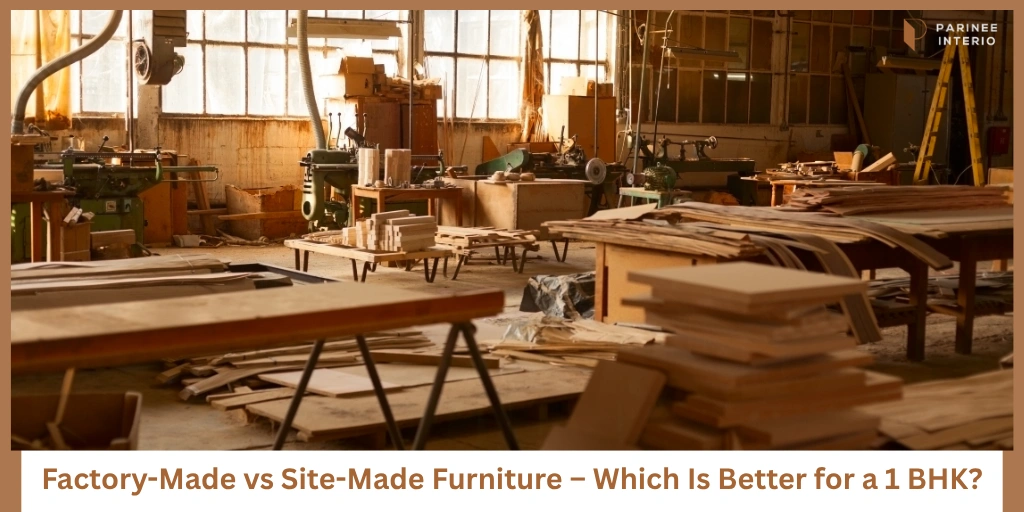
If you’re planning interiors for your 1 BHK, you’ve probably already heard different opinions from everyone around you.
Your carpenter says site-made furniture is stronger.
An interior company says factory-made modular furniture is more premium.
Relatives suggest going with “traditional carpentry.”
Instagram reels say modular is the future.
And honestly, that’s where most homeowners get confused.
In compact Mumbai homes, furniture decisions matter a lot because storage, movement space, and finishing all affect daily comfort. One wrong wardrobe size or poor kitchen finish becomes noticeable very quickly in a smaller flat.
The truth is — both factory-made and site-made furniture can work well.
The better option depends on:
- your budget
- customization needs
- finishing expectations
- project timeline
- execution quality
Not just marketing terms.
What Is the Difference Between Factory-Made and Site-Made Furniture?
Before comparing both, it’s important to understand how they actually work.
What Is Factory-Made Modular Furniture?
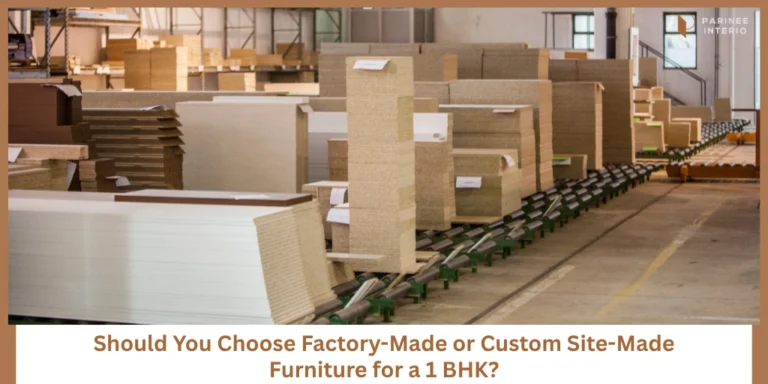
Factory made modular furniture is manufactured inside a factory using machines and standardized systems.
Usually:
- panels are pre-finished
- cutting happens through machines
- edge banding is factory done
- units are assembled on-site later
This process improves:
- precision
- alignment
- finishing consistency
Factory installations are also usually faster and cleaner.
What Is Site-Made Furniture?
Site made furniture is built directly at the home by carpenters.
This includes:
- on-site cutting
- manual fabrication
- flexible sizing
- custom detailing
Many homeowners still prefer carpenter made furniture because adjustments can happen during execution itself.
Why Furniture Planning Matters More in a 1 BHK
In compact homes, furniture affects:
- storage efficiency
- movement comfort
- visual spaciousness
- organization
That’s why the best furniture type for 1 bhk homes is usually the one that balances practicality and space optimization properly.
FREE CONSULTATION
Free Furniture Planning Consultation for Your 1 BHK
What you’ll get:
- Modular vs carpenter guidance
- Furniture layout recommendations
- Storage optimization ideas
- Execution planning suggestions
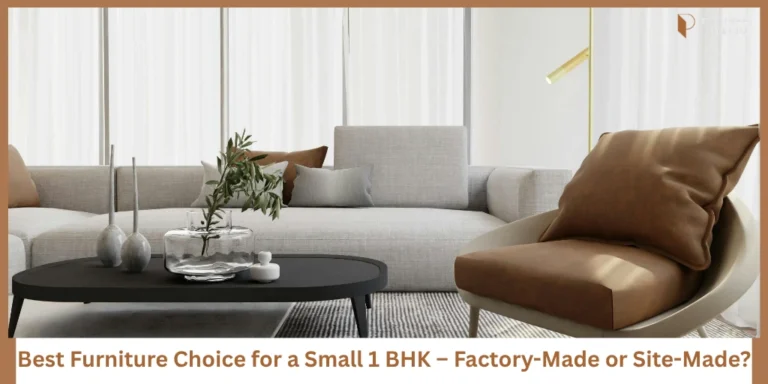
Factory-Made vs Site-Made Furniture — Full Comparison
Both systems have strengths and limitations.
Finishing Quality Comparison
Factory-made furniture usually offers:
- cleaner edge finishing
- machine precision
- smoother alignment
- uniform laminates
With site-made furniture, the result depends heavily on carpenter skill and supervision quality.
A skilled carpenter can still achieve premium finishing — but consistency may vary.
Customization Flexibility
This is where site-made furniture has an advantage.
Factory-made systems follow modular sizing, so last-minute changes become harder.
Site-made furniture allows:
- flexible dimensions
- custom adjustments
- easier modifications during execution
This matters in awkward layouts or older apartments.
Timeline and Installation Speed
Factory-made furniture is generally faster.
Since units are pre-manufactured:
- installation becomes quicker
- site work reduces
- dust and noise reduce significantly
Site-made furniture takes longer because:
- fabrication happens on-site
- polishing requires multiple stages
- drying time increases execution duration
Durability and Long-Term Performance
Durability depends less on “factory vs carpenter” and more on:
- plywood quality
- hardware brands
- edge sealing
- moisture handling
Poor-quality modular furniture can still fail quickly.
And good carpenter work with quality materials can last many years.
Cost Comparison
Modular furniture cost is usually more structured because:
- factory overheads exist
- machinery costs are included
- systems are standardized
Site-made furniture allows more pricing flexibility because:
- materials can be sourced separately
- labour varies
- phased execution becomes easier
That’s why carpenter furniture pricing sometimes feels more budget-friendly.
Site Cleanliness and Execution Experience
Factory-made installations are cleaner.
There’s:
- less dust
- less cutting noise
- reduced site mess
Site carpentry work usually creates more disruption during execution.
Warranty and After-Service Support
Most modular companies offer:
- structured warranties
- organized service systems
- support teams
With local carpenters, after-service depends on individual availability.
Factory-Made vs Site-Made Comparison Table
| Factor | Factory-Made Furniture | Site-Made Furniture |
|---|---|---|
| Finish Quality | More consistent | Depends on carpenter skill |
| Installation Speed | Faster | Slower |
| Customization | Moderate | High |
| Site Cleanliness | Cleaner | More dust and noise |
| Pricing | Structured | Flexible |
| Warranty | Usually available | Informal |
| Precision | Machine-based | Manual |
| Design Flexibility | Limited changes | Easier modifications |
Which Furniture Type Works Better for Different Homeowners?
The better option depends on your priorities.
Factory-Made Furniture Works Better for Faster Projects
Turnkey modular furniture works well when homeowners want:
- faster execution
- organized timelines
- cleaner installation
- predictable finishing
This suits busy Mumbai homeowners especially well.
Site-Made Furniture Works Better for Customized Spaces
Custom carpentry furniture is useful when:
- layouts are unusual
- dimensions are irregular
- on-site flexibility is needed
Older apartments often benefit from this approach.
Factory-Made Furniture Works Better for Consistent Finishing
Machine edge banding and factory precision usually create:
- cleaner alignment
- uniform finishes
- modern modular interiors
This helps achieve a more polished appearance.
Site-Made Furniture May Work Better for Budget-Conscious Projects
Site-made furniture allows:
- phased work
- selective execution
- material flexibility
This can help homeowners manage tighter budgets more comfortably.
FURNITURE COMPARISON SHEET
Free Furniture Comparison Template for 1 BHK Homes
Includes:
- Modular vs carpenter comparison sheet
- Material checklist
- Pricing tracker
- Warranty comparison guide
Hidden Challenges Homeowners Often Ignore
This is where many furniture decisions go wrong.
Assuming All Modular Furniture Is Premium
Not all modular furniture has high quality.
Low-quality boards and poor hardware still create problems later.
Ignoring Plywood and Hardware Specifications
This matters more than branding.
Always check:
- plywood grade
- hinge brands
- channel quality
- edge sealing
Choosing Based Only on Lower Pricing
Cheap furniture often creates:
- finishing issues
- poor durability
- future maintenance costs
Not Clarifying Warranty Terms
Always ask:
- what’s covered
- how long support lasts
- how service requests work
Underestimating Carpenter Coordination
Site-made work requires:
- supervision
- coordination
- regular follow-ups
Without proper management, delays become common.
Questions You Should Ask Before Finalizing Furniture Type
Before deciding, ask:
- Which plywood grade will be used?
- Which hardware brands are included?
- How long will manufacturing take?
- Can I see completed projects?
- How is edge banding handled?
- What happens if modifications are needed later?
These questions usually reveal execution quality very quickly.
FREE MATERIAL REVIEW
Get a Free Furniture Scope and Material Review
Includes:
- Material evaluation
- Modular vs site-made guidance
- Storage planning feedback
- Execution recommendations
Final Thoughts
Factory-made and site-made furniture solve different problems.
Factory-made systems usually work better for:
- speed
- cleaner finishing
- organized execution
Site-made furniture works better for:
- flexibility
- custom sizing
- budget adjustments
But in both cases, execution quality matters more than labels.
Because even the most expensive furniture setup fails if:
- materials are poor
- supervision is weak
- planning is incomplete
The right furniture system quietly improves storage, comfort, and durability every single day.
FURNITURE REVIEW WORKSHEET
Free Furniture Material and Quote Review Worksheet
Includes:
- Furniture comparison framework
- Material verification sheet
- Pricing comparison tracker
- Warranty checklist
Frequently Asked Questions
Both can work well. Factory-made furniture offers better finishing consistency, while site-made furniture offers better customization flexibility.
Durability depends more on plywood, hardware, and execution quality than the manufacturing method itself.
Factory systems include machinery, structured production, organized installation, and warranty support.
Yes. Skilled carpenters with proper supervision and quality materials can achieve very good finishing.
Factory-made modular furniture usually installs faster because manufacturing happens before site execution.