+ 91 8108850334
info@parineeinterio.in
+ 91 8108850334
info@parineeinterio.in

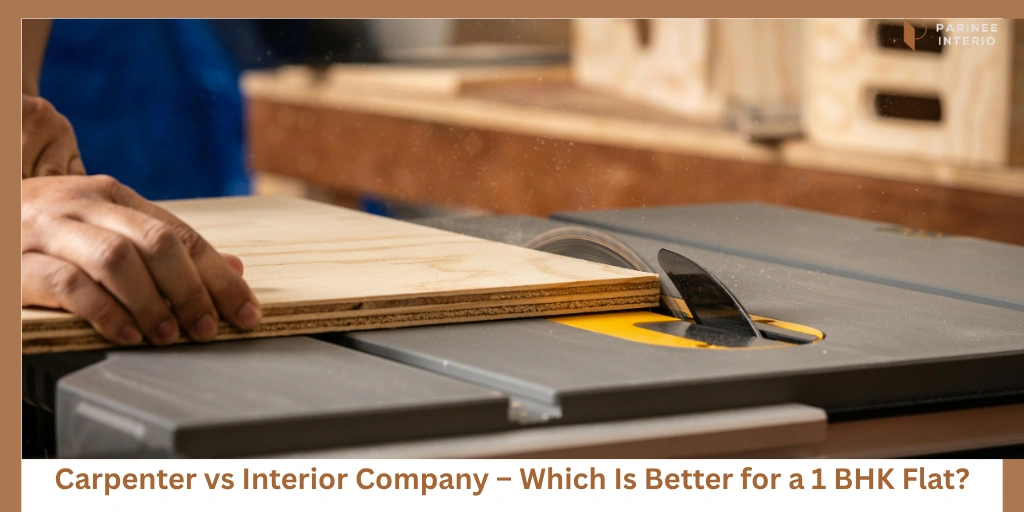
Many homeowners get confused when comparing quotes from a local carpenter and an interior company.
One vendor gives a much lower price. Another offers complete turnkey interiors with design, planning, and supervision included.
That’s where the confusion starts.
People often wonder:
- Is paying more actually worth it?
- Will a carpenter give the same result?
- Who will manage delays and coordination?
- What happens if the finishing quality is poor?
In compact homes, mistakes become noticeable very quickly because every inch matters.
The truth is — both carpenters and interior companies can work well depending on:
- budget
- project size
- finish expectations
- supervision needs
- homeowner involvement level
The real difference is usually not furniture alone — it is planning, supervision, and accountability.
What Is the Difference Between a Carpenter and an Interior Company?
Before comparing pricing, it’s important to understand what each one usually handles.
What a Local Carpenter Usually Handles
Most local carpenter interiors focus mainly on:
- furniture fabrication
- on-site carpentry work
- wardrobes
- TV units
- modular alternatives
The work is usually labour-focused execution.
However, many carpenters do not independently handle:
- complete layouts
- storage planning
- lighting coordination
- full project management
That responsibility often stays with the homeowner.
What an Interior Company Usually Handles
Interior company services are usually broader.
They often manage:
- layouts and design
- modular production
- material selection
- site coordination
- turnkey execution
Many turnkey interiors for 1 bhk homes also include:
- 3D visualization
- project supervision
- vendor coordination
- installation management
Why Compact 1 BHK Homes Need Better Coordination
In compact apartment interiors, planning matters much more because:
- storage precision affects usability
- layouts affect movement
- lighting affects spaciousness
- finishing quality becomes highly visible
That’s why 1 bhk interior planning usually benefits from stronger coordination systems.
FREE CONSULTATION
Free Interior Vendor Consultation for Your 1 BHK
What you’ll get:
- Carpenter vs company evaluation guidance
- Budget planning suggestions
- Execution model recommendations
- Project coordination advice

Carpenter vs Interior Company — Full Comparison for 1 BHK Homes
Both options have advantages depending on the homeowner’s priorities.
Cost Comparison
Carpenter Setup
- lower initial pricing
- labour-based billing
- flexible phased execution
However, homeowners may separately manage:
- electricians
- painters
- hardware vendors
- polish work
Interior Company Setup
- bundled execution pricing
- centralized accountability
- structured costing
The carpenter vs interior company cost difference usually comes from coordination systems and project management.
Design and Space Planning Support
Carpenter Setup
Most carpenters work based on:
- homeowner references
- existing ideas
- basic layouts
Design planning support is usually limited.
Interior Company Setup
Interior companies usually provide:
- professional layouts
- storage optimization
- 3D visualization
- lighting planning
This becomes useful in compact apartment layouts where space efficiency matters heavily.
Material Selection and Procurement
With carpenter setups, homeowners often handle:
- laminate selection
- hardware sourcing
- finish coordination
With interior companies, material sourcing is usually more structured and standardized.
This often improves consistency in modular material planning.
Execution Quality and Finishing
Carpenter Setup
Finishing quality depends heavily on:
- individual skill
- labour experience
- site conditions
Results may vary.
Interior Company Setup
Most companies follow:
- factory production systems
- quality checks
- structured installations
This often creates more consistent modular furniture finishing.
Timeline and Coordination Management
Carpenter Setup
Multiple vendors may work separately.
This increases homeowner-managed coordination.
Interior Company Setup
Interior companies usually provide:
- project managers
- synchronized timelines
- dedicated supervision
Turnkey project coordination becomes easier for homeowners with limited time.
Warranty and After-Service Support
Carpenter support is often informal and relationship-based.
Interior companies usually offer:
- structured warranties
- after-service processes
- issue tracking systems
This improves long-term support reliability.
Carpenter vs Interior Company Comparison Table
| Factor | Local Carpenter | Interior Company |
|---|---|---|
| Design Support | Basic | Professional |
| Space Planning | Limited | Detailed |
| Material Coordination | Homeowner Managed | Company Managed |
| Timeline Management | Flexible but less structured | Organized |
| Execution Quality | Skill-dependent | Standardized |
| Warranty Support | Informal | Structured |
| Homeowner Involvement | High | Moderate |
| Budget Control | Flexible | More predictable |
Which Option Works Better for Different Homeowners?
The right choice depends on project expectations.
A Carpenter May Work Better for Tight Budgets
A carpenter setup may work well for:
- simple modular work
- phased interiors
- budget home interiors
- homeowners comfortable managing vendors
It can also work well for carpenter modular kitchen work and individual furniture pieces.
Interior Companies Work Better for Turnkey Convenience
Interior companies are usually better for:
- full-service home interiors
- complete home setups
- end-to-end execution
This reduces coordination stress significantly.
Interior Companies Usually Work Better for First-Time Homeowners
First-time homeowners often benefit from:
- guided execution
- easier material selection
- structured project handling
Turnkey home setup services simplify decision-making.
Carpenters May Work Better for Small Custom Modifications
Carpenters are often useful for:
- furniture repairs
- minor upgrades
- custom carpentry work
- small interior renovations
Not every project requires a full interior company.
VENDOR COMPARISON TEMPLATE
Free Interior Vendor Comparison Template
Includes:
- Carpenter vs company comparison sheet
- Material quality checklist
- Pricing comparison framework
- Project planning worksheet

Hidden Challenges Homeowners Often Ignore Before Choosing
Many problems appear only after execution starts.
Underestimating Coordination Stress with Multiple Vendors
Managing separate vendors can become exhausting during execution.
Assuming Higher Pricing Automatically Means Better Quality
Premium pricing does not always guarantee premium execution.
Not Comparing Material Quality Properly
Material transparency matters more than brochure images.
Ignoring Site Supervision Structure
Poor supervision often creates:
- delays
- finishing issues
- communication gaps
Choosing Only Based on Cheapest Pricing
Cheap interior quote risks usually appear later through:
- poor finishing
- low-quality hardware
- incomplete execution
Not Clarifying Warranty and Service Terms
Always confirm:
- warranty duration
- after-service process
- issue resolution timelines
Before finalizing any vendor.
Questions You Should Ask Before Finalizing Either Option
Good questions help avoid future problems.
Ask:
- Who will handle site coordination daily?
- What materials and brands will be used?
- Is installation included in the quote?
- What happens if delays occur?
- What warranty support is available?
- Can I visit completed projects?
These questions to ask interior designer or carpenter setups help compare vendors more clearly.
FREE QUOTE REVIEW
Get a Free Scope and Quote Review Before Finalizing Any Vendor
What you’ll get:
- Quotation review
- Scope comparison guidance
- Material quality evaluation
- Execution planning feedback
Final Thoughts — Choose the Option That Matches Your Budget, Time, and Coordination Comfort
There is no single correct answer in the carpenter vs interior company comparison.
Both options can work well depending on:
- budget
- project complexity
- supervision comfort
- finish expectations
Carpenters usually work better for:
- smaller scopes
- phased execution
- flexible customization
Interior companies usually work better for:
- complete planning
- coordinated execution
- turnkey convenience
In most cases, process clarity matters more than pricing alone.
Because the right interior partner quietly reduces stress while improving the final living experience.
QUOTE REVIEW WORKSHEET
Free Quote Review Worksheet for 1 BHK Interiors
Includes:
- Vendor comparison framework
- Hidden cost checklist
- Material verification sheet
- Execution tracking guide
Frequently Asked Questions
Usually yes. Carpenters often have lower initial pricing because they mainly focus on labour and furniture execution.
It depends on your budget, coordination comfort, and project complexity. Interior companies usually provide better planning and supervision.
Many companies provide more standardized finishing because of factory production systems and structured quality checks.
Yes. Many homeowners hire carpenters specifically for modular kitchens, wardrobes, or individual furniture work.
Most professional interior companies offer structured warranty and after-service support systems.