+ 91 8108850334
info@parineeinterio.in
+ 91 8108850334
info@parineeinterio.in

11 Benefits of Turnkey Interior Solutions for New Homeowners
Buying a home is exciting.
Managing its interiors?
Not always.
Many homeowners imagine a simple process.
Approve a few designs.
Finalize the budget.
Wait for the work to finish.
Move into a beautiful home.
Reality often looks very different.
Multiple vendors.
Endless phone calls.
Unexpected delays.
Confusing quotations.
Last-minute decisions.
Site visits every week.
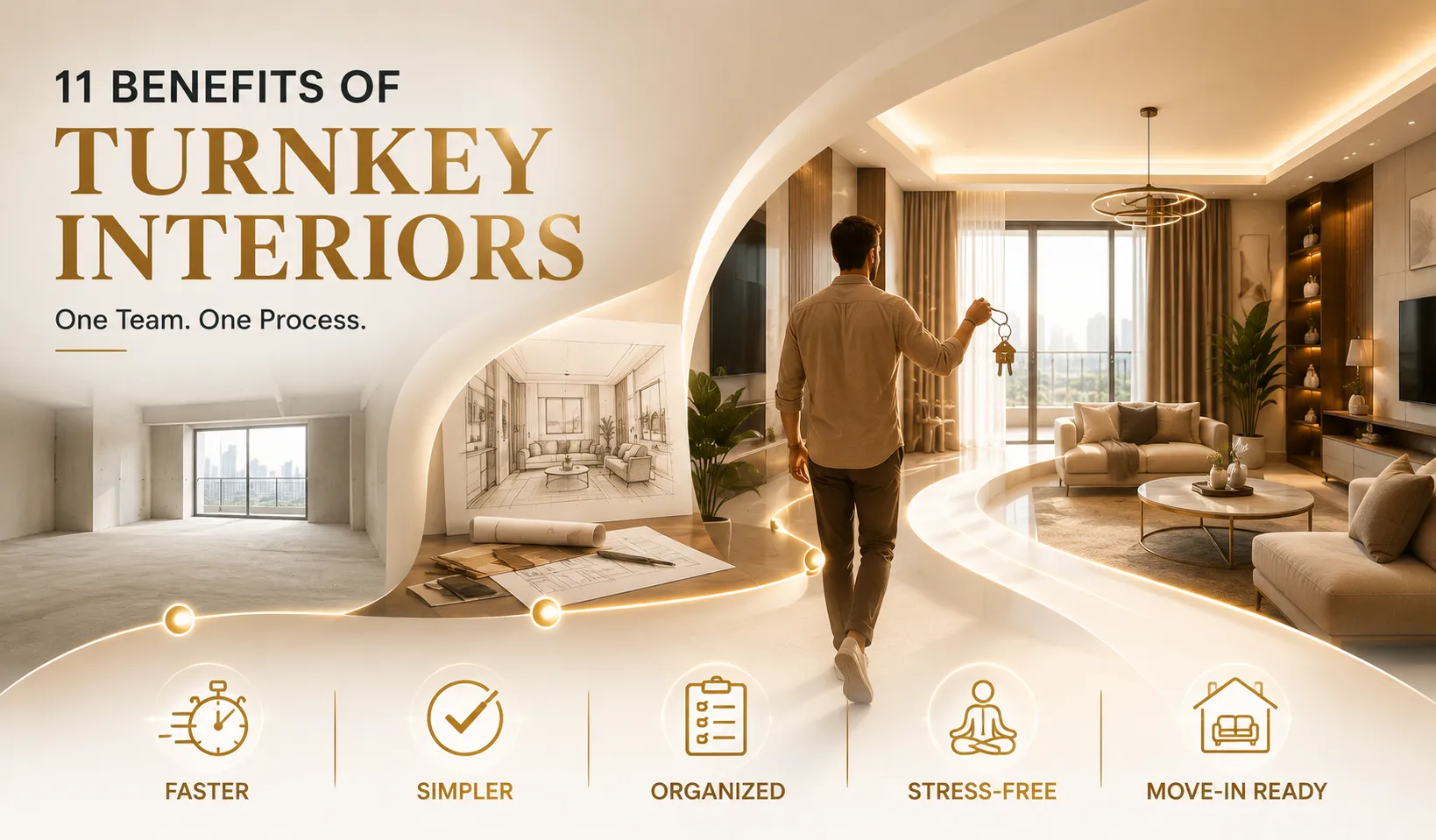
This is exactly why turnkey interior solutions have become increasingly popular among homeowners.
Instead of managing multiple people, multiple timelines, and multiple responsibilities, homeowners work with a single team that handles the project from start to finish.
But what practical benefits will you actually experience?
Is turnkey interior worth it?
And who benefits the most from this model?
Let’s break it down.
First, What Is a Turnkey Interior Solution?
Before we discuss the benefits, let’s understand what turnkey interiors actually mean.
What “Turnkey” Actually Means
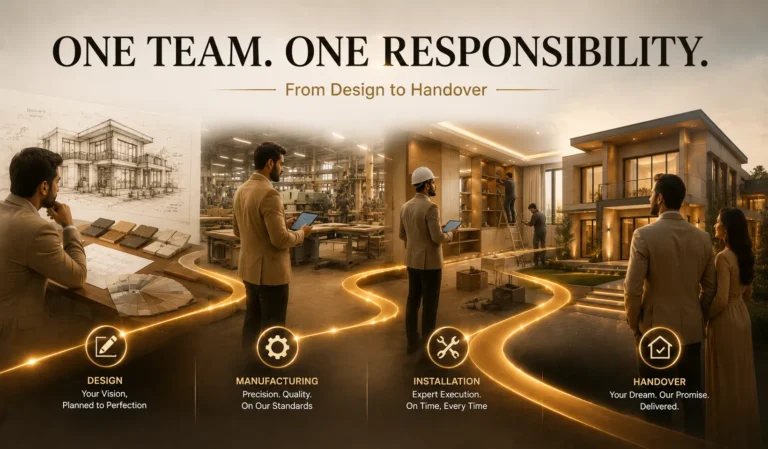
A turnkey interior solution means one company takes responsibility for the complete interior journey.
This typically includes:
- Interior design
- Space planning
- Storage planning
- Material selection
- Manufacturing
- Site execution
- Vendor coordination
- Quality checks
- Final handover
The goal is simple.
The homeowner receives a ready-to-use home without having to coordinate every stage personally.
How It Differs From Traditional Project Management
In a traditional setup, homeowners often coordinate:
- Contractor
- Carpenter
- Electrician
- Painter
- Hardware suppliers
- Material vendors
In a turnkey model, these responsibilities usually sit under one coordinated team.
That difference affects the entire project experience.
Is a Turnkey Solution the Right Fit for Your Home?
Not sure whether a turnkey solution fits your apartment, budget, timeline, and lifestyle? Get expert guidance before you commit to a project model. We’ll help you evaluate what actually makes sense for your specific home setup.
Apartment Layout Assessment
Budget & Cost Fit Check
Timeline Feasibility Review
Family Requirement Mapping
Lifestyle Alignment Analysis
Personalized Execution Recommendation
Benefit #1: One Team Takes Responsibility for the Entire Project
One of the biggest frustrations during interiors is accountability.
What Happens When Multiple Vendors Share Responsibility
Imagine a delay occurs.
Or a measurement issue appears.
Or the final finish doesn’t look right.
When multiple parties are involved, responsibility often becomes unclear.
The carpenter points to the contractor.
The contractor points to another vendor.
The homeowner becomes the coordinator.
Why Single-Point Accountability Creates More Confidence
A turnkey model usually provides one primary point of contact.
Questions go to one team.
Updates come from one team.
Problems go to one team.
Why This Matters During Delays and Issues
Interior projects rarely go perfectly.
The difference is how quickly problems get solved.
A simple rule many homeowners discover:
When everyone is responsible, nobody is responsible.
Turnkey interiors help solve that problem.
Benefit #2: Less Coordination for Homeowners
Many homeowners underestimate how much time interior projects require.
The Time Commitment Most Homeowners Don’t Expect
A typical project involves:
- Vendor calls
- Site visits
- Material approvals
- Follow-ups
- Schedule management
- Issue resolution
For some homeowners, that level of involvement feels comfortable.
For many others, it becomes exhausting.
Traditional Approach vs Turnkey Approach
| Traditional Approach | Turnkey Approach |
|---|---|
| Contractor | One Coordinated Team |
| Carpenter | Included |
| Electrician | Included |
| Painter | Included |
| Vendor Follow-Ups | Included |
| Scheduling | Included |
| Coordination | Included |
Why Busy Professionals Often Prefer Turnkey Models
Many homeowners already manage demanding careers and family responsibilities.
Reducing project coordination becomes a significant benefit.
Benefit #3: Better Planning Before Execution Begins
Many interior problems don’t start during execution.
They start before execution.
Why Storage Problems Usually Appear After Move-In
Storage often looks sufficient when the home is empty.
Six months later, reality feels different.
Seasonal clothing.
Luggage.
Kids’ belongings.
Household items.
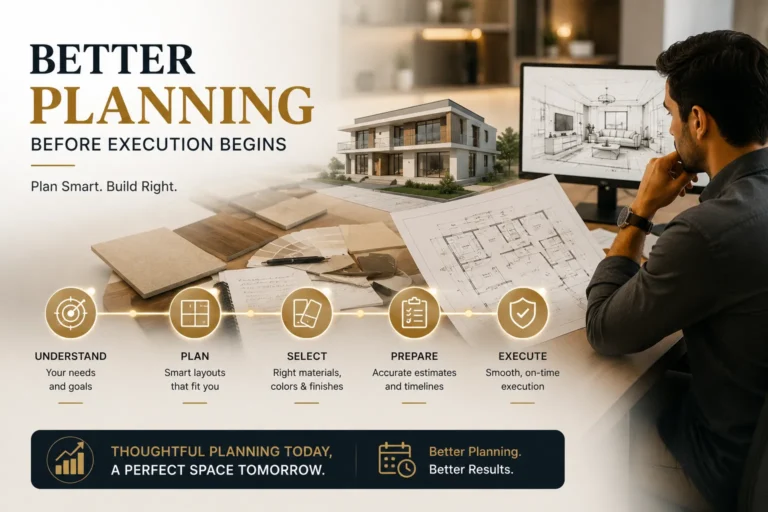
A proper planning process helps identify these requirements earlier.
The Layout Decisions That Affect Daily Life for Years
Small decisions often create long-term consequences.
Examples include:
- Wardrobe placement
- Furniture positioning
- Kitchen workflow
- Study corners
The Material Decisions Most Homeowners Make Only Once
Most homeowners don’t select laminates, hardware, countertops, and finishes regularly.
Professional guidance helps simplify these decisions.
Why Better Planning Usually Creates Better Budget Visibility
When scope becomes clearer, budgets usually become clearer too.
Benefit #4: Faster Project Completion
Ask homeowners about their biggest fears during interiors.
Delays usually appear near the top of the list.
Why Coordination Problems Often Slow Projects Down
Multiple vendors often depend on one another.
One delay affects another stage.
Then another.
And another.
How Integrated Teams Usually Improve Timelines
Teams that regularly work together often coordinate more efficiently.
This reduces waiting periods between activities.
Why Faster Completion Matters More Than Most Homeowners Realize
Every additional week can affect:
- Move-in schedules
- Rental expenses
- Family routines
- Personal plans
Time has value too.
Want a Clear, Realistic Understanding of Your Project Timeline?
Get a detailed breakdown of your project timelines, completion expectations, and the key factors that impact delivery schedules. Understand how budget, scope, materials, and execution decisions influence your overall project duration before you begin.
Project Timeline Estimation
Phase-Wise Execution Planning
Budget Impact Analysis
Material & Design Dependencies
Delay Risk Evaluation
Personalized Delivery Roadmap
Benefit #5: Improved Budget Visibility
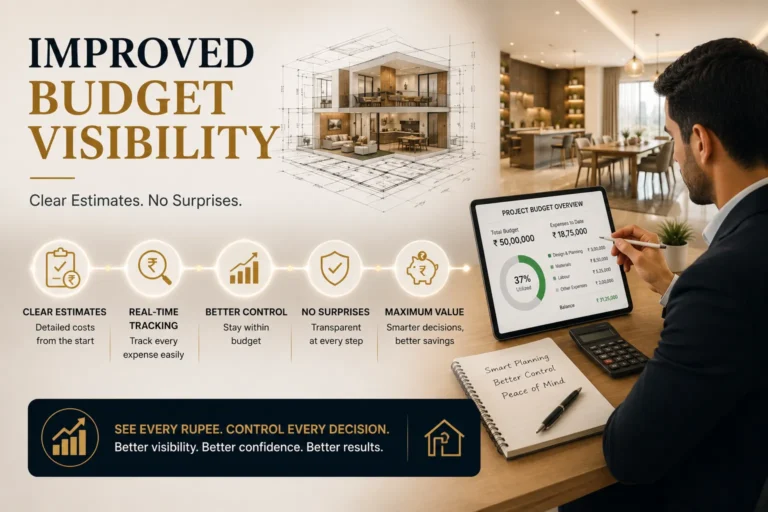
Most homeowners don’t like surprises.
Especially financial surprises.
Why Scope Clarity Helps Homeowners Make Better Decisions
Many budget problems start because project scope is unclear.
Questions such as:
- What is included?
- What comes later?
- What will cost extra?
need clear answers.
Why Better Cost Forecasting Creates Confidence
The earlier homeowners understand project requirements, the easier budgeting becomes.
The Budget Surprises Many Homeowners Want to Avoid
Common examples include:
- Additional storage
- Electrical modifications
- Material upgrades
- Design revisions
Early visibility helps reduce uncertainty.
Benefit #6: Better Space Planning and Storage Design
This benefit becomes especially valuable in apartments.
Why Storage Problems Continue Long After Move-In
Paint colors become less important over time.
Storage problems do not.
They affect daily life continuously.
How Better Space Utilization Improves Functionality
Every square foot should serve a purpose.
Especially in:
- 1 BHK homes
- Compact 2 BHK apartments
- Urban residences
The Difference Between an Empty Apartment and a Fully Functional Home
A home should support how a family lives.
Not just how it looks.
Good space planning often creates:
- Better organization
- Less clutter
- Improved usability
- Greater flexibility
Benefit #7: Reduced Risk of Rework
Rework is one of the biggest hidden costs in home interiors.
Why Small Changes Become Expensive Changes
A modification on paper costs very little.
The same modification after execution begins can become expensive.
What Usually Causes Rework in Home Interiors
Common examples include:
- Electrical changes
- Layout revisions
- Storage corrections
- Material replacements
How Rework Affects Budgets
Every correction consumes:
- Time
- Labour
- Materials
- Budget
Better planning often reduces avoidable revisions.
Benefit #8: Easier Decision-Making
A complete home interior project can involve hundreds of decisions.
The Material Choices That Overwhelm Many Homeowners
Examples include:
- Laminates
- Hardware
- Countertops
- Flooring
- Paints
- Finishes
Why Too Many Choices Often Create Decision Fatigue
The challenge is rarely a lack of options.
The challenge is having too many options.
The Storage Decisions That Affect Daily Living
Storage choices often affect long-term satisfaction more than decorative choices.
Why Consistency Usually Improves With Structured Guidance
A coordinated process often creates a more unified final result.
Benefit #9: Better Quality Control
Quality is not only about materials.
It’s also about execution.
Why Consistency Matters Across the Entire Home
A beautiful design loses value when execution quality varies from room to room.
The Small Details Homeowners Notice After Move-In
Examples include:
- Alignment
- Finishing quality
- Hardware installation
- Joinery precision
Why Accountability Often Improves Quality Standards
When one team oversees delivery, quality expectations become easier to maintain.
How Will a Turnkey Process Actually Work for Your Home?
Review your apartment layout, family requirements, budget, and goals to understand how a turnkey process would work for your specific project. Get clarity on execution flow, planning priorities, and what level of support your home actually needs.
Apartment Layout Review
Family Requirement Mapping
Budget & Goal Alignment
Storage Requirement Analysis
Turnkey Process Breakdown
Personalized Execution Roadmap
Benefit #10: Less Stress During the Entire Journey
This may be one of the most valuable benefits.
What Usually Creates Stress During Home Interiors
Common reasons include:
- Multiple vendors
- Constant follow-ups
- Unclear timelines
- Unexpected issues
Why Centralized Communication Feels Simpler
One team.
One communication channel.
One process.
Many homeowners find this significantly easier to manage.
Traditional Route vs Turnkey Route
| Traditional Route | Turnkey Route |
|---|---|
| Multiple Vendors | Centralized Team |
| Multiple Follow-Ups | Structured Communication |
| Separate Responsibilities | Unified Accountability |
| Frequent Coordination | Simplified Process |
Benefit #11: Better Experience for First-Time Homeowners
First-time homeowners often experience the steepest learning curve.
Why First-Time Buyers Often Feel Overwhelmed
Everything feels new.
Layouts.
Materials.
Furniture.
Budgets.
Execution.
Timelines.
The Mistakes Many New Homeowners Wish They Had Avoided
Common examples include:
- Storage shortages
- Furniture sizing issues
- Budget overruns
- Scope changes
Why Structured Processes Create More Confidence
A structured process helps many homeowners feel more informed and more comfortable throughout the project.
Who Benefits Most From Turnkey Interior Solutions?
Turnkey interiors are not the perfect fit for everyone.
But some homeowners benefit significantly more than others.
| Homeowner Type | Turnkey Suitability |
|---|---|
| First-Time Buyers | High |
| Busy Professionals | High |
| Families With Children | High |
| Investors | Medium |
| DIY Enthusiasts | Lower |
| Small Upgrade Projects | Lower |
A Simple Rule
The more complex the project becomes, the more valuable centralized coordination often becomes.
Common Misconceptions About Turnkey Interiors
Many homeowners evaluate turnkey solutions based on assumptions.
Let’s address a few common misconceptions.
| Myth | Reality |
|---|---|
| Turnkey Is Always Expensive | Depends on Project Scope |
| Turnkey Means Less Customization | Many Projects Are Highly Customized |
| Contractors Are Always Cheaper | Total Project Cost Varies |
| Turnkey Is Only for Luxury Homes | Many Apartment Owners Use Turnkey Services |
| Turnkey Means Homeowners Lose Control | Homeowners Still Approve Major Decisions |
What is a turnkey interior solution?
A turnkey interior solution typically covers planning, design, execution, coordination, and final delivery through one provider.
Is turnkey interior worth it?
For many homeowners, the value comes from convenience, accountability, planning, and reduced coordination.
What is included in turnkey interiors?
Services often include design, planning, manufacturing, execution, vendor coordination, and project management.
Are turnkey interiors more expensive?
Not necessarily. Total project cost depends on scope, planning quality, and execution efficiency.
How do turnkey projects reduce stress?
They usually reduce coordination responsibilities and centralize communication.
Who should choose turnkey interiors?
First-time homeowners, busy professionals, and families with complex requirements often benefit the most.
How do turnkey interiors improve accountability?
Most turnkey projects provide a single point of responsibility throughout the project.
Are turnkey interiors suitable for apartments?
Yes. Many apartment owners choose turnkey services because planning and coordination become more important in compact spaces.
Do turnkey interiors include storage planning?
Typically yes. Storage planning often forms an important part of the design process.
Can turnkey interiors help avoid delays?
Strong coordination can help reduce many common delay-related challenges.
What is the biggest advantage of turnkey interiors?
For many homeowners, it is the convenience of having one team manage the complete journey.
Are turnkey interiors good for first-time homeowners?
Yes. Many first-time buyers appreciate the structure and support that turnkey models provide.
Before You Compare Turnkey Interiors Only on Price
Most homeowners compare interior options by looking at quotations.
That’s understandable.
But many of the biggest benefits of turnkey interiors don’t appear inside a quote.
They appear during the project.
When you don’t have to coordinate five different vendors.
When you know who is responsible for the outcome.
When timelines feel more predictable.
When planning happens before execution.
And when the process feels manageable instead of overwhelming.
The question isn’t simply:
“How much does a turnkey interior solution cost?”
The better question is:
“How much convenience, accountability, coordination, and peace of mind matter to me during this project?”
For many homeowners, that’s where the real value begins.
Want a Realistic Understanding of Your Interior Project Timeline?
Get a clear breakdown of project timelines, completion expectations, and the key factors that affect delivery schedules. Understand how budget, design choices, materials, and execution methods influence your overall project duration before you begin.
Project Timeline Estimation
Phase-Wise Execution Planning
Budget Impact Analysis
Material & Design Dependencies
Delay Risk Assessment
Personalized Delivery Roadmap