+ 91 8108850334
info@parineeinterio.in
+ 91 8108850334
info@parineeinterio.in

You are sitting with your interior designer, discussing the kitchen and wardrobe designs. Everything looks good until the conversation moves to materials.
The designer suggests plywood for the kitchen, HDHMR for the wardrobe shutters and MDF for some decorative panels.
Then you receive another quotation where the designer has recommended particle board for the wardrobes.
Now you are confused.
Why are different materials being suggested for the same home? Is plywood always better? Is HDHMR actually waterproof? And if MDF is cheaper, does choosing it mean compromising on quality?
These are reasonable questions, especially when you are spending a significant amount on your home interiors.
The important thing to understand is that there is no single material that is perfect for every part of your home.
Let us understand the differences so that you can make informed decisions rather than simply accepting whatever appears in your quotation.
First, Understand What These Four Materials Actually Are
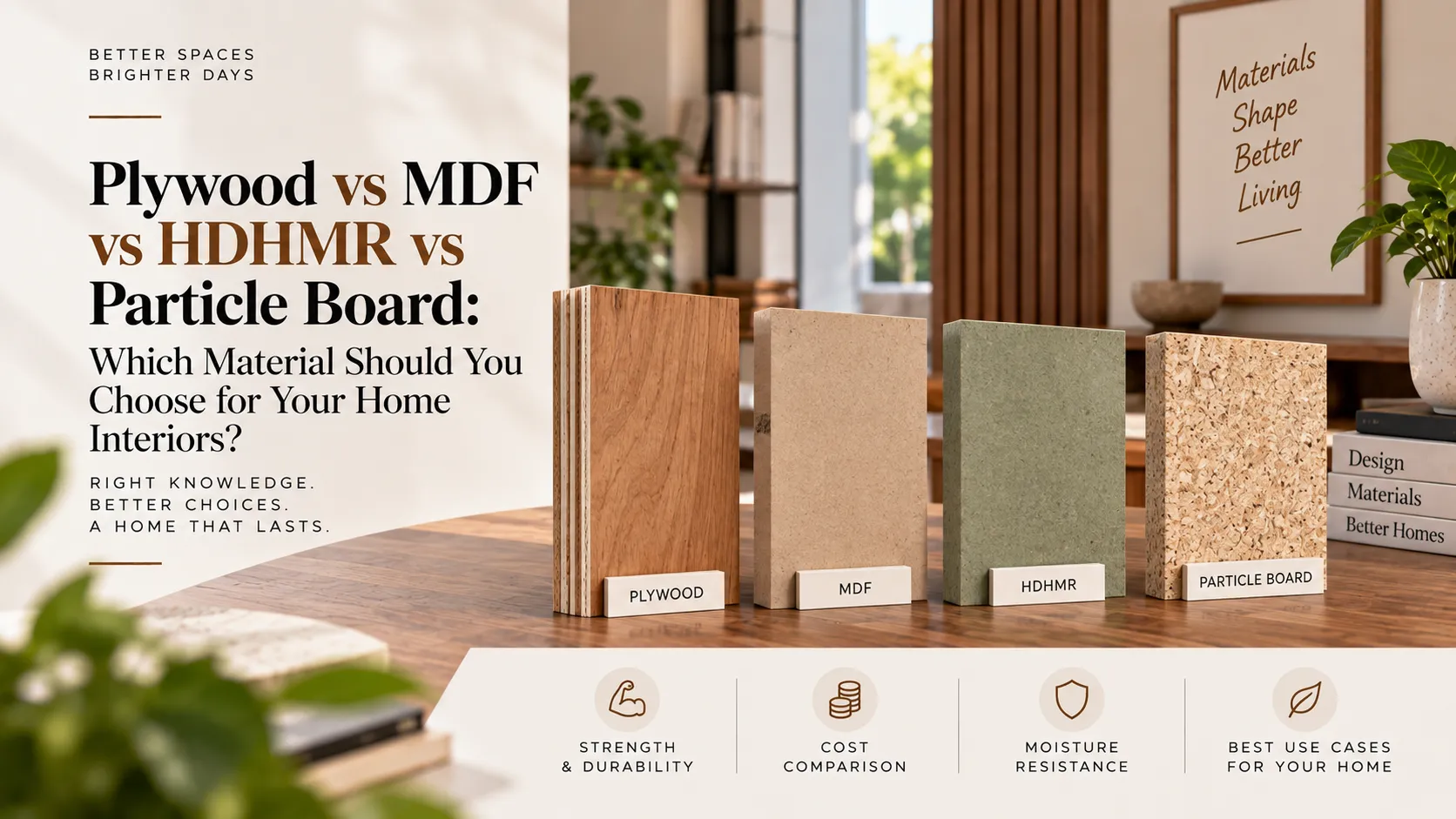
Before comparing durability or moisture resistance, you should understand what goes inside these boards.
Because two wardrobes can look almost identical from the outside while being manufactured using completely different materials.
1. Plywood
Plywood is manufactured by bonding thin layers of wood veneer together. These layers are generally arranged with the grain direction alternating between them.
This construction gives plywood strength and stability, making it suitable for furniture that needs to carry weight and accommodate hardware.
But here is something important.
Not all plywood is the same.
You will commonly encounter three terms:
- MR plywood: Moisture-resistant plywood generally used for dry interior applications.
- BWR plywood: Boiling-water-resistant plywood suitable for applications where humidity and occasional moisture are expected.
- BWP plywood: Boiling-waterproof or marine-grade plywood intended for more demanding moisture conditions.
In India, IS 303:2024 covers general-purpose plywood, while IS 710:2024 covers marine plywood. These are specifications published by the Bureau of Indian Standards.
Remember, buying plywood without checking its grade is like buying a car without knowing which model you are getting.
2. MDF
MDF stands for Medium Density Fibreboard.
It is manufactured by combining fine wood fibres with resin and compressing them into boards under heat and pressure.
Unlike plywood, MDF does not have visible wood layers.
Its surface is smooth and consistent, which makes it particularly useful for decorative furniture and painted finishes.
For example, imagine you want wardrobe shutters with elegant grooves and a painted finish.
MDF can be a practical choice because it allows detailed machining and offers a uniform surface for finishing.
However, standard MDF is sensitive to moisture, particularly through exposed edges.
This makes material selection and proper finishing important.
3. HDHMR
HDHMR stands for High Density High Moisture Resistant.
It is an engineered fibreboard manufactured for greater density and improved moisture resistance compared with ordinary MDF.
Its dense, uniform surface makes it useful for shutters, routed designs and selected furniture applications.
But do not make the mistake of assuming that HDHMR and waterproof plywood are interchangeable.
HDHMR is moisture-resistant, not automatically suitable for continuous water exposure.
Also, HDHMR is a commonly used commercial product description. Different manufacturers may offer different density, swelling, strength and moisture-resistance specifications.
Ask for the actual manufacturer’s technical datasheet rather than relying only on the word HDHMR.
4. Particle Board
Particle board is manufactured using wood particles, chips or similar wood-based material bonded with resin and compressed into sheets.
You may have seen it in ready-made furniture, modular wardrobes and office furniture.
It is often supplied with a prelaminated surface, so the furniture looks finished when assembled.
Particle board can be suitable for dry, controlled indoor applications where the furniture is properly designed and supported.
However, ordinary particle board is generally less forgiving of water exposure and repeated fastening into damaged edges.
It is also worth knowing that moisture-resistant and high-moisture-resistant particle board grades exist. Do not assume every particle board has identical properties.
Plywood vs MDF vs HDHMR vs Particle Board Comparison
Now that you understand their composition, let us compare how these materials behave in actual home interiors.
| Comparison Factor | Plywood | MDF | HDHMR | Particle Board |
|---|---|---|---|---|
| Composition | Bonded wood veneer layers | Compressed fine wood fibres | Dense, moisture-resistant engineered fibres | Compressed wood particles |
| Moisture resistance | Depends on MR, BWR or BWP grade | Standard MDF is sensitive to moisture | Improved moisture resistance, depending on product | Depends on grade; ordinary boards need dry conditions |
| Strength | Suitable for many load-bearing furniture applications | Suitable for appropriately supported furniture and panels | Dense and suitable for many furniture applications | Suitable for designed, supported furniture |
| Screw holding | Generally good with correct fastening | Depends on density and screw selection | Often good with suitable hardware and installation | Requires suitable fasteners and careful assembly |
| Surface finish | Laminate, veneer and other suitable finishes | Particularly suitable for painted and routed finishes | Suitable for laminate, paint and routed finishes | Commonly supplied prelaminated |
| Maintenance | Depends on grade and finish | Requires protection from water | Requires edge protection and moisture control | Requires particular care against moisture |
| Common applications | Kitchens, wardrobes, beds and storage | Decorative shutters, wall panels and furniture | Wardrobes, shutters and selected kitchen applications | Dry-area wardrobes and modular furniture |
| Budget consideration | Varies considerably by grade and brand | Can be economical for suitable applications | Depends on product specifications | Often considered for cost-controlled furniture |
Important: This comparison describes general characteristics. Actual performance depends on the manufacturer’s product, board thickness, furniture design, finishing and installation quality.
A well-manufactured board used correctly can perform better than a poorly manufactured alternative with a more impressive name.
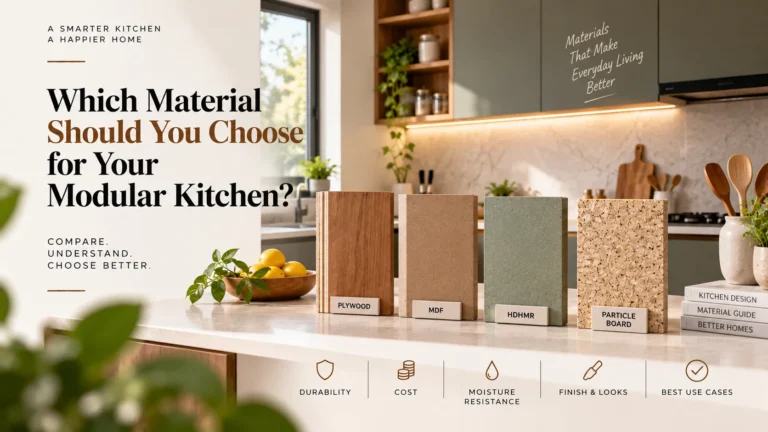
Which Material Should You Choose for Your Modular Kitchen?
Let us start with the kitchen because this is where material selection deserves particular attention.
Your kitchen furniture faces conditions that your bedroom wardrobe normally does not.
There is steam from cooking, occasional water splashing, cleaning chemicals, heavy utensils and frequent opening and closing of shutters.
So choosing the cheapest board for every kitchen component may create maintenance problems later.
Kitchen Base Cabinets
Base cabinets support the countertop and accommodate utensils, drawers and appliances.
They may also experience occasional spills.
For these applications, appropriately specified BWR or BWP plywood can be considered, depending on moisture exposure and the overall kitchen design.
HDHMR may also be suitable for selected cabinet applications when the manufacturer’s specifications support the intended use.
But material grade alone is not enough.
Check the cabinet construction, joining method, countertop support and protection around plumbing.
The Cabinet Below Your Kitchen Sink
This deserves special attention.
Picture this.
A small pipe connection beneath your sink starts leaking. You do not notice it immediately because the cabinet doors remain closed.
Water collects inside the cabinet over several days.
If the board is unsuitable for the exposure, its edges may swell, the finish may lift or the joints may deteriorate.
For this reason, BWP plywood is worth considering for under-sink cabinetry where accidental water exposure is a concern.
However, even marine-grade plywood does not make an entire cabinet waterproof.
The plumbing, cut edges, joints, sealant and overall detailing still matter.
Kitchen Shutters
Here, the decision becomes more flexible.
You can consider:
- Plywood shutters with laminate or suitable decorative finishes.
- HDHMR shutters where the design and manufacturer specifications support their use.
- Appropriately specified MDF for selected painted or decorative shutters away from significant moisture exposure.
The correct choice depends on the finish you want, the location of the shutter and its dimensions.
Plan Your Modular Kitchen Around the Right Material Options
Planning your modular kitchen and unsure which material combination suits your requirements? Discuss your kitchen layout, storage needs and material options with Parinee Interio before finalising the specifications.
- Review your kitchen layout and storage requirements
- Discuss suitable material options for different applications
- Consider moisture exposure, usage and maintenance needs
- Clarify material and hardware specifications before finalising the design
A focused material discussion can help you define kitchen specifications around your actual usage and requirements.
Plywood vs HDHMR for Wardrobes: What Actually Makes Sense?
Now let us move to the bedroom.
Suppose you are designing a large wardrobe with hanging space, shelves, drawers and loft storage.
Your designer suggests plywood for the main structure and HDHMR for the shutters.
Why use two materials instead of one?
Because the wardrobe structure and its shutters perform different functions.
Wardrobe Carcass
The carcass is the main body of your wardrobe.
It includes the side panels, top, bottom, partitions and shelves.
For a typical bedroom wardrobe, appropriately graded plywood can be a suitable choice.
HDHMR can also be considered when its technical specifications and the furniture design support the expected loads and fastening requirements.
For dry interiors, good-quality particle board may be suitable for properly designed wardrobe structures, particularly when manufactured as a modular system.
The important questions are how the shelves are supported, where the hinges are fixed and whether the wardrobe may encounter dampness.
Wardrobe Shutters
Wardrobe shutters have different requirements.
They must remain properly aligned, accommodate hinges and support the selected decorative finish.
If you want plain laminate shutters, plywood or a suitable engineered board may work.
If you prefer painted shutters with decorative grooves, MDF or HDHMR may offer finishing advantages.
And if you want tall shutters, the designer should also consider their dimensions, weight, hinge selection and suitability for the proposed design.
A material can be suitable for a wardrobe body without automatically being suitable for every shutter size.
What About Mumbai’s Humidity?
If your wardrobe shares a wall with a bathroom, or your bedroom has experienced dampness during the monsoon, mention this before material selection.
Do not simply upgrade every wardrobe to a more expensive board.
First, identify the source of dampness and resolve it wherever possible.
Then select materials and construction details that suit the actual conditions.
Can You Use MDF or Particle Board Without Compromising Quality?
This is where many homeowners become unnecessarily worried.
Someone tells them that MDF is poor quality or that particle board should never be used in a home.
But material suitability is not decided by reputation alone.
Let us say you want a decorative TV wall with routed panels and a painted finish.
MDF may be well suited to that application.
Similarly, prelaminated particle board can be considered for selected dry-area modular furniture.
The concern begins when a material is used outside its intended conditions.
For example:
Using standard MDF in a cabinet repeatedly exposed to water is different from using it for a decorative bedroom panel.
And using ordinary particle board for a long, heavily loaded shelf without adequate support is different from using it for a properly engineered wardrobe compartment.
The correct question is not whether MDF or particle board is good or bad. It is whether the selected grade is appropriate for the particular furniture component.
Material Thickness Matters Just as Much as Material Type
Here is something homeowners often overlook when comparing quotations.
Both designers may mention plywood, but are they quoting the same thickness?
You may commonly see specifications such as:
| Board Thickness |
Possible Applications |
|---|---|
| 6 mm | Selected backing panels and lightweight applications |
| 9 mm | Back panels and other appropriately supported components |
| 12 mm | Selected panels, partitions and furniture components |
| 18 mm | Commonly specified for cabinet bodies, partitions and shutters |
| 25 mm or thicker | Selected shelves, furniture components and applications requiring additional stiffness |
These are illustrative applications, not universal rules.
The final thickness must depend on the board type, dimensions, expected load and furniture construction.
For example, an 18 mm shelf spanning a short distance may perform differently from an 18 mm shelf extending across a large wardrobe compartment.
The longer shelf may require additional thickness, intermediate support or a different construction detail.
Similarly, an extremely thin backing board fixed loosely may contribute less to cabinet stability than a properly secured backing system.
Ask your designer to explain the thickness of each important component rather than providing one material description for the entire wardrobe.
The Finish Can Change How Your Furniture Performs
You may spend time selecting plywood, MDF or HDHMR and still face problems if the finishing is poorly executed.
Why?
Because the board is only one part of the finished furniture.
Laminate
Laminate is a decorative surface applied to the board.
It offers a wide range of colours, textures and finishes.
However, laminate does not automatically protect a cabinet from every type of water exposure.
Its edges, joints and cutouts must also be properly detailed.
Edge Banding
Edge banding covers exposed board edges.
It is particularly important for engineered boards, where unprotected edges may absorb moisture.
Poorly applied edge banding can loosen, allow moisture to enter or expose the board beneath.
Painted Finishes
MDF and suitable HDHMR products can be considered for routed designs and painted finishes.
But the final result depends on surface preparation, primer, paint system and workmanship.
A smooth raw board does not guarantee a good finished shutter.
Hardware
Do not forget the hinges, drawer channels and other fittings.
Even a well-selected board can develop problems if the furniture uses inappropriate fasteners or poorly installed hardware.
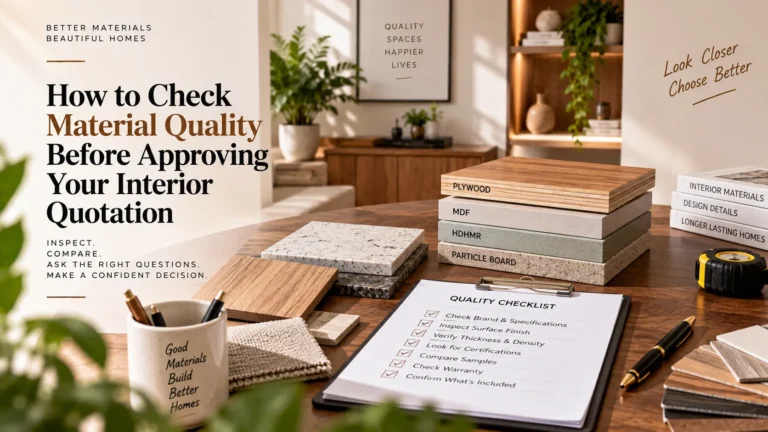
How to Check Material Quality Before Approving Your Interior Quotation
Now comes the practical part.
You do not need to become a furniture manufacturing expert.
But you should know which questions to ask before approving a large interior project.
Here is a checklist you can take to your designer.
| What to Check |
What You Should Ask |
|---|---|
| Material type | Is the furniture made from plywood, MDF, HDHMR or particle board? |
| Brand | Which manufacturer and product range are being proposed? |
| Grade | Is it MR, BWR, BWP or another specified board grade? |
| Thickness | What thickness will be used for carcasses, shutters, shelves and backing? |
| Finish | Will the furniture have laminate, veneer, paint or another finish? |
| Edges | How will exposed edges and cutouts be protected? |
| Hardware | Which hinges, channels and fittings are included? |
| Moisture exposure | Which material will be used near the kitchen sink and other vulnerable areas? |
| Warranty | What exactly does the manufacturer's warranty cover? |
| Documentation | Will these specifications appear in the final quotation or BOQ? |
A BOQ, or Bill of Quantities, is a document that describes the work, quantities and specifications included in your interior project.
It should make the proposed materials easier to understand.
For plywood, you can also ask for the applicable Indian Standard and verify relevant BIS licence details through the official BIS Care app where the product carries a certification mark.
For fibreboard and particle board products, ask for product-specific technical information. Indian standards include IS 12406:2025 for general-purpose MDF and IS 3087:2025 for general-purpose particle board, with different performance grades.
One more thing worth checking is the formaldehyde emission classification or available emission test documentation, particularly when selecting large quantities of engineered wood products for enclosed living spaces.
Review the Material Specifications in Your Interior Quotation
Not sure whether your interior quotation gives enough information about materials? Parinee Interio can help you discuss suitable material specifications before you commit to a design and budget.
- Review the material types proposed for your furniture
- Clarify board grades, thicknesses and finishes
- Discuss hardware and construction specifications
- Identify material details that should appear in the quotation
Clear material specifications can help you compare proposals and understand what is included before committing to the project.
A Practical Material Combination for Your Home
Let us say you are planning the interiors of a 2BHK.
You want durable furniture, attractive finishes and sensible spending.
Rather than selecting the same board everywhere, you could discuss a combination like this with your designer:
| Interior Component | Material Worth Considering |
|---|---|
| Kitchen base cabinets | Suitable BWR or BWP plywood, depending on exposure |
| Under-sink cabinet | BWP plywood with appropriate water-protection detailing |
| Kitchen shutters | Plywood or suitable HDHMR, depending on design |
| Bedroom wardrobe carcass | Appropriate plywood, HDHMR or engineered modular board |
| Decorative wardrobe shutters | Suitable MDF or HDHMR |
| TV wall panels | MDF, HDHMR or other suitable decorative substrates |
| Dry-area modular storage | Appropriate plywood or engineered board |
| Heavily loaded shelves | Material and thickness selected according to span and load |
This is an illustrative selection framework, not a fixed material specification for every home.
Your final choices should depend on the actual dimensions, usage, moisture conditions and available budget.
And that brings us to the most important point.
Spend on better material specifications where they solve a real functional problem, not simply because one material has been described as premium.
Frequently Asked Questions
01 Is plywood better than MDF for home interiors?
Plywood and MDF serve different purposes. Plywood is often suitable for furniture structures, while MDF can offer advantages for smooth painted finishes and decorative designs. The decision should depend on the required strength, moisture exposure, furniture dimensions and finish rather than treating either material as universally better.
02 Is HDHMR better than plywood for wardrobes?
HDHMR can be suitable for wardrobe shutters and structures when its specifications support the intended application. Plywood is also suitable for many wardrobe components. Compare the actual board grade, thickness, moisture resistance and fastening requirements before deciding which material to use.
03 Is HDHMR completely waterproof?
No. HDHMR is designed to provide improved moisture resistance, but it should not automatically be treated as waterproof. Its performance depends on the manufacturer's specifications and finishing. Continuous water leakage can still damage the board, joints or finished furniture.
04 Which plywood is suitable for a modular kitchen?
BWR or BWP plywood can be considered depending on the cabinet's location and expected moisture exposure. BWP plywood is particularly worth considering around sinks and vulnerable plumbing areas. Other appropriately specified engineered boards may also suit selected kitchen components.
05 Can I use MDF for kitchen shutters?
Yes, suitable MDF products can be considered for selected kitchen shutters, particularly where decorative machining or painted finishes are required. However, standard MDF should be protected from significant moisture exposure, and all edges and cutouts should be properly finished.
06 Is particle board suitable for bedroom wardrobes?
Good-quality particle board can be suitable for properly designed wardrobes in dry indoor conditions. Its performance depends on board grade, thickness, hardware and construction. If the wardrobe faces persistent dampness or demanding loads, other materials may deserve consideration.
07 What is the difference between BWR and BWP plywood?
BWR stands for Boiling Water Resistant, while BWP stands for Boiling Water Proof. BWP marine-grade plywood is intended for more demanding moisture conditions. However, neither specification eliminates the need for good installation, protected joints and proper water management.
08 Is 18 mm plywood sufficient for wardrobes?
18 mm plywood is commonly considered for wardrobe components, but it is not automatically sufficient for every application. Long shelves, tall shutters and heavily loaded compartments may require additional thickness, support or different construction details. Ask your designer to consider the actual furniture dimensions.
09 How can I know which material my interior designer is using?
Ask for the material brand, product name, grade and thickness in your quotation or BOQ. You can also request technical datasheets and inspect material markings where available. A clear material schedule makes it easier to compare quotations and verify what is being supplied.
10 Does expensive plywood always last longer?
Not necessarily. Durability depends on the plywood grade, manufacturing quality, exposure conditions and furniture construction. Spending more on marine-grade plywood for a dry decorative panel may not provide a meaningful benefit, while upgrading material near a sink may be justified.
11 Can I combine plywood and HDHMR in the same wardrobe?
Yes. Different components can use different materials when their properties suit the design. For example, a designer may specify plywood for the carcass and HDHMR for decorative shutters. The important consideration is whether both materials are appropriate for their intended applications.
12 What should I do if my designer recommends a material I have never heard of?
Ask for the full product name, manufacturer and technical specifications. Find out why that material is being recommended for the particular component. A useful explanation should connect the material's properties to your furniture design, expected usage, maintenance requirements and budget.
Final Thoughts: Choose Materials Based on Your Home, Not Just Their Names
By now, you have probably realised that choosing materials is not simply about deciding between plywood, MDF, HDHMR and particle board.
You need to understand where the material will be used, what it needs to support, how much moisture it may encounter and which finish you want.
A kitchen sink cabinet has different requirements from a bedroom wardrobe. A decorative wall panel does not need the same construction as a heavily loaded storage unit.
And there is nothing wrong with using different materials throughout your home when those choices are technically appropriate.
At Parinee Interio, the aim is to help you understand these practical decisions before they become expensive changes during execution.
Discuss the Right Materials for Your Home
Share your floor plan, furniture requirements and budget with Parinee Interio to discuss material combinations that suit your home, your lifestyle and your long-term maintenance expectations.
- Review your floor plan and furniture requirements
- Discuss material combinations for different applications
- Consider usage, moisture exposure and maintenance needs
- Relate material choices to your available budget
A focused material discussion can help you define suitable specifications before finalising your interior design and budget.