+ 91 8108850334
info@parineeinterio.in
+ 91 8108850334
info@parineeinterio.in


You have finally received an interior design quotation for your new home.
The overall amount looks manageable. You and your partner have discussed the budget, considered your home loan EMI and worked out how much you can comfortably spend before moving in.
Then the interior designer mentions something reassuring.
“We offer fixed-price interiors.”
Naturally, you feel relieved. At least you know how much your home interiors will cost.
But before you sign the agreement, there is an important question worth asking.
What exactly has been fixed at that price?
Does it include every wardrobe, kitchen cabinet, electrical modification and decorative element you discussed? What happens if you change a laminate later? What if your quotation mentions one material, but you had something different in mind?
Fixed-price interior design can make budgeting more predictable, but only when the agreed work, materials, exclusions and conditions are clearly documented.
Let us understand what you should check before committing your money.
What Does Fixed-Price Interior Design Actually Mean?
Fixed-price interior design means that the designer or interior execution company agrees to complete a defined scope of work for an agreed price, subject to the terms and conditions recorded in the contract.
The important words here are defined scope of work.
A fixed price does not automatically mean that every possible requirement, modification or future addition will be included.
Think of it this way.
Suppose your quotation covers a modular kitchen, three wardrobes, a TV unit and selected false ceiling work.
If you later decide to add a crockery cabinet, change the kitchen shutters or extend the false ceiling into another room, those requirements may fall outside the original agreement.
The quoted price can remain fixed for the work originally agreed upon, while additional work is charged separately through an approved variation.
That is not necessarily a problem. The concern arises when homeowners do not understand these conditions before work begins.
Fixed Price and Fixed Budget Are Not the Same
A fixed budget is the amount you have decided to spend.
A fixed price is the amount a company has agreed to charge for specified work.
You might have a total interior budget of ₹12 lakh, for example, but your designer’s fixed-price quotation may not include appliances, loose furniture, curtains or certain electrical modifications.
These are illustrative figures, not Parinee Interio project prices.
If those additional purchases must come from the same budget, you need to account for them separately.
The real purpose of fixed-cost home interiors is to make your financial commitments understandable before execution, not simply to provide an attractive headline amount.
1. A Clearly Defined Interior Scope Should Come Before the Fixed Price
Before comparing quotations, ask yourself something.
Do you know exactly what each company has agreed to deliver?
Many homeowners begin by comparing the total amount at the bottom of the quotation. But two quotations can show similar prices while covering very different quantities of work.
One may include full-height wardrobes. Another may include wardrobes only up to a specified height.
One may include kitchen accessories. Another may provide basic cabinets while charging separately for accessories.
Both companies may describe their proposals as fixed-price interiors.
What Should Your Interior Scope Include?
Your scope of work should identify the specific work planned for every room.
For example:
| Area | Details That Should Be Defined |
|---|---|
| Modular kitchen | Cabinet layout, dimensions, shutter material, countertop, hardware, accessories and included installation work |
| Bedrooms | Wardrobe dimensions, lofts, internal storage, dressing units and finishes |
| Living room | TV unit, storage, panelling, display cabinets and other agreed furniture |
| False ceiling | Rooms covered, approximate design extent, materials and lighting provisions |
| Electrical work | Included points, wiring modifications, switchboards and installation responsibilities |
| Painting | Surfaces covered, preparation, paint specifications and number of coats |
| Bathroom-related work | Vanity units, mirrors, storage and any agreed plumbing modifications |

Not every project requires all these items.
The purpose is to identify what your particular home needs and record what is included in the agreed price.
A detailed Bill of Quantities, commonly called a BOQ, can help establish this clarity. It typically describes work items, quantities, specifications, rates and amounts.
However, the level of detail varies between companies, so check whether your BOQ actually explains what you are buying.
Before accepting a fixed-price interior quotation, ask the designer to take you through the scope room by room.
This discussion often reveals differences between what you imagined and what has actually been quoted.
If you are finding it difficult to connect your requirements with the quotation, Parinee Interio can help you discuss a clearly defined interior scope and price before you make your commitment.
2. Material Specifications Must Be Recorded, Not Merely Discussed
Imagine visiting an interior design studio.
You see a beautiful kitchen display and tell the designer that you want something similar.
The designer prepares your quotation. You approve it.
A few weeks later, during material selection, you discover that the displayed kitchen and your quoted kitchen use different shutter finishes and hardware.
You may have assumed those materials were included. The designer may have quoted a different specification.
This is why material discussions should eventually become written specifications.
What Should Material Documentation Mention?
Depending on the work, your quotation or accompanying specification sheet should identify:
- Material category, such as plywood, MDF, HDHMR or another agreed board.
- Relevant grade and thickness.
- Laminate or other surface finish specifications.
- Hardware brands, product series or agreed performance specifications.
- Edge banding and finishing details.
- Kitchen countertop material and thickness.
- Applicable warranties and their conditions.
A general description such as “premium plywood” does not provide the same clarity as a specific, agreed material specification.
Similarly, “branded hardware” may not tell you which product range or mechanism is included.
You do not need to become a material expert overnight.
You simply need enough information to understand what is included and whether a later selection will affect the price.
What If a Material Becomes Unavailable?
Ask how substitutions will be handled.
Will the company propose an equivalent material? Will you approve the replacement? Will a difference in price require written agreement?
These questions matter because material availability can affect execution.
A fixed-price interior contract should make the approval process clear rather than leaving either party to make assumptions.
3. Design Approvals Should Establish What Is Being Manufactured
Here is a situation that can become expensive.
Your designer shares a wardrobe elevation. You approve the appearance, but the internal drawers and hanging sections are not finalised.
Manufacturing begins.
Later, you realise you need more drawers, an additional shelf and a different hanging arrangement.
Depending on the construction stage, these changes may require revised drawings, new materials or manufacturing adjustments.
The original quotation may not cover them.
Which Documents Should Be Approved?
Before execution begins, understand which drawings and specifications form part of your agreement.
These may include furniture layouts, modular kitchen drawings, wardrobe elevations, internal storage arrangements, electrical layouts, material selections and other relevant execution details.
Confirm whether approvals are required before manufacturing and how revisions will be handled after approval.
You should also understand whether the fixed price includes a defined number of design revisions or whether certain post-approval changes are chargeable.
A useful question is:
“Once I approve this drawing, which decisions will become difficult or expensive to change?”
The answer can help you spend additional time on important decisions before they affect your budget.
4. Inclusions and Exclusions Deserve Equal Attention
Homeowners usually ask what is included in a quotation.
Far fewer spend enough time understanding what is excluded.
But exclusions often determine whether your overall interior budget remains comfortable.
Consider a working couple preparing to move into a new flat.
Their interior quotation covers the kitchen, wardrobes and living room furniture. They assume lighting fixtures, curtains and appliances will also be taken care of.
Near handover, they realise these purchases require a separate budget.
Their fixed-price quotation has not necessarily changed. Their understanding of the complete cost of moving in was incomplete.
Common Items Worth Clarifying
| Item | Question to Ask |
|---|---|
| Appliances | Are the hob, chimney, oven and other appliances included? |
| Decorative lighting | Are fixtures included or only electrical provisions? |
| Loose furniture | Are the sofa, dining table and beds included? |
| Curtains and blinds | Are window furnishings part of the quotation? |
| Electrical changes | Which wiring and switchboard modifications are covered? |
| Plumbing | Are sink connections or other modifications included? |
| Site preparation | Are removal, dismantling and debris disposal covered? |
| Building requirements | Who bears applicable society permissions, deposits or related charges? |
| Transportation | Are delivery, handling and installation included? |
| Taxes | Is the quoted amount inclusive or exclusive of applicable taxes? |
Request a written exclusions section and discuss anything that appears unclear.
Do Not Forget Taxes
Ask whether the amount presented is inclusive or exclusive of applicable GST and other relevant charges.
The quotation and contract should make the tax treatment understandable and identify the amount payable under the agreed terms.
Avoid comparing one company’s tax-inclusive quotation with another company’s tax-exclusive figure as though they represent the same financial commitment.
If you are working within a strict home interior budget, the amount you actually need to pay matters more than the headline price.
5. Understand Provisional Allowances Before Treating the Price as Final
Sometimes, a designer cannot finalise the price of every item immediately.
Perhaps you have not selected your kitchen countertop, decorative lights or a particular accessory.
The quotation may therefore contain a provisional allowance.
A provisional allowance is an amount set aside for an item whose final selection or cost has not yet been established.
For example, your quotation might include an illustrative allowance of ₹40,000 for a countertop.
If your final selection costs more than that allowance, the difference may become payable under the agreed contract terms.
If it costs less, the treatment of the saving should also be clear.
The exact adjustment depends on what your contract says.
Questions to Ask About Provisional Items
Before signing, understand which items remain provisional, what allowance has been included and when final selection must happen.
Ask whether the allowance covers only the product or also transportation, installation, cutting, fitting and other associated work.
Most importantly, understand how any difference will be calculated and approved.
Understand Provisional Allowances Before Finalising Your Interior Budget
A quotation containing provisional allowances may still establish a fixed price for the confirmed scope, but the final payable amount can change when those allowances are reconciled. That distinction is especially important when you are managing interiors alongside home loan EMIs and other financial commitments.
- Identify which amounts are confirmed and which are provisional
- Clarify what may cause an allowance to increase or decrease
- Understand how reconciled amounts affect the final payable cost
- Review your interior budget alongside other financial commitments
Clear documentation of provisional amounts can make it easier to plan your interior spending before the project begins.
6. Understand How Changes Will Be Charged After Work Starts
Even with careful planning, homeowners sometimes change their minds.
You may decide that the original wardrobe arrangement does not work for your clothes.
Your partner may prefer a different kitchen finish.
Or you may discover that an additional storage unit would make everyday life easier.
Changes are part of many interior projects.
What matters is having an agreed process for handling them.
What Is a Change Order?
A change order is a written record of an approved modification to the original scope, specification or agreed work.
It should explain what is changing, the additional cost or credit, and any effect on the project timeline.
For example, suppose your original agreement includes laminate wardrobe shutters.
You later decide to use a different finish that costs more.
The designer should explain the revised cost before proceeding with the change.
You should then have the opportunity to approve or reject it.
What Should the Change Process Include?
A practical fixed-price interior contract should establish how variations are requested, priced, approved and recorded.
It should also explain how changes affect payment schedules or completion dates when relevant.
Ideally, additional work should not proceed merely because someone discussed it during a site visit or exchanged an informal message.
For financially cautious homeowners, written approvals help prevent disagreements about whether a modification was requested and what it was expected to cost.
Remember: a fixed price applies according to the agreed contract. It does not automatically include future scope changes.
7. Payment Milestones and Unexpected Site Conditions Also Matter
A predictable project price should be supported by an understandable payment schedule.
Before work starts, ask what payment is required at booking, design approval, manufacturing, installation and handover, as applicable to the company’s process.
You should know which deliverable or milestone triggers each payment.
Avoid assuming that every interior company follows the same schedule.
What About Unexpected Site Conditions?
Sometimes, work reveals conditions that were not visible during the initial assessment.
For example, dismantling an existing kitchen might expose damaged surfaces or concealed plumbing problems.
Whether the resulting corrective work is included in the fixed price depends on the contract, original scope and agreed treatment of unforeseen conditions.
Ask how such discoveries will be documented and whether separate approval is required before additional work proceeds.
This is particularly relevant for renovation projects.
For a new flat, clarify which builder-related defects, site readiness issues and modifications fall under whose responsibility.
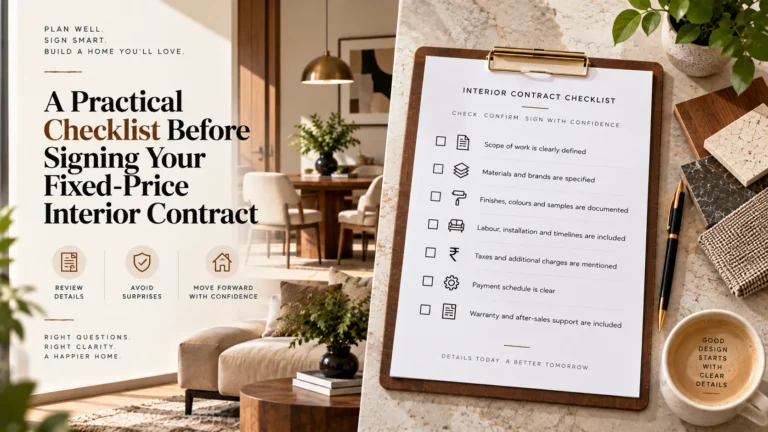
A Practical Checklist Before Signing Your Fixed-Price Interior Contract
By this stage, you should be able to answer these questions confidently:
| Before You Sign | What You Should Know |
|---|---|
| Scope | Exactly which rooms and work items are included |
| Quantities | What dimensions and quantities have been agreed |
| Materials | Which specifications and finishes form part of the price |
| Design | Which drawings and selections require approval |
| Exclusions | Which purchases and services require a separate budget |
| Taxes | Whether the quoted amount includes applicable taxes |
| Allowances | Which items have provisional values |
| Variations | How additional work and changes will be priced |
| Payments | When payments become due |
| Site conditions | How unexpected additional work will be handled |
| Completion | What determines completion and handover |
You do not need to approach this conversation as though you are trying to catch your designer making a mistake.
A good quotation discussion should help both parties establish the same understanding of the project.
At Parinee Interio, you can begin by discussing your requirements, financial expectations and the work you want included, so that the scope and price can be examined together before you commit.
Frequently Asked Questions
01 Does fixed-price interior design mean the final amount can never change?
No. The agreed price generally applies to the scope and conditions defined in the contract. Additional work, approved changes, provisional allowances or other contractually permitted adjustments may affect the final payable amount. Check the variation terms before signing.
02 Is a fixed-price interior package better than an itemised quotation?
They describe different things. A fixed-price package establishes a price for defined work, while an itemised quotation explains the components and their costs. A fixed-price proposal supported by sufficiently detailed itemisation can help you understand what you are purchasing.
03 Can I change my kitchen design after approving the quotation?
You can request changes, but the financial and timeline implications depend on what you change and when. A modification before manufacturing may have different consequences from one requested after cabinets are produced. Ask for a revised cost before approving additional work.
04 Should a fixed-price interior quotation include material brands?
Material specifications should be sufficiently clear to establish what has been agreed. Relevant brands, grades, thicknesses, finishes and product ranges can help. Where equivalent alternatives are permitted, the substitution and approval process should also be recorded.
05 What happens if my final material selection exceeds the quoted allowance?
The difference may become payable according to the contract. Ask how the adjustment will be calculated, whether installation is included and whether you must approve the additional amount before the item is ordered.
06 Are appliances included in fixed-cost home interiors?
Not automatically. Some quotations include selected appliances, while others cover only cabinets and installation provisions. Check the scope for each appliance and clarify whether purchasing, delivery, installation and associated connections are included.
07 Can an interior designer charge extra for electrical changes?
It depends on the agreed scope. Additional points, relocated switches or modifications beyond the original electrical layout may require separate pricing. Review the electrical plan before execution and confirm how later changes will be approved.
08 Should I ask for a fixed-price contract before finalising designs?
You can discuss budget expectations early, but the final contractual price should be supported by a sufficiently defined scope and specifications. Otherwise, important assumptions may remain unresolved and require clarification or adjustment later.
09 How should I compare two fixed-price interior quotations?
Compare the actual work, quantities, materials, exclusions, allowances, taxes, payment terms and change procedures. Similar total prices do not necessarily represent similar deliverables. Ask both companies to clarify differences before making your decision.
10 Is fixed-price interior design suitable for homeowners paying home loan EMIs?
It can help with financial planning when the scope, payment schedule and permitted adjustments are clearly documented. However, you should still account for excluded purchases and possible additional requirements rather than assuming the quoted amount represents every expense associated with moving in.
Final Conclusion: Financial Clarity Begins With a Defined Scope
When you are investing your savings in home interiors while managing EMIs, family responsibilities and moving expenses, knowing what you have committed to financially can make a meaningful difference.
But that clarity does not come from the words “fixed price” alone.
It comes from understanding your scope of work, material specifications, design approvals, exclusions, taxes, allowances and change procedures before execution begins.
You should know what you are paying for, what remains undecided and which future choices could affect your budget.
That is the foundation of a clearly defined interior scope and price.
Discuss a Clearly Defined Interior Scope and Price With Parinee Interio
If you are evaluating interior quotations for your home, share your requirements and the financial commitment you are comfortable making. A focused discussion can help you understand what should be included, what needs clarification and which decisions should be finalised before work starts.
- Review your room-wise furniture and interior requirements
- Clarify what should be included in the proposed scope
- Identify specifications, exclusions and decisions that need confirmation
- Discuss the proposed scope in relation to your comfortable budget
A clearly defined scope can make the proposed price easier to understand before you commit to the project.