+ 91 8108850334
info@parineeinterio.in
+ 91 8108850334
info@parineeinterio.in

You have finally decided to get your home interiors done professionally.
Perhaps you have already spoken to two or three interior designers.
One showed you beautiful 3D designs.
Another promised to complete your home within 60 days.
A third gave you a quotation that was surprisingly lower than the others.
Now you are sitting with your family, trying to decide whom to hire.
And somewhere in your mind, there is an uncomfortable question.
What if we choose the wrong designer?
After all, you are not buying a sofa that you can replace later.
You are trusting someone with a substantial amount of money, your family’s daily comfort and possibly your entire savings allocated for interiors.
That is why understanding how to choose an interior designer is about much more than comparing photographs and quotations.
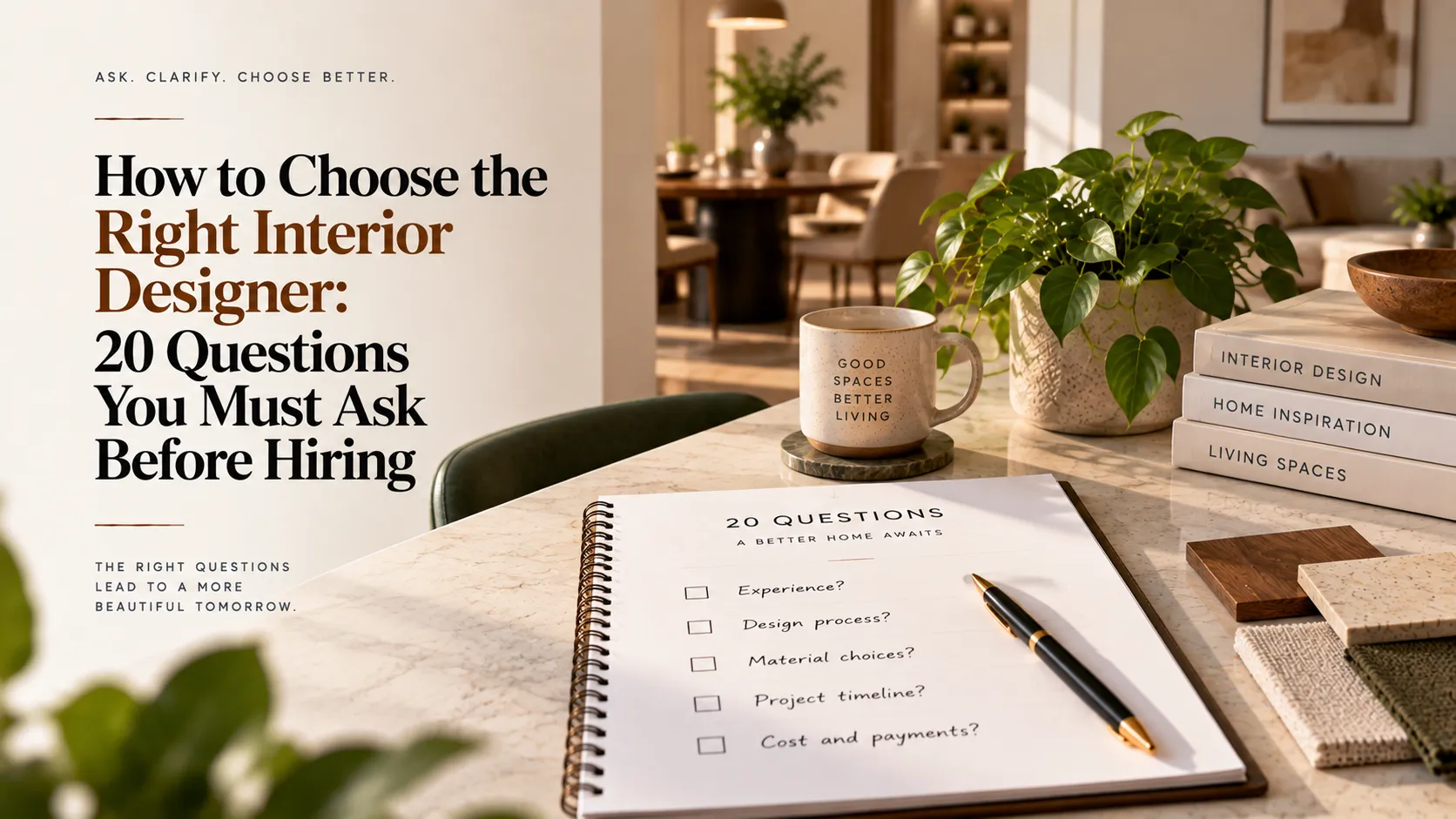
Before you pay an advance or sign an agreement, ask these 20 questions.
The answers will help you understand what you are actually committing to.
First, Understand What You Are Really Hiring an Interior Designer For
Many homeowners begin their search by looking at portfolios.
That makes sense. You want to know whether someone can create a home that matches your taste.
But beautiful designs are only one part of a successful interior project.
You also need someone who can translate your requirements into practical layouts, recommend suitable materials, prepare clear quotations, coordinate different teams and take responsibility for execution.
For example, imagine that your designer creates a beautiful wardrobe with sliding shutters.
The design looks excellent.
But after installation, you discover that the internal drawers cannot open properly because the sliding shutters obstruct them.
This is not a problem of appearance. It is a problem of practical planning.
The right questions help you understand whether a designer considers these details before work begins.
Let us go through them in the order you would naturally discuss them during a consultation.
Part 1: Questions About Experience and Previous Work
1. How Much Experience Do You Have, and Who Will Actually Work on My Project?
Ask about the company’s experience, but also ask who will be assigned to your home.
An experienced company may have several designers and execution teams. You should understand who will handle your project and what their responsibilities will be.
What to request: Details of your proposed design and execution team, including their relevant experience.
2. Can You Show Me Completed Projects Similar to My Home?
A portfolio containing beautiful luxury homes does not automatically tell you how the company handles a compact 2BHK.
If you have purchased a flat with limited storage space, ask to see completed projects with similar requirements.
Look beyond the colours and finishes. Notice how the available space has been used.
What to request: Photographs of completed homes, along with information about their approximate size and project scope.
3. Can I Speak to a Previous Client or Visit a Completed Project?
This is one of the most useful questions to ask interior designers.
A previous homeowner may be able to explain how the company handled communication, changes, timelines and problems during execution.
A completed-site visit, where the homeowner agrees, can also help you examine finishing quality more closely.
What to request: Available client references or a completed-site visit arranged with the homeowner’s permission.
4. Which Work Is Handled by Your Own Team and Which Work Is Outsourced?
Interior projects involve carpenters, electricians, painters, fabricators and several other specialists.
Outsourcing is not necessarily a concern. What matters is who coordinates these teams and takes responsibility when something goes wrong.
You should not have to resolve disagreements between different contractors yourself.
What to request: A clear explanation of execution responsibilities and how subcontracted work is supervised.
Before You Choose an Interior Designer
Book a consultation with Parinee Interio and ask the same questions you are using to compare designers.
Part 2: Questions About the Design Process
Once you understand the company’s experience, the next step is discovering how your own home will be planned.
5. How Will You Understand My Family’s Requirements Before Designing?
A good consultation should involve more than asking whether you prefer modern or traditional interiors.
The designer needs to understand your family size, storage requirements, cooking habits, work-from-home needs and plans for the coming years.
A home for newlyweds may require a different layout from a home shared with elderly parents.
What to request: An explanation of the requirement-gathering and site-measurement process.
6. What Drawings and Designs Will I Receive Before Execution Begins?
3D images help you visualise the finished home, but they do not explain every construction detail.
Ask whether you will receive furniture layouts, electrical drawings, kitchen details, wardrobe internals and other relevant working drawings.
These documents help translate an approved design into something the execution team can build.
What to request: A list of design deliverables and drawings included in the service.
7. How Many Design Revisions Are Included in Your Fees?
You may love your first design presentation but later realise that the wardrobe needs more hanging space or the living room requires additional seating.
Find out how many revision rounds are included and when additional charges apply.
Otherwise, ordinary design discussions can become unexpected expenses.
What to request: Written revision terms covering limits, approval stages and additional fees.
8. What Happens If I Change My Mind After Approving the Design?
Imagine approving your modular kitchen and then deciding that you want a different countertop or cabinet configuration.
If manufacturing has already started, the change could affect both cost and completion time.
Ask how modifications are documented and approved before additional work begins.
What to request: A written change-request procedure explaining revised costs and timelines.
Part 3: Questions About Quotations and Material Specifications
Now comes the part that many homeowners find uncomfortable.
You want a beautiful home, but you also need to know whether the proposed expenditure is justified.
These questions are particularly important when comparing different quotations.
9. Will You Give Me a Detailed, Itemised Quotation?
Suppose one designer quotes ₹12 lakh and another quotes ₹15 lakh.
Which quotation should you choose?
You cannot answer that question from the total amounts alone.
One may include wardrobes, kitchen hardware, painting and electrical modifications. Another may exclude several of these items.
Ask for an itemised Bill of Quantities, commonly called a BOQ.
What to request: A room-wise BOQ showing item descriptions, measurements, quantities, unit rates and totals.
10. What Exactly Is Included and Excluded From My Quotation?
Ask directly about appliances, decorative lighting, loose furniture, civil modifications, painting, transportation, debris removal and applicable taxes.
The relevant exclusions will depend on your particular project.
An attractive quotation can become difficult to manage when essential items are discovered later.
What to request: A written inclusion and exclusion list, including any provisional allowances.
11. Under What Circumstances Can the Final Price Change?
A quotation may change because of revised designs, additional work, unforeseen site conditions or material substitutions.
Ask how these situations are handled.
Most importantly, understand whether additional expenditure requires your written approval before the work proceeds.
What to request: Price-variation terms and the process for approving additional charges.
12. Can You Suggest Alternatives if My Budget Is Lower Than the Proposed Estimate?
A designer should be able to explain practical trade-offs.
For example, you might retain better-quality kitchen hardware while simplifying decorative wall treatments.
The objective is not to reduce every specification indiscriminately. It is to understand which changes affect durability, functionality and appearance.
What to request: Alternative specifications with corresponding revised estimates.
13. Which Materials, Brands and Hardware Are Included?
This question deserves particular attention.
A quotation stating only “plywood wardrobe with laminate finish” leaves several important details unanswered.
Ask about plywood grade and thickness, laminate specifications, edge finishing, hinges, drawer channels and other relevant fittings.
The same applies to kitchen carcasses, countertops and shutters.
What to request: A material specification sheet, relevant samples and written hardware details.
Compare Interior Quotations Clearly
When two quotations look similar, compare the specifications and scope before making a commitment.
Part 4: Questions About Execution and Project Management
Once you are satisfied with the design and budget, you need to understand what happens after work begins.
This is where coordination becomes particularly important.
14. Who Will Be My Dedicated Project Manager?
You should know whom to contact when you have a question about site progress, material delivery or an installation issue.
Ask how frequently updates will be shared and how unresolved concerns are escalated.
Clear communication reduces the need for homeowners to repeatedly follow up with different workers.
What to request: The proposed project contact, communication process and escalation arrangement.
15. What Is the Realistic Timeline for Completing My Home?
Be cautious about accepting a completion date without understanding the work behind it.
A realistic schedule should account for design approvals, material procurement, manufacturing, installation and finishing.
In Mumbai housing societies, permitted working hours and material movement restrictions may also affect progress.
What to request: A milestone-based project schedule showing important dependencies and how delays will be addressed.
16. How Will You Check the Quality of Work During Execution?
Ask how the designer checks dimensions, installation quality, alignment, finishes and functional details.
For instance, wardrobe shutters should not merely look aligned. They should open smoothly without obstructing adjacent furniture.
Also ask how defects identified during the final inspection will be resolved.
What to request: An explanation of quality-check stages and the final snag-list and handover procedure.
17. Who Will Handle Housing Society Requirements and Site Coordination?
Depending on your building and scope of work, interior execution may involve society permissions, contractor entry procedures, lift protection and restrictions on noisy work.
Clarify which responsibilities belong to the designer and which require your involvement.
This is especially relevant when renovating an occupied building.
What to request: A responsibility list covering society coordination, site access and property protection.
Plan Your Interior Project With Less Daily Oversight
During your consultation, ask how site coordination, project updates and execution responsibilities will be handled for your home.
Part 5: Questions About Payments, Contracts and Warranties
You may now feel comfortable with the designer’s experience and proposed work.
Before transferring money, however, make sure the commercial terms are equally clear.
18. What Is the Payment Schedule, and What Triggers Each Payment?
Ask whether payments are linked to specific milestones, manufacturing stages or agreed dates.
You should understand what work or deliverable corresponds to each payment.
Also clarify invoicing, applicable taxes and any amount payable at final handover.
What to request: A written payment schedule explaining amounts, due dates and milestone conditions.
19. What Happens if the Project Scope, Timeline or Agreement Changes?
A proper agreement should clarify the approved scope, responsibilities, payment terms, changes, delays and cancellation conditions.
Ask how disagreements will be handled and what happens if either party needs to discontinue the engagement.
Take time to read the agreement before signing.
What to request: The proposed contract and its provisions for changes, delays, cancellation and dispute resolution.
20. What Warranty and After-Sales Support Will I Receive?
Do not stop at asking whether a warranty is available.
Ask what it covers.
Cabinet workmanship, hardware, accessories and appliances may have different warranty conditions and responsible parties.
Find out whom you should contact after handover and how a complaint would be processed.
What to request: Written warranty terms covering duration, inclusions, exclusions and claim procedures.
Your Interior Designer Selection Checklist
Take your 20 consultation questions with you and record the answers from each designer.
- 20 Questions to guide your consultations
- Documents to Request before making a decision
- Notes Space to record missing information
Frequently Asked Questions
1. How many interior designers should I consult before hiring?
Speaking to two or three designers can provide useful perspectives on layouts, materials, pricing and execution. Focus on whether each proposal addresses your requirements with sufficient clarity.
2. Should I choose an interior designer based on Instagram photographs?
Instagram can help you understand design styles, but photographs alone cannot establish material quality or execution processes. Ask for completed projects and supporting documentation.
3. Is the interior designer with the lowest quotation necessarily a risky choice?
Not necessarily. A lower quotation may reflect a different scope, materials or services. Compare the BOQ, specifications, exclusions and responsibilities before drawing conclusions.
4. Should I hire an interior designer before getting possession of my flat?
An early consultation can help with layouts, storage requirements and preliminary budgets. Final measurements and technical decisions may require site verification after possession or site access.
5. What should I carry to my first interior design consultation?
Carry your floor plan, approximate budget, possession timeline and design references. Also prepare your family's requirements for storage, appliances, furniture and other layout considerations.
6. Is a 3D design enough to begin interior execution?
A 3D design helps visualise the intended appearance, but execution may require working drawings, measurements, material specifications and approved furniture details.
7. What if my partner and I have different interior design preferences?
Discuss the differences before finalising the design. Separate aesthetic preferences from functional requirements and explore alternatives that address the shared priorities.
8. Can I negotiate an interior designer's quotation?
You can discuss your budget and request alternative specifications or a revised scope. Ask what changes in materials, design or services when the price changes.
9. Should I pay an advance before receiving the complete quotation?
Before paying an advance, understand what the payment covers and which documents or services you will receive. Clarify any separate design fee and how it relates to the execution quotation.
10. What should I do if the designer promises everything verbally?
Ask for important commitments to be documented, including materials, scope, payment conditions, timelines, revisions and warranties. Written confirmation keeps expectations clear during execution.
Book a Consultation With Parinee Interio
Bring your floor plan, budget expectations and designer-selection checklist.