+ 91 8108850334
info@parineeinterio.in
+ 91 8108850334
info@parineeinterio.in

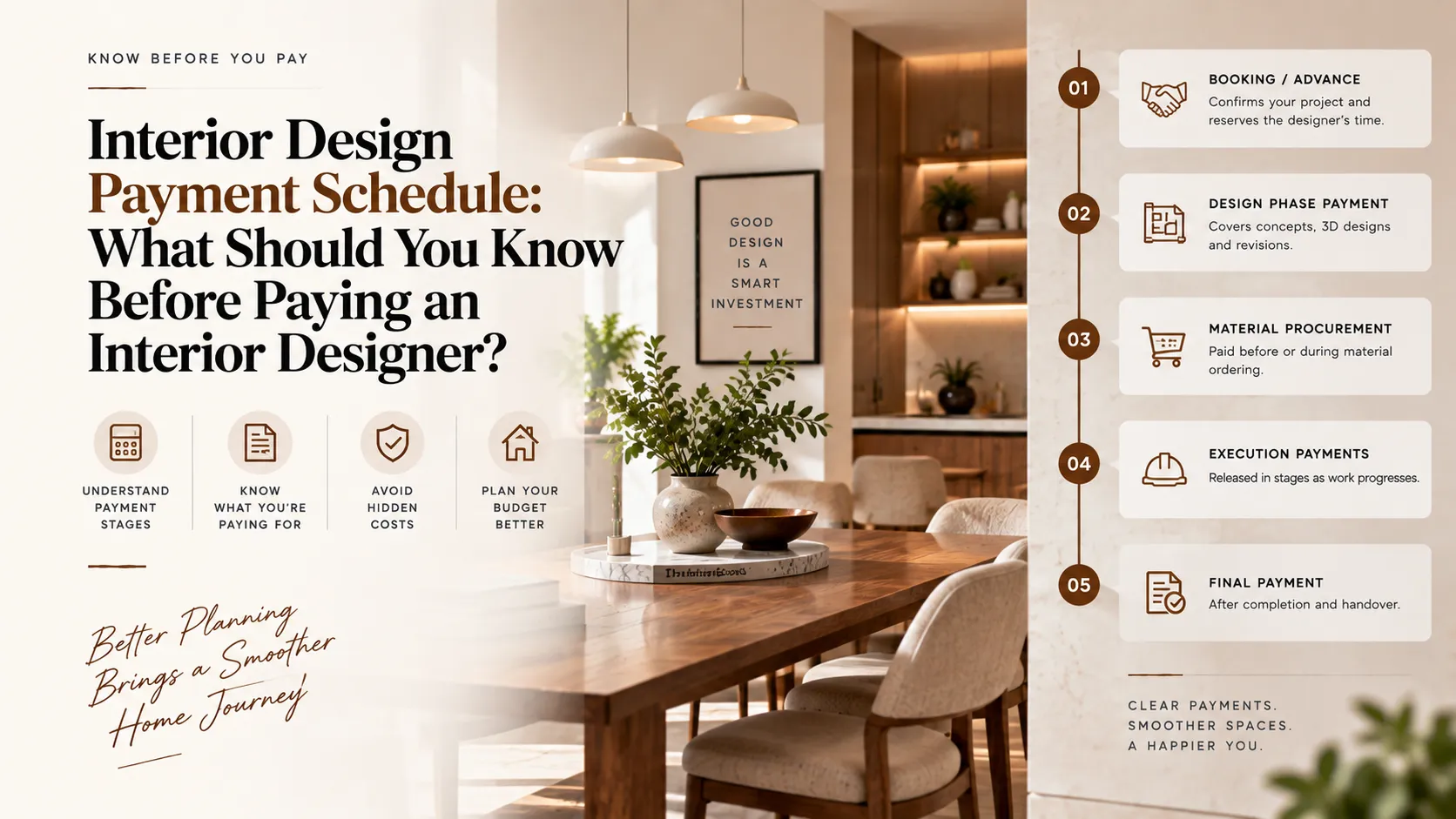
You have shortlisted an interior designer. The quotation looks reasonable, your family likes the proposed designs, and you are almost ready to begin.
Then comes the conversation about payment.
The designer asks for a booking amount to confirm your project. You understand that work cannot begin without some financial commitment. But transferring a substantial amount before anything has been manufactured or installed feels uncomfortable.
What if the project gets delayed? What if you change your mind about certain designs? What happens if you have already paid most of the amount and some work remains unfinished?
These are reasonable questions, especially when you are planning your first home and managing several expenses simultaneously.
An interior design payment schedule should help you understand when money becomes payable, what work that payment covers and what you should receive before releasing the next amount.
Let us understand how this works before you make your first payment.
Why Understanding the Payment Schedule Matters Before Booking
Imagine you have approved an interior quotation for your new 2BHK.
The quotation mentions the total project cost and lists the proposed payment instalments. However, it does not clearly explain what will be completed before each instalment becomes payable.
You might assume that the next payment will be requested after a certain amount of work is finished.
Your designer might expect that payment before placing manufacturing orders.
Neither expectation has been discussed properly.
This is where misunderstandings begin.
Interior projects involve several activities before you see anything installed inside your home. Designers prepare drawings, teams take measurements, materials are ordered, and furniture may be manufactured away from the site.
The payment schedule must account for these activities.
A clear schedule should answer three questions:
- What event makes the next payment due?
- What work or commitment does that payment cover?
- What documents or evidence will confirm that the milestone has been reached?
The objective is not to avoid paying an advance. It is to understand how your money moves through the project.
What Are the Common Interior Contractor Payment Stages?
There is no single payment percentage structure that suits every interior project.
A designer offering consultancy may follow a different payment process from a turnkey contractor managing design, materials, manufacturing and installation.
A project involving extensive custom furniture may also require different funding arrangements from a smaller renovation.
However, most interior contractor payment stages are connected to the following activities.
| Project Stage | What the Payment May Cover | What You Should Clarify |
|---|---|---|
| Booking | Project confirmation and initial planning | Whether the amount is adjustable or refundable |
| Design approval | Drawings, specifications and design finalisation | Which deliverables must be approved |
| Manufacturing | Material procurement and furniture production | What has been ordered or released for production |
| Installation | Delivery, assembly and site execution | Which installation milestone triggers payment |
| Handover | Final inspection and project closure | How pending work and defects will be addressed |
Let us look at each stage more closely.

1. Booking Payment: What Exactly Are You Paying For?
The booking amount is often the first financial commitment you make.
It may reserve the designer’s availability, initiate detailed measurements or allow the design team to begin preparing your project.
However, the words booking amount do not automatically explain what you are purchasing.
Ask whether the amount will be adjusted against the final project value.
Also understand what happens if the project does not proceed.
For example, suppose you pay a booking amount and later discover that your budget cannot accommodate the proposed scope.
Will the designer refund the amount? Deduct the value of design work already completed? Offer a credit towards a revised project?
These arrangements depend on the agreed terms.
Clarify Your Interior Advance Payment Before Transferring It
Before transferring an advance payment for interior design, ask for written confirmation of what the payment includes, when it becomes non-refundable if applicable, and how it will be adjusted.
- Confirm what services, work or project stage the payment covers
- Clarify the terms related to refundability and cancellation
- Understand how the advance will be adjusted against future payments
- Check the payment milestone and related project deliverables
Written payment terms can make the financial arrangement clearer before you transfer an advance for your interior project.
If you are still unsure about the proposed scope or payment conditions, Parinee Interio can help you understand the project requirements and payment process before you make a booking commitment.
2. Design Approval Payment: Know What You Are Approving
Once the project begins, your designer may prepare layouts, furniture drawings, material selections and other technical details.
A payment may become due when a defined design milestone is completed.
The important question is what counts as design approval.
For example, approving a 3D image of your kitchen is not necessarily the same as approving its manufacturing details.
You may still need to confirm the cabinet dimensions, internal storage, shutter materials, hardware and appliance provisions.
If these decisions remain open, the design may not be ready for manufacturing.
Ask your designer which documents will be shared at each approval stage.
Also clarify how many design revisions are included and whether changes requested after approval will involve additional charges.
A properly defined design milestone reduces the possibility of paying for work you believed was still under discussion.
3. Manufacturing Payment: Why Money May Be Required Before Installation
This is one stage that first-time homeowners often find difficult to understand.
You may be asked to release a substantial payment even though your flat looks almost exactly as it did when the project started.
Why?
Because custom furniture may be manufactured at a workshop or factory before being transported to your home.
For example, your modular kitchen cabinets might be cut, finished and assembled outside your flat.
The contractor may need to purchase plywood, laminates, hardware and other materials before manufacturing begins.
This can justify a manufacturing-linked payment, depending on the service arrangement.
However, the milestone should be clearly defined.
Before releasing the amount, understand whether manufacturing has merely been scheduled, whether materials have been ordered or whether production has actually started.
Also confirm which approved designs are being released for manufacturing.
For custom furniture, changes after production begins can become expensive because materials may already have been cut to size.
A manufacturing payment should therefore connect to an identifiable project activity rather than an unclear request for funds.
4. Installation Payment: Understand What Completion Means
Once manufactured furniture reaches your home, installation begins.
Cabinets are positioned, shutters are fitted, hardware is installed and finishing work progresses.
Your contractor may have an installation-linked payment milestone.
However, there can be a significant difference between materials reaching the site and installation being completed.
Suppose your bedroom wardrobes arrive at your flat.
The main structures are assembled, but the shutters, handles and internal accessories remain pending.
Has the agreed installation milestone been achieved?
The answer should come from the payment terms rather than an argument after the payment request arrives.
For larger projects, installation may be divided into clearly defined stages.
You should know whether payments are linked to delivery, assembly, room-wise completion or another agreed event.
5. Handover Payment: Do Not Confuse Installation With Project Closure
Your home may look almost complete, but small pending items can still affect daily use.
A drawer might need adjustment. A wardrobe shutter may not close properly. A cabinet handle could be missing.
The final payment stage should account for the process of checking and closing such items.
Before releasing the agreed handover payment, arrange a joint inspection with your designer or project representative.
Prepare a written list of unfinished or defective work, often called a snag list.
Confirm how these items will be completed and whether any payment holdback has been agreed in the contract.
Also understand when warranty or service commitments begin.
A clear handover process protects both parties: you know what remains to be completed, and the contractor knows what must be resolved before the project is formally closed.
How Much Advance Should You Pay an Interior Designer?
You may be expecting a specific percentage here.
However, a universal recommendation would be misleading.
The appropriate advance depends on what the contractor is committing to deliver, the project scope and the commercial arrangement.
A design-only consultant may charge an upfront design fee.
A turnkey interior company may collect an amount towards planning and later request funds for materials and manufacturing.
A renovation contractor may have different requirements because demolition, electrical modifications and other site activities begin earlier.
Instead of comparing the advance percentage alone, compare what you receive against that payment.
For example, two quotations may require similar booking amounts but include different deliverables.
One might cover detailed drawings and design development. Another might simply confirm the project, with design work billed separately.
The amounts look similar, but the commitments are different.
That is why your payment decision should follow the scope of work, not just the percentage mentioned in the quotation.
What Evidence Should You Receive Before Releasing a Milestone Payment?
You do not need to monitor every purchase or manufacturing activity yourself.
However, you should be able to understand why the next payment has become due.
Depending on the milestone, reasonable supporting documents may include approved design drawings, material specifications, purchase confirmations, manufacturing updates, delivery records or installation progress photographs.
For site-related milestones, you may prefer an inspection.
Ask your designer how progress will be communicated.
Will you receive scheduled updates? Can you inspect completed work? Who confirms that a milestone has been achieved?
The agreement should make these expectations clear.
If the next payment depends on manufacturing, for example, a general message saying that work is progressing may not provide enough information.
A better update would identify which furniture items have entered production and whether any decisions are still pending.
The purpose is not to make the relationship unnecessarily complicated.
It is to ensure that both parties recognise the same milestone.
Why Payment Receipts and Documentation Are Essential
Picture this.
You transfer your booking amount and send a screenshot through WhatsApp.
Your designer acknowledges the payment, and the project begins.
Several months later, you are reviewing your total expenses and cannot remember whether that amount was adjusted against the project value.
A payment screenshot confirms a transfer, but it does not explain every commercial condition attached to the amount.
Maintain a proper payment record throughout the project.
Each payment should be traceable to the correct contractor, quotation and milestone.
Your documentation should include:
- The recipient’s business name and payment details.
- The amount and payment date.
- The relevant invoice, receipt or receipt voucher.
- The project and milestone against which payment was made.
- Applicable taxes and the cumulative payment position.
- Any balance remaining under the agreed contract.
Under India’s GST framework, registered suppliers receiving advances are required to issue a receipt voucher or other prescribed document evidencing receipt. Tax invoices have their own applicable requirements. Ask your contractor which documents will be issued at each stage.
Prefer transferring money to the officially confirmed business account and retaining the transaction reference.
A simple project payment tracker can prevent considerable confusion later.
What Happens If You Change the Scope After Paying?
Now imagine that your kitchen design has been approved and manufacturing is about to begin.
You decide to replace a standard cabinet with a tall pantry unit.
The change may affect material quantities, hardware, manufacturing costs and installation requirements.
It may also affect your payment schedule.
This is why scope changes should be documented before additional work begins.
Ask for a revised quotation or written variation showing the additional or reduced cost, timeline implications and revised payment requirements.
You should also understand how previously paid amounts will be treated if an item is removed.
For example, removing a wardrobe before materials are ordered may have different financial consequences from cancelling it after manufacturing has started.
Do not assume that every change is free before installation. Equally, do not assume that every requested change automatically justifies an unspecified additional charge.
The relevant stage of work and agreed contractual terms matter.
If you are considering changes to an already approved project, discuss the revised scope and financial implications with Parinee Interio before allowing the work to proceed.
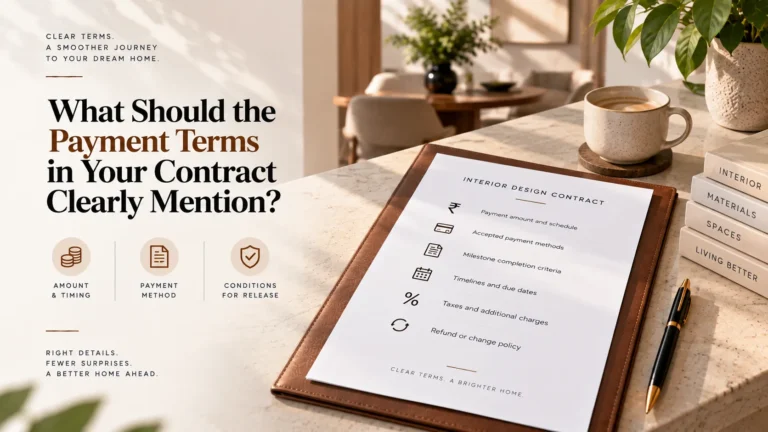
What Should the Payment Terms in Your Contract Clearly Mention?
A quotation tells you what the project may cost.
Your agreement should also explain how the financial and execution responsibilities will work.
Before booking, look for clarity on the total agreed project value, included work, material specifications, payment milestones and completion expectations.
Pay particular attention to these contractual questions:
What happens if the project is delayed?
Understand how delays will be communicated and whether the agreement addresses payment dates, revised milestones and responsibility for delays.
What happens if you postpone or cancel the project?
The contract should explain the applicable cancellation process, completed work, committed purchases and treatment of advances.
What happens if a payment is delayed?
Check whether work may be paused, whether additional charges apply and how the project will restart.
What happens if the quotation changes?
Identify who can approve variations and whether verbal discussions are sufficient or written approval is required.
What happens if the project remains incomplete?
Understand the procedure for documenting pending work, raising concerns and resolving disagreements.
A statement such as “advance is non-refundable” should not be left unexplained. Ask what the amount covers and how the condition operates at different stages.
Do not rely on assumptions that are absent from the written agreement.
Questions to Ask Before Transferring Money to Your Interior Designer
Before making the booking payment, have one final discussion about the financial process.
You can keep this checklist open during your meeting.
| Question | Why It Matters |
|---|---|
| What does the booking amount cover? | Clarifies your initial commitment. |
| Is the advance adjusted against the project cost? | Helps you understand the total payable amount. |
| What triggers every subsequent payment? | Prevents milestone disagreements. |
| What documents will I approve before manufacturing? | Reduces costly design changes. |
| How will manufacturing progress be confirmed? | Gives visibility into off-site work. |
| Are GST and other applicable charges included? | Clarifies the complete financial commitment. |
| What happens if I reduce the scope? | Explains adjustments to the project value. |
| How are additional charges approved? | Prevents unexpected payment requests. |
| What happens if the project is delayed? | Establishes expectations during execution. |
| What must be completed before handover payment? | Clarifies project closure. |
| Who will issue receipts and payment statements? | Keeps your financial records organised. |
| What are the cancellation and refund terms? | Explains your position if plans change. |
You do not need to negotiate every detail aggressively.
You simply need to make sure that the amount, timing and corresponding responsibilities are understood by everyone involved.
Frequently Asked Questions
01 Is it normal for an interior designer to ask for an advance payment?
Yes. An advance may cover booking, design work or other initial project commitments. However, the amount and purpose should be documented. Before paying, understand what services begin immediately, whether the advance is adjusted against the project value and what happens if you cancel.
02 Should I pay the full interior design amount before work starts?
Paying the entire project value before execution can reduce your financial flexibility. Understand why the contractor requires that arrangement and what protections the agreement provides. A milestone-linked structure is worth discussing, although the appropriate arrangement depends on the specific project and service model.
03 Can I negotiate the interior design payment schedule?
You can discuss the proposed schedule before signing. Explain your concerns and ask whether payments can be linked to clearer deliverables or milestones. The contractor may also need funds for materials and manufacturing, so aim for terms that account for both parties' commitments.
04 What if my designer asks for the next payment before completing the previous stage?
Review the agreed milestone wording. If payment is due after a defined deliverable, ask for confirmation that it has been achieved. If the designer needs early funding for a specific reason, discuss and document any mutually agreed change to the payment schedule.
05 Is a booking amount always refundable?
No universal refund rule applies to every booking arrangement. The answer depends on the agreed terms, the work completed, expenses committed and applicable law. Ask for the cancellation and refund conditions in writing before transferring money, particularly if design work will begin immediately.
06 Should I pay the manufacturing amount before seeing my furniture?
Furniture may be manufactured away from your home, so payment can become due before delivery. Ask what manufacturing milestone triggers payment and how it will be verified. Also ensure the relevant drawings, dimensions and materials have been approved before production begins.
07 Can an interior contractor increase the payment amount after booking?
A project change may affect the agreed cost, but additional charges should have a documented basis. Ask for the reason, revised scope and amount before approving extra work. Check your agreement for how variations, material substitutions and unforeseen site conditions are handled.
08 What if I want to remove an item after paying an advance?
Tell your designer as early as possible. Ask whether materials have been ordered or work has started for that item. Request a written cost adjustment showing any applicable deductions, completed work or committed expenses before agreeing to the revised project scope.
09 Should I keep some payment pending until the interior work is completed?
You can discuss a handover-linked payment or agreed holdback before signing the contract. The amount and release conditions should be clearly documented. Do not assume that you can unilaterally withhold an amount if the agreed payment milestone has already been achieved.
10 What if I pay the advance and the designer stops responding?
First, contact the business through its official channels and document your attempts. Review the agreement and request a written project update or resolution. If the issue remains unresolved, you can explore the National Consumer Helpline and appropriate legal advice based on your circumstances.
Final Conclusion: Understand the Project Scope and Payment Process Before Booking
Paying an advance should feel like the beginning of a properly planned project, not a financial decision you are making without enough information.
Before transferring money, make sure you understand the project scope, booking conditions, design approvals, manufacturing commitments, installation milestones and handover requirements.
Remember that the lowest advance is not automatically the safest arrangement, just as a higher advance does not automatically mean something is wrong.
What matters is whether the payment schedule is clearly documented and connected to identifiable responsibilities.
You should know what you are paying for, what happens next and what your options are if circumstances change.
Understand Your Booking Amount and Payment Terms Before You Begin
Planning to begin your home interiors but unsure about the booking amount or payment terms? Speak with Parinee Interio to understand your project scope, proposed execution process and payment milestones before making a financial commitment.
- Clarify what the booking amount covers
- Understand the proposed payment milestones
- Review the project scope before making a financial commitment
- Discuss the execution process and what happens at each stage
A clear discussion before booking can help you understand the payment process and project responsibilities from the beginning.