 + 91 8108850334
info@parineeinterio.in
+ 91 8108850334
info@parineeinterio.in


Most 1 BHK homeowners start with one belief:
“Carpenter-made interiors are cheaper. Modular is expensive.”
And honestly, that assumption makes sense.
- Carpenters are easily available
- You feel like you’re paying directly for work
- Modular looks like a branded, premium option
But here’s where things get interesting.
The real difference is not just cost.
It’s:
- What you’re paying for
- What you’re getting
- And what it costs you later
Because in many cases, what looks cheaper at the start doesn’t stay cheaper till the end.
In this blog, we’ll break this down properly:
- Cost
- Durability
- Control
- Long-term value
So you can take a decision without confusion.
Quick Comparison — Modular vs Carpenter (At a Glance)
| Factor | Modular | Carpenter |
|---|---|---|
| Cost | Predictable | Variable |
| Finish | Consistent | Depends |
| Time | Faster | Slower |
| Customization | Limited | Flexible |
| Durability | Standardized | Depends |
Both options can work—but for very different reasons.
Before You Choose, Plan Your Interior Budget Clearly
A lot of wrong decisions happen here.
You compare modular vs carpenter without a clear budget.
And then:
- You stretch your budget
- Or compromise quality
Without a proper plan, both options can go wrong.
1 BHK Budget Planner (Helps you plan room-wise budget and compare options clearly)
Ready to Transform Your Space?
Talk to our expert designer today — no cost, no commitment. Just real ideas for your dream interior.
🔒 Your details are safe with us. No spam.
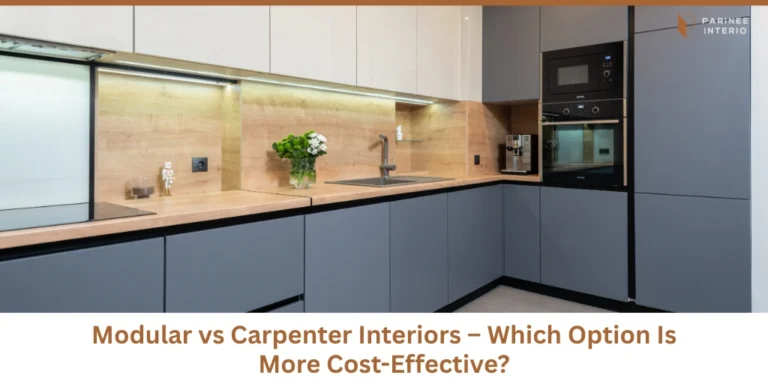
What You Get with Modular Interiors (Clear Breakdown)
Let’s break this down in simple terms.
Factory-Made Units
Everything is made in a controlled environment.
This means:
- Precision in measurements
- Clean finishing
- Minimal errors
Faster Installation
Most of the work is done in the factory.
So on-site installation is quick.
You don’t deal with weeks of ongoing work.
Standardized Materials
You know exactly what you’re getting.
- Same quality
- Same finish
- No surprises
Limited Customization
You can choose designs within a system.
But:
- Fully custom ideas may not work
- Adjustments are limited
Here’s the key takeaway:
You’re paying for speed, consistency, and predictability.
What You Get with Carpenter-Made Interiors
Now let’s look at the other side.
Full Customization
You can design anything.
- Odd spaces
- Unique ideas
- Specific requirements
Everything can be adjusted.
On-Site Work
Work happens at your home.
This allows:
- Real-time changes
- Flexibility during execution
Lower Initial Cost (Sometimes)
At the start, it often looks cheaper.
Especially if:
- You choose basic materials
- You avoid branded fittings
Quality Depends on Skill
This is the biggest variable.
- A good carpenter = excellent result
- Average carpenter = inconsistent output
Key insight:
You’re paying for flexibility—but taking on more risk.
Real Cost Comparison — Modular vs Carpenter
Let’s look at real numbers for a 1 BHK setup.
| Element | Modular | Carpenter |
|---|---|---|
| Kitchen | ₹1.5–3L | ₹1–2.5L |
| Wardrobe | ₹1.2–2.5L | ₹1–2L |
| Timeline | Faster | Slower |
At first glance, carpenter looks cheaper.
But here’s what usually happens:
- Costs increase due to changes
- Materials get upgraded mid-way
- Extra work gets added
And suddenly, the gap reduces.
Important insight:
Cost difference often reduces once everything is included.
Hidden Costs Most People Ignore in Both Options
This is where real budgeting mistakes happen.
Modular Hidden Costs
- Delivery charges
- Installation costs
- Add-ons
Carpenter Hidden Costs
- Rework
- Material wastage
- Delays
Here’s the reality:
Hidden costs exist in both—just in different forms.
Which Option Is Better for a 1 BHK in Mumbai?
There’s no single right answer.
It depends on your priorities.
Choose Modular If:
- You want faster completion
- You prefer fixed pricing
- You don’t want uncertainty
Choose Carpenter If:
- You need full customization
- You’re working with a tight starting budget
- You can manage execution closely
Compare Modular vs Carpenter Quotes Properly
Most people get confused here.
They compare:
- One modular quote
- One carpenter estimate
And try to decide.
Without structure, this comparison doesn’t work.
Modular vs Carpenter Comparison Sheet + BOQ Template (Helps you compare costs, materials, and scope side-by-side)
The Smart Approach Most Homeowners Are Choosing Today
Instead of choosing one option completely, many homeowners mix both.
For example:
- Modular kitchen
- Carpenter-made wardrobes
Why this works:
- Kitchen needs precision → modular fits well
- Wardrobes need flexibility → carpentry works better
This balance gives you:
- Cost control
- Customization
- Better overall value
Conclusion: It’s Not About Cheap vs Expensive—It’s About Fit
Modular is not always expensive.
Carpenter is not always cheaper.
Both are valid options.
The right choice depends on:
- Your budget
- Your expectations
- Your level of involvement
When you understand this clearly, the decision becomes easy.
Plan the Right Interior Approach for Your Budget
Still unsure which option works for you?
That’s completely normal.
Instead of guessing, plan it properly.
Personalized Interior Cost Comparison (Get modular vs carpenter recommendation based on your layout and budget)
FAQs
Modular furniture usually has a higher upfront cost due to factory production and consistency. However, carpenter-made furniture can reach similar costs depending on materials and changes during execution.
Modular is better for speed and consistency, while carpenter-made interiors offer flexibility. The right choice depends on your priorities.
Costs increase due to design changes, material upgrades, wastage, and lack of fixed pricing.
Modular interiors offer consistent durability due to standardized processes. Carpenter durability depends on skill and materials used.
Yes. Many homeowners use modular for kitchens and carpentry for wardrobes. This gives a good balance of cost and flexibility.



This is a really refreshing take that cuts through the common myth that carpenters are always the budget-friendly option. You’re absolutely right that the long-term value and finish consistency often make modular solutions cheaper over time once maintenance and durability are factored in. It’s a crucial reminder for 1 BHK owners to plan their budget with the future in mind, not just the initial price tag.
I never realized how much long-term value modular interiors can offer, especially when it comes to consistent finishes and durability. Planning the budget beforehand definitely seems crucial to avoid unexpected costs. It’s a helpful reminder that the cheapest option upfront isn’t always the most economical in the long run.