+ 91 8108850334
info@parineeinterio.in
+ 91 8108850334
info@parineeinterio.in


Can Interior Designers Save Money or Do They Increase Costs?
If you’re about to start your home interiors, you’ve probably asked yourself this question at least once:
“Why should I pay an interior designer when I can use that money for my home itself?”
It’s a fair question.
After all, a designer is an additional cost.
At first glance, it seems simple.
Skip the designer.
Save the fee.
Spend the money elsewhere.
But here’s what many homeowners realize after their project starts:
Most interior projects do not become expensive because of designer fees.
They become expensive because of mistakes.
A wardrobe that doesn’t fit your storage needs.
Electrical points that end up in the wrong place.
A sofa that looks perfect in the showroom but feels oversized in your living room.
A kitchen that requires modifications after installation.
These are the costs that quietly increase your budget.
That’s why the real question isn’t:
“Does an interior designer cost money?”
Of course they do.
The better question is:
“Can an interior designer help me avoid spending more money later?”
The answer depends on your project, your experience, and the complexity of your home.
Let’s look at it honestly.
The Wrong Question Most Homeowners Ask
When homeowners start comparing options, they usually focus on one number.
“How Much Does an Interior Designer Cost?”
This is the easiest cost to see.
The designer fee is clearly visible.
You know exactly what you’re paying.
But that number tells only part of the story.
The Better Question: How Much Can Poor Planning Cost Me?
Many hidden costs don’t appear at the start of a project.
Examples include:
- Electrical rework
- Additional carpentry
- Wrong furniture purchases
- Layout changes
- Storage modifications
- Vendor delays
- Material replacement
These costs often appear after execution starts.
And that’s where budgets begin to stretch.
Why Budget Decisions Should Focus on Total Project Cost
Think of it this way.
A designer’s fee is visible.
The cost of mistakes usually isn’t.
Most homeowners focus on the first number and completely miss the second.
That is why some projects that seem cheaper at the beginning become more expensive by the end.
Not Sure Whether Your Interior Plan Contains Hidden Budget Leaks?
Many homeowners unknowingly overspend on unnecessary upgrades while overlooking areas that add real value. Get a professional review of your layout, storage requirements, and spending priorities before execution begins.
Layout Review & Optimization
Storage Requirement Assessment
Budget Leak Identification
Spending Priority Evaluation
Cost Saving Opportunities
Personalized Budget Recommendations

7 Ways Interior Designers Can Potentially Save Money
Let’s talk about the areas where a designer often creates financial value.
Not by making products cheaper.
But by helping homeowners avoid expensive decisions.
1. Preventing Expensive Rework
One of the biggest causes of budget overruns is rework.
A small change on paper may cost almost nothing.
The same change after execution begins can cost thousands or even lakhs.
Common examples include:
- Shifting electrical points
- Moving switches
- Changing wardrobe layouts
- Revising false ceilings
- Relocating furniture positions
What We Notice Across Projects
Many homeowners underestimate how expensive changes become after workers have already completed part of the work.
A decision made before execution is usually far cheaper than a correction made later.
| Stage | Cost Impact |
|---|---|
| Before Work Starts | Low |
| During Execution | Medium |
| After Completion | High |
2. Planning Storage Correctly the First Time
Storage is one of the most underestimated parts of interior design.
Most homeowners focus on appearance.
Few think deeply about daily storage needs.
A Common Example
A family of four moves into a Mumbai 2 BHK.
The wardrobes look beautiful.
Six months later:
- Seasonal clothes have no space
- Suitcases sit outside
- Kids’ items overflow
- Additional cabinets become necessary
Now they spend more money than they would have spent initially.
Why This Matters
Good storage planning reduces future expenses.
Poor storage planning creates future purchases.
3. Avoiding Wrong Furniture Purchases
Furniture mistakes are surprisingly common.
A sofa may look perfect online.
The dining table may look ideal in a showroom.
But homes and showrooms are very different environments.
Common mistakes include:
- Oversized sofas
- Large dining tables
- Incorrect bed sizes
- Poor circulation space
- Furniture blocking storage access
The Financial Impact
Wrong furniture often leads to:
- Replacement purchases
- Modification charges
- Reduced functionality
That can become expensive very quickly.
4. Prioritizing Budget Allocation
Many homeowners ask:
“Where should I spend more?”
Experienced designers rarely distribute budgets equally.
They focus on value.
| Area | Investment Priority |
|---|---|
| Kitchen | High |
| Wardrobes | High |
| Storage | High |
| Bathrooms | Medium |
| Living Room Décor | Lower |
| Decorative Features | Lower |
Why This Works
The goal isn’t to spend less.
The goal is to spend where daily life improves the most.
5. Reducing Decision Mistakes
A modern interior project includes hundreds of decisions.
Examples include:
- Laminates
- Countertops
- Hardware
- Lighting
- Furniture layouts
- Paint selections
- Electrical points
Many homeowners make these decisions for the first time.
What Usually Happens
Too many options create confusion.
Confusion creates mistakes.
Mistakes create expenses.
A designer shortens the learning curve.
6. Coordinating the Project More Efficiently
A home interior project involves multiple people.
Examples:
- Carpenters
- Electricians
- Plumbers
- Painters
- Hardware suppliers
- Furniture vendors
Without coordination, delays increase.
And delays often increase costs.
What We Frequently See
Many homeowners spend more time managing vendors than they expected.
Time has value too.
7. Designing for Long-Term Family Needs
A good interior plan doesn’t only solve today’s requirements.
It also considers tomorrow.
Questions include:
- Will your family grow?
- Will children need study areas later?
- Will work-from-home continue?
- Will storage needs increase?
When homes adapt to future needs, homeowners avoid major modifications later.
Situations Where an Interior Designer May Not Save Money
Let’s be honest.
Designers do not save money in every situation.
Very Small Projects
If you’re replacing a few furniture pieces or repainting a room, a designer may not provide significant financial value.
Cosmetic Upgrades Only
Simple décor updates often require limited planning.
Homeowners With Strong Design and Construction Experience
Some homeowners already understand:
- Space planning
- Materials
- Execution processes
- Vendor management
In these cases, they may handle projects effectively themselves.
Limited Scope Renovations
If only one small area requires work, professional design support may not always be necessary.
A Simple Rule
A designer usually creates more value as project complexity increases.
Not Sure Whether Your Project Needs Professional Design Support?
Some homes need complete design involvement, while others only require guidance on layouts, materials, and execution. Get an honest assessment based on your project size, complexity, budget, and family requirements.
Project Scope Evaluation
Budget vs Requirement Analysis
Design Complexity Assessment
Family Lifestyle Planning
Space & Storage Recommendations
Professional Support Guidance
| Common DIY Mistake | Potential Cost Impact |
|---|---|
| Poor Storage Planning | Future Modifications |
| Wrong Furniture Sizes | Replacement Purchases |
| Electrical Oversights | Rework Expenses |
| Material Selection Errors | Replacement Costs |
| Layout Changes After Execution | Delays and Extra Spending |
| Vendor Coordination Issues | Budget Overruns |

Why Experience Matters
Experience helps people spot problems before they become expensive.
That’s often where the financial value of a designer appears.
The Hidden Cost of Poor Interior Planning
Most homeowners focus only on money.
But poor planning creates other costs too.
Time Loss
Research, vendor meetings, revisions, and coordination consume significant time.
Stress
Decision fatigue is real.
Many homeowners feel overwhelmed midway through the project.
Vendor Coordination
Multiple vendors often create communication gaps.
Budget Overruns
Unexpected changes increase spending.
Living With Regret
This may be the biggest hidden cost.
Many mistakes stay with homeowners for years.
Where Interior Budgets Usually Go Wrong
The biggest budget increases usually come from changes and corrections, not professional fees.
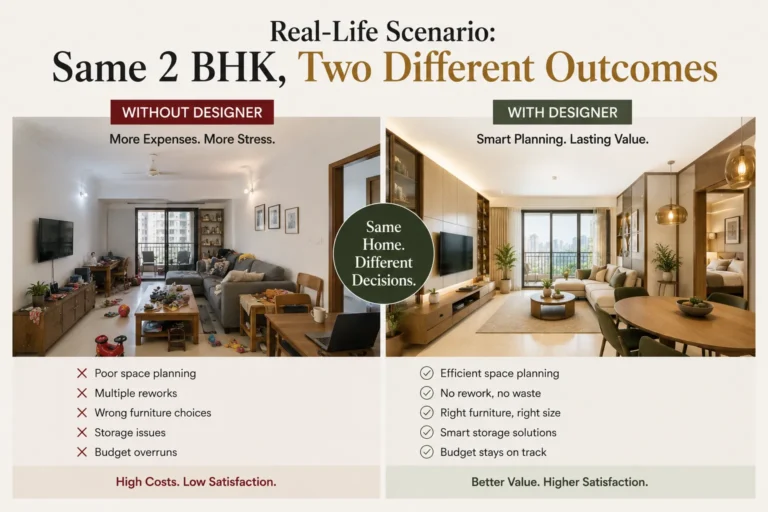
Real-Life Scenario: Same 2 BHK, Two Different Outcomes
Let’s compare two homeowners with similar apartments and similar budgets.
Scenario A: Planning-Led Approach
Before execution starts:
- Storage requirements finalized
- Furniture sizes confirmed
- Electrical points approved
- Kitchen workflow reviewed
- Budget allocation established
Result:
- Fewer surprises
- Better storage
- Better budget control
- Minimal revisions
Scenario B: Execution-Only Approach
Work starts quickly.
Many decisions happen during execution.
Changes occur repeatedly.
Examples:
- Additional drawers added later
- Electrical points relocated
- Furniture replaced
- Wardrobes modified
Result:
- Delays
- Additional spending
- Functional compromises
Key Lesson
The difference often isn’t material quality.
The difference is preparation.
Not Sure Whether Your Interior Budget Is Being Spent in the Right Places?
Get a professional review of your apartment layout, family requirements, storage needs, and budget priorities. Identify where smarter decisions could improve functionality, long-term value, and overall project efficiency before execution begins.
Apartment Layout Assessment
Storage Requirement Analysis
Budget Priority Evaluation
Value Optimization Recommendations
Cost Saving Opportunities
Personalized Interior Planning Advice
How to Measure the Value of an Interior Designer
Ask yourself these questions.
Interior Readiness Checklist
□ Will I manage multiple vendors?
□ Do I know my exact storage requirements?
□ Can I visualize furniture layouts accurately?
□ Do I understand material differences?
□ Am I comfortable making technical decisions?
□ Is this a long-term family home?
□ Do I have enough time to coordinate the project?
□ Can I confidently prevent costly mistakes?
Interpreting Your Answers
If you answered “No” to several questions, professional guidance may provide significant value.
If you answered “Yes” to most questions, you may manage a simpler project yourself.
The Real Answer: Do Interior Designers Save Money?
The honest answer is:
Sometimes yes. Sometimes no.
When They Often Do
Designers usually create more value when:
- The project is complex
- Multiple rooms require work
- Storage needs are significant
- The homeowner lacks technical experience
- The home is a long-term residence
- The family is growing
- Budget control matters
When They May Not
Designers may create less financial value when:
- The project is very small
- Changes are purely cosmetic
- The homeowner has construction experience
- Scope remains limited
The key point is this:
Interior designers do not magically make projects cheaper.
Their value often comes from helping homeowners avoid spending more later.
Can an interior designer reduce project costs?
Not directly. However, they may help reduce rework, mistakes, and unnecessary spending.
Is hiring a designer worth the fee?
For many homeowners, especially first-time homeowners, the value often comes from better decisions and fewer mistakes.
Do designers help prevent budget overruns?
They can help identify risks before execution starts, which may reduce unexpected expenses.
Can I save money by doing interiors myself?
You can save professional fees, but mistakes may increase total project costs.
What mistakes do designers usually prevent?
Storage issues, layout problems, furniture sizing mistakes, material selection errors, and coordination issues.
Do designers help with storage planning?
Yes. Storage planning is often one of the most valuable parts of interior design.
When does hiring a designer make the most sense?
For larger homes, family homes, full-home interiors, renovations, and long-term residences.
Are interior designers worth it for a 2 BHK apartment?
Many 2 BHK homeowners benefit from professional planning because space optimization and storage become critical.
Can designers help me stay within budget?
A good designer can help prioritize spending and avoid unnecessary upgrades.
Is DIY interior design always cheaper?
Not necessarily. The final cost depends on the quality of decisions and execution.
Do interior designers increase project costs?
They add a professional fee, but they may also help reduce waste and costly corrections.
What is the biggest financial benefit of hiring a designer?
Avoiding expensive mistakes before execution begins.
Before You Decide Whether to Hire a Designer, Think About This
Every professional service costs money.
Doctors cost money.
Lawyers cost money.
Architects cost money.
Interior designers cost money too.
The real question is not whether a designer charges a fee.
The real question is whether the decisions they help you make can protect you from bigger expenses later.
For some homeowners, especially those with simple projects, the answer may be no.
For others, particularly first-time homeowners and families investing in a long-term home, better planning often creates value far beyond the designer’s fee.
That is why the smartest decision isn’t always the cheapest option at the beginning.
It’s often the option that helps you avoid spending more throughout the life of the home.
Want an Honest Opinion on Whether Your Project Needs Professional Design Support?
Get a personalized review of your home layout, budget, storage requirements, and project scope. We’ll help you identify where expert guidance could create value—and where you may not need it at all.
Home Layout Review
Budget & Scope Assessment
Storage Requirement Evaluation
Cost Optimization Opportunities
Professional Support Recommendations
Personalized Interior Planning Advice