+ 91 8108850334
info@parineeinterio.in
+ 91 8108850334
info@parineeinterio.in

Almost every homeowner planning interiors eventually hears two completely different opinions.
One person says:
“Go modular. It’s cleaner, faster, and more modern.”
Someone else immediately says:
“Nothing beats traditional carpentry.”
The problem?
Both sides sound convincing.
Which leaves homeowners wondering:
- Which option gives better value?
- Which one lasts longer?
- Which one looks better?
- Which one works better in apartments?
- Which one creates fewer problems after move-in?
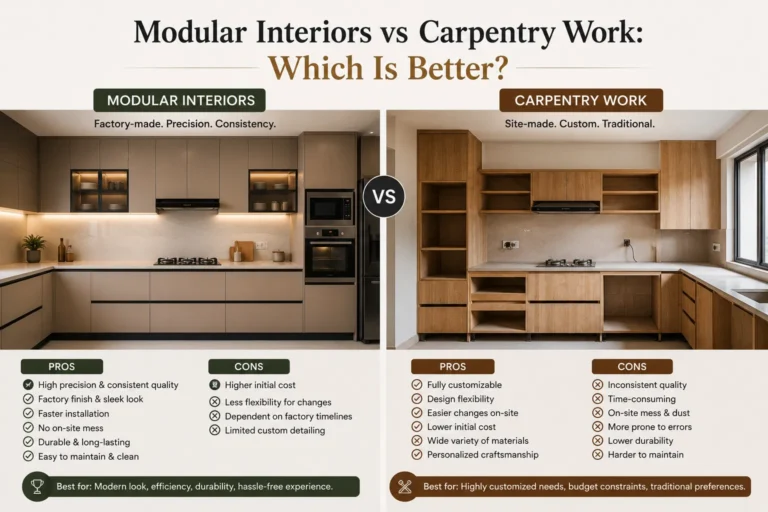
The truth is neither option is automatically better.
The right choice depends on:
- Your apartment layout
- Your budget
- Your timeline
- Your storage needs
- Your family’s lifestyle
If you’re about to do interiors for a new home and want to get it right the first time, this comparison will help you make a more informed decision.
What Are Modular Interiors?
Before comparing the two approaches, let’s understand what modular interiors actually mean.
How Factory-Made Interiors Reach Your Home
Modular interiors are manufactured in a factory environment rather than being built entirely inside your home.
The design gets finalized first.
Measurements are approved.
Production happens in a controlled factory setup.
The finished components then arrive at your home for installation.
Why Manufacturing Conditions Matter
Factories operate under controlled conditions.
This often leads to:
- Better consistency
- Cleaner finishes
- Predictable production quality
- Faster execution
This is one reason modular interiors have become popular in urban apartments.
What Happens After Production Is Complete
Once manufacturing is complete, the modules arrive at the site.
Installation teams assemble them inside your home.
Compared to traditional carpentry, this usually creates:
- Less dust
- Less noise
- Less disruption
Where Homeowners Commonly Use Modular Interiors
Most homeowners choose modular solutions for:
- Kitchens
- Wardrobes
- TV units
- Study units
- Storage systems
- Utility storage
These areas often benefit from standardized systems and faster installation.
What Is Traditional Carpentry Work?
Traditional carpentry follows a very different approach.
How Furniture Gets Built Inside the Home
Instead of factory production, furniture is created directly at the site.
Carpenters work inside the apartment throughout the execution process.
Measurements, adjustments, and fabrication happen during construction.
Why Every Piece Can Be Customized
Traditional carpentry offers greater flexibility.
A carpenter can often adapt designs based on:
- Unusual room shapes
- Site conditions
- Specific homeowner requests
- Unique storage requirements
This flexibility remains one of carpentry’s biggest strengths.
Why Some Homeowners Still Prefer Carpentry
Many homeowners prefer carpentry because:
- Customization feels unlimited
- Design changes remain possible during execution
- Unique layouts become easier to accommodate
For homes with highly specific requirements, this can be valuable.
Not Sure Whether Modular Interiors, Traditional Carpentry, or a Combination Makes Sense for Your Home?
Every home has different requirements. Get expert guidance based on your layout, budget, storage needs, durability expectations, and move-in timeline to determine the most practical execution approach.
Modular vs Carpentry Comparison
Budget & Cost Analysis
Storage Requirement Evaluation
Material Selection Guidance
Move-In Timeline Planning
Personalized Execution Strategy
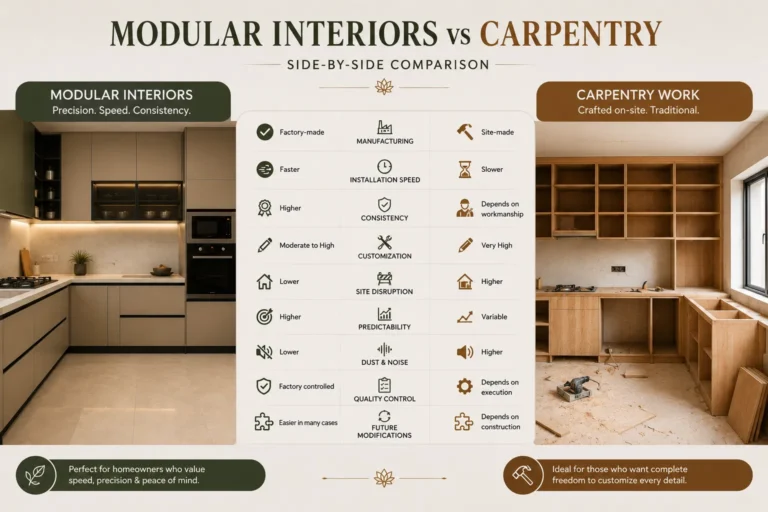
| Factor | Modular Interiors | Carpentry Work |
|---|---|---|
| Manufacturing | Factory-Made | Site-Made |
| Installation Speed | Faster | Slower |
| Consistency | Higher | Depends on Workmanship |
| Customization | Moderate to High | Very High |
| Site Disruption | Lower | Higher |
| Predictability | Higher | Variable |
| Dust & Noise | Lower | Higher |
| Quality Control | Factory Controlled | Depends on Execution |
| Future Modifications | Easier in Many Cases | Depends on Construction |
What These Differences Actually Mean After Move-In
Many homeowners focus only on how furniture looks.
The bigger question is how the home performs after move-in.
For example:
- Faster installation may help you move in sooner.
- Better consistency may reduce quality surprises.
- Greater customization may solve unique storage challenges.
The “best” option depends on which advantages matter most to your family.
Which Option Helps You Move Into Your Home Faster?
Many homeowners face tight timelines.
Especially possession-stage homeowners.
Why Factory Production Usually Reduces Project Timelines
A large portion of the work happens before installation begins.
This allows multiple activities to happen simultaneously.
As a result, installation time is often shorter.
Why Site Execution Sometimes Takes Longer Than Expected
Traditional carpentry depends heavily on:
- Site conditions
- Labour availability
- Material delivery
- Weather conditions
- Execution sequencing
Any delay can affect overall timelines.
Why Timeline Delays Matter More Than Most Homeowners Expect
Many homeowners underestimate the financial impact of delays.
Additional rent.
Temporary accommodation.
Storage expenses.
Repeated site visits.
All of these costs add up.
Example
Imagine a possession-ready apartment in Mumbai.
If your move-in date is approaching quickly, faster execution may become a major advantage.
Which Option Delivers Better Quality?
This is one of the most debated topics in interior design.
The reality is more balanced than most people realize.
| Myth | Reality |
|---|---|
| Modular Is Always Better | Depends on Manufacturer |
| Carpentry Is Always Stronger | Depends on Workmanship |
| Factory-Made Means Superior | Execution Quality Matters |
| Custom Means Premium | Quality Depends on Materials and Skill |
What Most Homeowners Miss When Evaluating Quality
Quality comes from multiple factors:
- Materials
- Hardware
- Installation
- Design
- Workmanship
- Maintenance
Two modular projects can produce completely different results.
The same applies to carpentry.
The Question That Matters More Than Modular vs Carpentry
Instead of asking:
“Which option is better?”
Ask:
“Who is executing the work and what materials are being used?”
That usually matters more.
Confused About Laminates, Plywood Grades, Hardware Brands, Finishes, or Construction Methods?
Material decisions can significantly impact durability, maintenance, appearance, and long-term costs. Get expert guidance before committing to expensive choices that may not suit your home, lifestyle, or budget.
Laminate & Finish Selection Guidance
Plywood & Material Grade Review
Hardware Brand Recommendations
Construction Method Comparison
Quality vs Budget Assessment
Personalized Material Recommendations
Which Homes Usually Need More Customization Than Standard Solutions Can Offer?
Customization is where traditional carpentry often shines.
Where Carpentry Often Creates More Flexibility
Examples include:
- Irregular layouts
- Sloping ceilings
- Structural challenges
- Unique storage requirements
- Highly personalized furniture
These situations may benefit from site-built solutions.
Where Standardized Systems Create Better Results
Modular systems often perform well when:
- Layouts are predictable
- Storage requirements are structured
- Consistency matters
- Faster timelines matter
Many apartments fall into this category.
Why Most Homes Don’t Need Unlimited Customization
A surprising number of homeowners never use the extra customization they initially thought they needed.
That is why practicality often matters more than flexibility.
Cost Comparison: Modular Interiors vs Carpentry
This is usually the first question homeowners ask.
Why Simple Cost Comparisons Rarely Work
There is no universal answer.
A modular kitchen can cost less than carpentry.
Or more.
The same applies to wardrobes and storage systems.
What Usually Influences the Final Cost
The biggest factors include:
- Materials
- Hardware
- Finish quality
- Scope of work
- Brand selection
- Design complexity
Why Upfront Cost Doesn’t Tell the Full Story
Many homeowners compare only the initial quotation.
The bigger picture includes:
- Maintenance
- Future modifications
- Project delays
- Rework expenses
- Durability
The cheapest option upfront isn’t always the least expensive over time.
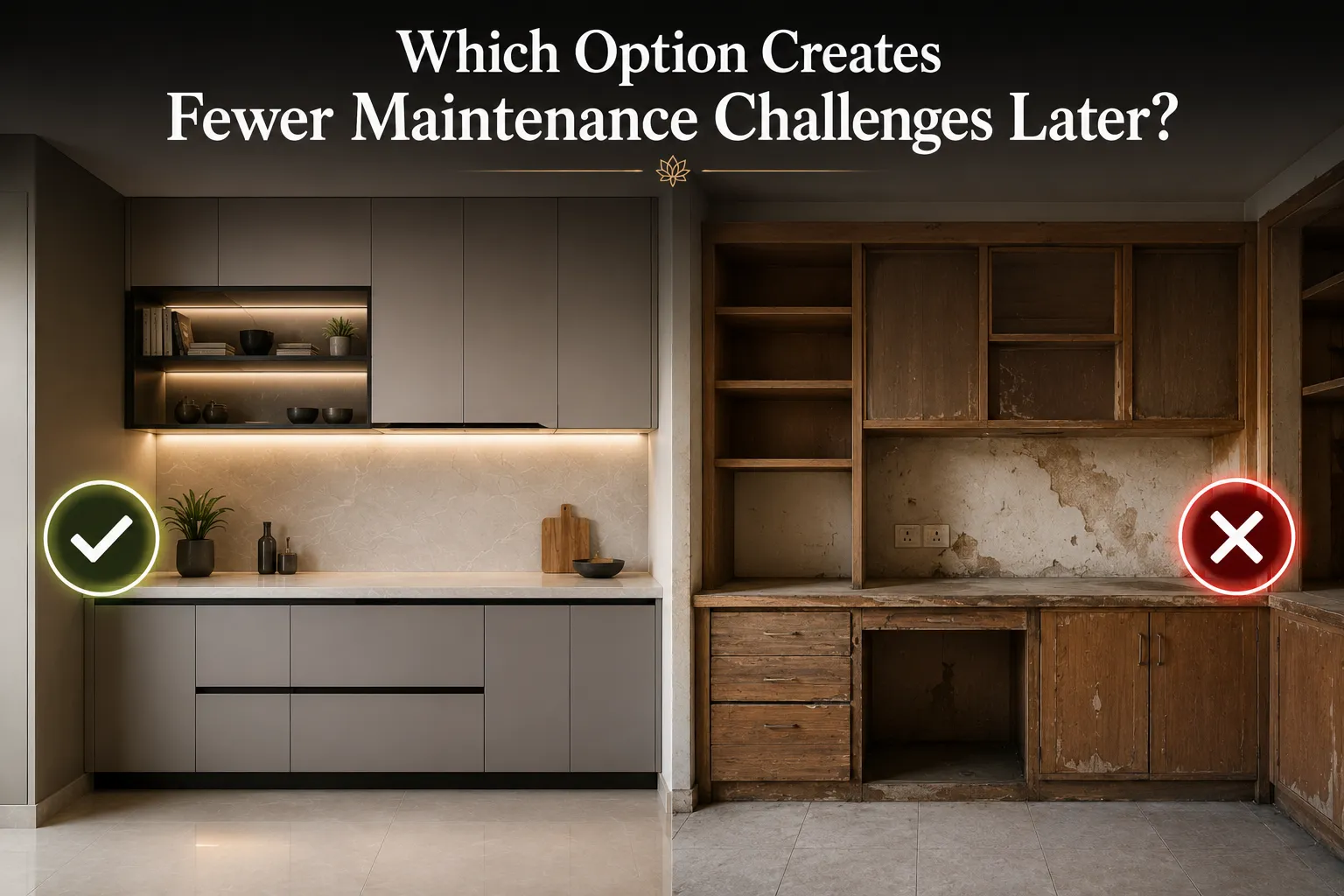
Which Option Creates Fewer Maintenance Challenges Later?
Most homeowners focus on installation.
Long-term ownership deserves equal attention.
| Aspect | Modular | Carpentry |
|---|---|---|
| Component Replacement | Easier | More Complex |
| Repair Access | Easier | Depends on Construction |
| Future Modifications | Easier in Some Cases | More Custom Work Required |
| Standardized Parts | Usually Available | Custom Solutions Required |
What Most Homeowners Realize Years Later
The real test begins after move-in.
Questions like:
- How easy is it to repair?
- How easy is it to replace?
- How easy is it to modify?
become more important over time.
What Works Better in Mumbai Apartments?
The answer depends heavily on apartment type.
Why Compact 1 BHK Homes Often Prioritize Efficiency
Smaller homes usually benefit from:
- Faster execution
- Better space utilization
- Organized storage systems
Modular solutions often align well with these priorities.
What Family-Oriented 2 BHK Homes Usually Need
Many 2 BHK homeowners need:
- Larger wardrobes
- Children’s storage
- Work-from-home solutions
- Flexible layouts
The decision may depend on customization needs.
Why Larger 3 BHK Homes Offer More Flexibility
Larger homes provide more opportunities for:
- Hybrid solutions
- Custom features
- Specialized furniture
What Possession-Stage Homeowners Usually Prioritize
Most possession-stage homeowners care about:
- Timelines
- Move-in readiness
- Predictability
This often influences the decision more than anything else.
Why Many Homeowners End Up Choosing a Hybrid Approach
After evaluating both options, many homeowners realize the answer isn’t modular or carpentry.
It’s often both.
Why Kitchens and Wardrobes Often Go Modular
These areas usually benefit from:
- Faster execution
- Better systemization
- Easier maintenance
Where Custom Carpentry Still Creates Value
Custom furniture can work well for:
- Specialized requirements
- Unique layouts
- Personalized solutions
Why Hybrid Interiors Are Becoming More Common
A hybrid approach often combines:
- Modular kitchens
- Modular wardrobes
- Custom furniture
- Custom feature elements
This allows homeowners to use each method where it performs best.

Not Sure Where Modular Interiors, Custom Carpentry, or a Hybrid Approach Makes the Most Sense?
Get expert recommendations on which areas of your home should go modular, where custom carpentry adds more value, and where a hybrid approach can improve functionality while keeping costs under control.
Modular vs Carpentry Assessment
Room-Wise Execution Recommendations
Cost vs Value Analysis
Storage & Functionality Planning
Material & Execution Guidance
Personalized Hybrid Strategy
Common Mistakes Homeowners Make While Choosing
We see these mistakes repeatedly.
Why Price Alone Often Leads to the Wrong Decision
The lowest quotation rarely tells the full story.
What Happens When Move-In Timelines Are Ignored
Delays create costs beyond interiors.
Why Maintenance Gets Ignored During Decision-Making
Many homeowners think only about installation.
Few think about ownership.
The Storage Requirements That Get Discovered Too Late
Storage needs often become clear after move-in.
Why Trends Can Create Expensive Regrets
Trends change.
Functionality remains important for years.
What Future Modifications Often Reveal About Today’s Decisions
A good interior solution should adapt to changing requirements.
A Simple Decision Matrix
Use this framework as a starting point.
| Situation | Better Fit |
|---|---|
| Fast Move-In Needed | Modular |
| Highly Customized Requirements | Carpentry |
| Standard Apartment Layouts | Modular |
| Unique Design Concepts | Carpentry |
| Busy Professionals | Modular |
| Specialized Furniture Needs | Carpentry |
| Mixed Requirements | Hybrid Approach |
What is the difference between modular interiors and carpentry work?
Modular interiors are factory-produced and installed on-site, while carpentry work is built directly inside the home.
Which option is more durable?
Durability depends more on materials, hardware, and execution quality than on the construction method itself.
Is modular furniture worth the investment?
For many homeowners, modular furniture offers advantages in speed, consistency, and maintenance.
Which option is faster to install?
Modular interiors are usually faster because much of the work happens before site installation.
What works better for apartments?
Many apartments benefit from modular systems, but highly customized homes may benefit from carpentry.
Can I combine modular and carpentry solutions?
Yes. Many homeowners use a hybrid approach.
Which option offers better long-term value?
The answer depends on your priorities, maintenance expectations, and lifestyle requirements.
Is modular furniture suitable for a new apartment?
Yes. Many possession-stage homeowners prefer modular solutions because of faster timelines.
Does carpentry provide more customization?
Generally yes. Carpentry often offers greater flexibility for unusual layouts and specialized requirements.
Which option creates less mess during execution?
Modular installation usually creates less site disruption.
Is modular furniture more expensive?
Not necessarily. Pricing depends on materials, hardware, and project scope.
What is the biggest mistake homeowners make when comparing the two?
Many compare only price and ignore timelines, maintenance, and long-term usability.
Before You Decide Which Option Is Better
The smartest homeowners rarely ask:
“Which option is best?”
They ask:
“Which option is best for how my family will actually live in this home?”
Because modular interiors and traditional carpentry solve different problems.
Modular interiors often perform well when speed, consistency, and predictability matter.
Carpentry often performs well when flexibility and customization matter.
And for many homes, the strongest solution is not choosing one over the other.
It’s choosing the right combination of both.
That’s usually where fewer regrets, better functionality, and better long-term value come together.
Still Unsure Which Direction Makes Sense for Your Home?
Review your floor plan, storage requirements, move-in timeline, customization needs, and budget with an interior expert before making a final decision. Get clarity on whether modular interiors, traditional carpentry, or a hybrid approach is the better fit for your project.
Modular vs Carpentry Assessment
Floor Plan & Layout Review
Storage Requirement Analysis
Customization & Design Evaluation
Budget & Timeline Planning
Personalized Execution Strategy